
The Netherlands may not be the first country that comes to mind when you think of cricket bat manufacturing, yet in recent years, Dutch willow cricket bats have carved out a niche in the European market. Combining sustainability, craftsmanship, and innovation, Dutch bat makers are redefining what it means to produce high‑quality cricket equipment outside traditional hubs like England, India, and Pakistan.
Origins of Dutch Willow Bat Crafting
Cricket in the Netherlands dates back to the 19th century, introduced by British expatriates and sailors. While the sport remained niche for decades, the rise of Dutch cricket clubs in Amsterdam, Rotterdam, and The Hague created demand for locally made bats.
🌿 Early Development
- 1900s: Imported English willow bats dominated Dutch cricket.
- 1980s–2000s: Local craftsmen began experimenting with European white willow.
- 2020s–2026: Dutch bat makers embraced eco‑friendly production and boutique craftsmanship, appealing to European clubs and academies.
The Netherlands’ temperate climate and fertile soil allow European white willow to grow with similar grain density to English willow, making it suitable for bat manufacturing.
🪵 Understanding Dutch Willow
Dutch willow is typically European white willow (Salix alba) — a close cousin of English willow.
| Feature | Dutch Willow | English Willow | Kashmir Willow |
|---|---|---|---|
| Origin | Netherlands / Northern Europe | England (Kent, Essex, Suffolk) | India (Jammu & Kashmir) |
| Density | Medium‑light | Light | Heavy |
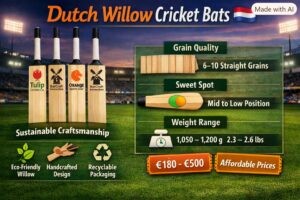
| Grain Count | 6–10 straight grains | 8–12 straight grains | 4–6 wide grains |
| Rebound | Moderate to high | High | Moderate |
| Durability | Excellent for club play | Professional grade | Practice level |
| Sustainability | High (renewable plantations) | Moderate | Moderate |
Dutch willow’s medium‑light density gives bats a balanced pickup and smooth rebound, ideal for technical stroke play rather than brute power.
🏭 Craftsmanship and Manufacturing Process
Dutch bat makers combine traditional handcrafting with modern precision tools.
🔹 Step‑by‑Step Process
- Cleft Selection: Only 20 % of harvested willow meets Grade 1 standards.
- Seasoning: Air‑dried for 6–9 months to maintain moisture balance.
- Pressing: Medium‑hard press enhances durability and rebound.
- Shaping: Hand‑crafted blades ensure perfect balance and pickup.
- Handle Fitting: Singapore cane or Dutch ash wood handles are spliced and reinforced with cork.
- Finishing: Matte polish, minimalist branding, and eco‑friendly lacquers complete the bat.
Each bat reflects the maker’s artistry — a blend of precision engineering and natural grain beauty.
🏏 Top Dutch Willow Bat Brands (2026)
Dutch bat makers are small but innovative, focusing on quality over quantity.
| Brand | Specialty | Price (EUR) | Best For |
|---|---|---|---|
| Tulip Cricket Co. | Sustainable willow sourcing, handcrafted bats | €180–€350 | Club players |
| Oranje Sports Gear | Lightweight pickup, balanced profile | €150–€300 | Beginners |
| Dutch Edge Cricket | Custom designs, mid‑sweet spot | €200–€400 | League players |
| BatCraft Amsterdam | Boutique craftsmanship, limited editions | €300–€500 | Professionals |
| Windmill Willow Works | Eco‑friendly clefts, classic finish | €250–€450 | Enthusiasts |
🧠 Performance Characteristics
Dutch willow bats are designed for balance, control, and sustainability.
1. Grain Quality
- Grade 1: 8–10 straight grains, flawless surface.
- Grade 2: 6–8 grains, minor blemishes.
- Grade 3: 4–6 grains, visible marks but solid performance.
2. Sweet Spot
Most Dutch bats feature a mid‑to‑low sweet spot, ideal for European turf and synthetic pitches.
3. Edge Thickness
Ranges from 38–42 mm, providing forgiveness on off‑center hits.
4. Weight
Typically 1,050–1,200 g (≈ 2.3–2.6 lbs) — lighter than English willow bats, offering faster bat speed.
⚙️ Technology Meets Sustainability
Dutch bat makers integrate green technology into their production:
- Solar‑powered workshops reduce carbon footprint.
- Water‑based lacquers replace chemical finishes.
- Recyclable packaging supports circular economy goals.
- Digital moisture sensors ensure consistent pressing quality.
This commitment to sustainability makes Dutch willow bats popular among eco‑conscious athletes and clubs.
🏆 Player Endorsements & Usage
While Dutch willow bats are not yet mainstream in international cricket, they are gaining traction in:
- European club leagues (Netherlands, Belgium, Germany).
- Indoor cricket tournaments across Europe.
- Youth academies promoting sustainable sports gear.
Professional Dutch players occasionally use BatCraft Amsterdam or Tulip Cricket Co. bats for domestic matches.
💰 Price Range & Value
Dutch willow bats offer excellent value for money, balancing craftsmanship and affordability.
| Grade | Price Range (EUR) | Typical Use |
|---|---|---|
| Grade 1 | €400–€500 | Professional cricket |
| Grade 2 | €250–€350 | Club and league cricket |
| Grade 3 | €150–€250 | Training and practice |
Compared to English willow bats, Dutch bats are 20–30 % cheaper, making them ideal for European players seeking quality without premium pricing.
🧾 Buying Tips for Dutch Willow Bats
- Inspect Grain Alignment: Straight, even grains indicate quality.
- Check Pressing: Medium‑hard press ensures durability.
- Handle Comfort: Choose oval for control, round for wrist play.
- Knocking‑In: Essential before match use (4–6 hours).
- Oiling: Two light coats of linseed oil prevent cracking.
- Storage: Keep in a dry, ventilated area; avoid dampness.
🧩 Dutch vs English vs Indian Willow
| Feature | Dutch Willow | English Willow | Indian Willow |
|---|---|---|---|
| Grain Count | 6–10 | 8–12 | 6–9 |
| Pressing | Medium‑hard | Medium | Hard |
| Durability | High | Very high | Moderate |
| Weight | 2.3–2.6 lbs | 2.7–2.9 lbs | 2.8–3.0 lbs |
| Sustainability | Excellent | Moderate | Moderate |
| Price | €150–€500 | £200–£700 | ₹12,000–₹75,000 |
Dutch willow bats strike a balance between English craftsmanship and Indian affordability, offering a sustainable alternative for modern players.
🧠 Maintenance & Longevity
Proper care ensures your Dutch willow bat lasts multiple seasons:
- Knock‑in regularly with a mallet.
- Avoid wet pitches — moisture weakens fibers.
- Re‑grip handles every few months.
- Use toe guards to prevent splitting.
- Store horizontally to maintain shape.
A well‑maintained Dutch willow bat can last 3–5 years of regular use.
🌍 Global Recognition & Future Outlook
The global cricket community is increasingly recognizing Dutch bat makers for their eco‑friendly approach and craftsmanship.
🔹 Growth Factors
- Rising popularity of European cricket leagues.
- Increased demand for sustainable sports gear.
Conclusion
Dutch willow cricket bats have emerged as a unique blend of sustainability, craftsmanship, and innovation in the global cricketing landscape. While England, India, and Pakistan dominate traditional bat‑making, the Netherlands has carved out a niche by focusing on eco‑friendly production, lightweight balance, and boutique artistry.
- Heritage: Rooted in European willow plantations, Dutch bats reflect a growing cricket culture in the Netherlands.
- Craftsmanship: Makers like Tulip Cricket Co. and BatCraft Amsterdam emphasize hand‑finishing, sustainable lacquers, and modern pressing techniques.
- Performance: With 6–10 straight grains, mid‑sweet spots, and lighter weights (2.3–2.6 lbs), Dutch bats suit technical stroke play and youth cricket.
- Affordability: Priced between €150–€500, they offer excellent value compared to English willow bats.
- Future Outlook: As European cricket expands, Dutch willow bats are poised to gain global recognition, especially among eco‑conscious players and clubs.
In essence, Dutch willow bats are not just equipment — they are a statement of sustainability and innovation, proving that cricket’s spirit can thrive beyond its traditional strongholds. For players seeking balance, affordability, and environmental responsibility, Dutch willow bats are a compelling choice in 2026 and beyond.
See More: Willow Cricket Bats Kent