
🌳 Origins of English Willow
English willow (Salix alba caerulea) has been the backbone of cricket bat making for centuries. Cultivated in Essex, Suffolk, and Kent, its unique climate produces willow with fine grains, elasticity, and lightweight strength. This makes it perfect for bats that need both power and control.
Historically, bat makers in England refined pressing and shaping techniques, ensuring bats delivered the famous “ping.” Today, clefts are exported worldwide, with artisans in India and Pakistan crafting bats for juniors and professionals alike.
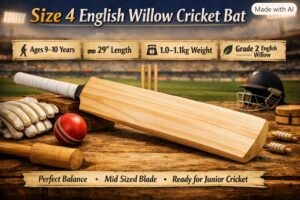
📏 Size 4 Bat Specifications
| Feature | Details |
|---|---|
| Player Age | 9–10 years |
| Bat Length | 29 in (73.6 cm) |
| Blade Width | 4.25 in (10.8 cm) |
| Weight | 1.0–1.1 kg (2.2–2.4 lb) |
| Handle | Short Singapore cane |
| Sweet Spot | Mid‑to‑low |
| Willow Grade | 2 or 3 |
These dimensions ensure comfort, balance, and proper stroke development for young cricketers.
🪵 Crafting Process
Handmade Size 4 bats follow the same process as full‑size bats:
- Cleft Selection – straight grains, minimal blemishes.
- Seasoning – air‑dried for 6–9 months.
- Pressing – hydraulic compression for rebound.
- Shaping – carved with drawknives and spokeshaves.
- Handle Fitting – Singapore cane spliced and bound.
- Finishing – sanded, polished, lightly oiled.
Each bat is unique, reflecting the artisan’s skill.
🧠 Performance Dynamics
- Rebound: Crisp “ping” from willow fibers.
- Pickup: Lightweight swing for juniors.
- Sweet Spot: Mid‑to‑low, ideal for slower pitches.
- Control: Narrow blade encourages precision.
🧾 Grades of Willow
| Grade | Grains | Performance | Price (₹) |
|---|---|---|---|
| Grade 1 | 8–12 | Professional | 18,000–25,000 |
| Grade 2 | 6–10 | Excellent | 12,000–18,000 |
| Grade 3 | 5–8 | Good | 8,000–12,000 |
Size 4 bats usually use Grade 2 or 3 willow.
🏭 Popular Models (2026)
| Brand | Model | Price (₹) |
|---|---|---|
| SG | KLR Ultimate Size 4 | 9,000–12,000 |
| SS | Ton Elite Size 4 | 8,500–11,000 |
| CA | Plus 15000 Junior | 7,000–9,000 |
| Gray‑Nicolls | Powerbow Junior | 10,000–13,000 |
| DSC | Krunch Pro Size 4 | 9,500–12,500 |
⚙️ Knocking‑In & Oiling
- Knock‑in for 4–6 hours with a mallet.
- Apply raw linseed oil lightly.
- Test with old balls before match use.
- Avoid over‑oiling — it weakens willow.
🧰 Maintenance
- Fit toe guards.
- Use anti‑scuff sheets.
- Replace grips regularly.
- Store horizontally in dry areas.
- Avoid damp pitches.
🏏 Training Benefits
- Builds proper technique.
- Improves timing and precision.
- Boosts confidence with authentic willow feel.
- Prepares players for larger bats.
🧠 Size Comparison
| Size | Age | Length (in) | Weight (kg) |
|---|---|---|---|
| 3 | 8 yrs | 28 | 0.9–1.0 |
| 4 | 9–10 yrs | 29 | 1.0–1.1 |
| 5 | 10–11 yrs | 30 | 1.1–1.2 |
| 6 | 11–13 yrs | 31 | 1.2–1.3 |
| Harrow | 13–15 yrs | 32 | 1.3–1.4 |
🪶 Design & Aesthetics
- Thick edges for power.
- Curved blade for pickup.
- Matte finish for focus.
- Neutral grips for simplicity.
🧾 Cultural Significance
Owning a Size 4 willow bat is a rite of passage. It symbolizes commitment, family pride, and heritage connection.
🧠 Psychological Impact
- Builds confidence.
- Encourages consistent practice.
- Reduces frustration with proper equipment.
🏏 Training Drills
- Front‑foot drives.
- Back‑foot punches.
- Shadow batting.
- Soft ball nets.
🧾 Buying Guide
Parents should check grains, weight, handle quality, balance, and price vs value.
🏭 Global Trends (2026)
- Rising demand in India & Pakistan.
- Junior leagues in England & Australia.
- Online customization options.
- Eco‑friendly willow cultivation.
🏁 Conclusion
The Size 4 English willow cricket bat is more than scaled‑down gear — it’s a gateway to cricketing excellence. With proper care, it helps young players build technique, confidence, and a lifelong love for the game.
See More: Unbranded English Willow Cricket Bats