
Choosing the right cricket bat for a child is one of the most important decisions parents can make in their young cricketer’s development. While many parents focus on brand names, professional endorsements, or the size of the bat’s edges, the truth is that the wrong bat can hinder a child’s technique, confidence, and enjoyment of the game. The right bat, on the other hand, can help develop proper batting habits, improve timing, and make learning the game far more enjoyable.
This guide explains everything parents need to know when selecting the ideal cricket bat for their child.
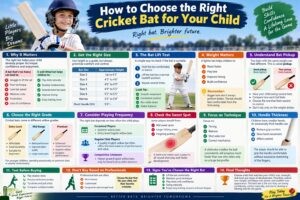
Why Choosing the Right Bat Matters
A cricket bat is more than just a piece of equipment. It becomes an extension of a player’s body.
When a bat is too heavy or too large, children often:
- Struggle to lift the bat correctly
- Develop poor batting techniques
- Lose bat speed
- Mistime shots
- Become frustrated during matches
- Lose confidence at the crease
Conversely, a bat that fits properly allows a child to:
- Play shots naturally
- Develop correct fundamentals
- Generate better bat speed
- Improve timing
- Enjoy batting more
A properly fitted bat supports long-term cricket development rather than simply providing short-term power.
Start With the Correct Bat Size
Bat size should always be the first consideration.
Many parents buy bats that are too large because they want the child to “grow into it.” While this might seem economical, it often delays technical development.
A general guide is:
| Bat Size | Approximate Height |
|---|---|
| Size 2 | Up to 4’3″ |
| Size 3 | 4’3″ to 4’6″ |
| Size 4 | 4’6″ to 4’9″ |
| Size 5 | 4’9″ to 5’2″ |
| Size 6 | 5’2″ to 5’5″ |
| Harrow | 5’5″ to 5’8″ |
| Short Handle (SH) | 5’8″+ |
Height charts provide a useful starting point, but comfort and control should always take priority.
See More: How to Fix Cracks, Toe Splitting, and Surface Cracks Using Wood Glue and Twine
The Bat Lift Test
One of the simplest ways to check if a bat is suitable is the bat lift test.
Ask your child to:
- Hold the bat comfortably in their stance.
- Lift the bat into a normal backlift position.
- Repeat the motion several times.
Watch for:
- Smooth movement
- Consistent control
- No visible strain
- Stable balance
If the child struggles to lift the bat repeatedly or their hands drop during the motion, the bat is probably too heavy.
Weight Matters More Than Size
A common misconception is that bigger bats automatically perform better.
For junior cricketers, weight is often more important than size.
A lighter bat can help a child:
- React faster
- Play late
- Improve timing
- Develop confidence against quicker bowling
Professional players may use heavier bats because they possess greater strength and refined technique. Young players should prioritize easy pickup and control.
The bat should feel comfortable from the first swing rather than requiring the child to “get used to it.”
Understand Bat Pickup
Two bats with the same listed weight can feel completely different.
This feeling is known as pickup.
A bat with excellent pickup feels lighter in the hands because the weight is distributed more efficiently.
When shopping:
- Ask the child to swing several bats.
- Compare how each bat feels.
- Choose the one that feels easiest to control.
Never rely solely on the weight sticker.
Choose the Right Grade for Your Budget
Cricket bats come in various willow grades.
Entry-Level Bats
Perfect for beginners and school cricketers.
Benefits include:
- Affordable pricing
- Good durability
- Suitable for learning basics
Mid-Range Bats
Ideal for club players.
Benefits include:
- Better performance
- Improved willow quality
- Larger sweet spots
Premium Bats
Designed for advanced players.
Benefits include:
- Enhanced responsiveness
- Superior willow
- Excellent performance
For younger children still learning the game, spending excessively on premium bats is usually unnecessary.
Consider Playing Frequency
The right bat depends partly on how often the child plays.
Occasional Players
Suitable options include:
- Kashmir willow bats
- Entry-level English willow bats
Regular Club Players
A quality English willow bat often represents the best balance of performance and value.
Competitive Cricketers
Players involved in academy or representative cricket may benefit from higher-grade English willow models as their skills advance.
Examine the Sweet Spot
The sweet spot is the area that produces the best contact and power.
Junior players generally benefit from:
- Mid sweet spots
- Larger hitting areas
- Forgiving profiles
A balanced sweet spot supports all-round shot play and faster technical development.
Focus on Technique Rather Than Power
Parents are often impressed by large edges and thick bat profiles.
However, junior development should focus on:
- Timing
- Balance
- Shot selection
- Correct mechanics
A child who learns to middle the ball consistently will progress much faster than one who relies solely on a large bat profile.
Handle Thickness Is Important
Children have smaller hands than adults.
An excessively thick handle can:
- Reduce grip comfort
- Slow hand movement
- Affect control
The player should be able to grip the handle comfortably without excessive stretching of the fingers.
Test Before Buying When Possible
Nothing replaces a hands-on trial.
If possible, allow the child to:
- Play shadow shots
- Practice defensive strokes
- Try drives and pull shots
- Compare multiple models
The bat that feels natural often proves to be the best choice.
Do Not Buy Based on Professional Players
Young cricketers are often attracted to the bats used by international stars.
However, professional bats:
- Are often much heavier
- Have customized specifications
- Suit adult strength levels
What works for a professional player may be completely unsuitable for a child.
Choose the bat that fits your child rather than their favorite cricketer.
Signs You’ve Chosen the Right Bat
A suitable bat should allow your child to:
- Lift the bat comfortably
- Maintain good technique
- Play shots with confidence
- Swing naturally
- Enjoy long batting sessions without fatigue
Most importantly, the child should feel excited and comfortable when using it.
Final Thoughts
Choosing the right cricket bat for your child is not about buying the most expensive model or the bat used by professional stars. It is about finding a bat that matches their size, strength, skill level, and stage of development.
Prioritize control over weight, technique over power, and comfort over appearance. A well-fitted bat helps children build confidence, develop correct batting habits, and enjoy the game while progressing through every stage of their cricketing journey.
The best cricket bat for any young player is simply the one they can swing confidently, control naturally, and use to develop a lifelong love for batting.