
For generations, cricketers have been told that oiling a bat is an essential part of bat care. The advice is sound. Applying a light coat of linseed oil helps nourish the willow, prevents excessive drying, and reduces the likelihood of surface cracking. However, many players make a critical mistake: they assume that if a little oil is good, more oil must be better.
Nothing could be further from the truth.
Over-oiling is one of the most common causes of premature bat damage. While the effects may not be visible immediately, excessive oil can slowly weaken the willow, make the blade overly soft, increase weight, reduce performance, and in severe cases contribute to the deterioration or rotting of the wood. Many otherwise excellent English willow bats have been ruined not by fast bowlers, yorkers, or toe damage, but by excessive enthusiasm with a bottle of linseed oil.
Understanding how over-oiling affects willow can save cricketers hundreds of dollars and significantly extend the lifespan of their bat.
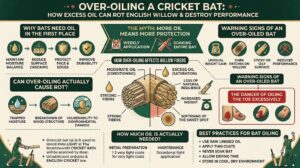
Why Cricket Bats Need Oil in the First Place
English willow is a natural material. Unlike synthetic sports equipment, willow is a living organic product that continues to react to environmental conditions long after being converted into a cricket bat.
Changes in humidity, temperature, and storage conditions can cause the wood to lose moisture or become overly dry. This is where oiling becomes important.
A small amount of raw linseed oil helps:
- Maintain the moisture balance of the willow
- Reduce surface cracking
- Protect the face and edges
- Improve durability during use
- Prepare a new bat for knocking-in
When applied correctly, oil acts as a conditioner, not a soaking agent. The goal is to nourish the willow’s fibers, not saturate them.
Unfortunately, many players misunderstand this principle.
The Myth That More Oil Means More Protection
One of the oldest myths in cricket is that repeated heavy oil applications make a bat stronger.
Some players apply oil every week. Others repeatedly soak the face, edges, toe, and back of the bat until the willow becomes visibly dark. There are even cases where players leave large amounts of oil on the blade overnight, believing it will create a tougher bat.
In reality, excessive oil creates the exact opposite effect.
Instead of strengthening the wood, it begins to alter the structure of the willow itself.
The bat can become:
- Heavier
- Softer
- Less responsive
- More vulnerable to seam compression
- More susceptible to long-term deterioration
The performance that made the bat attractive in the first place can slowly disappear.
See More: Best English Willow Cricket Bats Under $200
How Over-Oiling Affects Willow Fibers
English willow contains millions of tiny cellular structures that give the bat its unique combination of strength, flexibility, and rebound.
When moderate amounts of oil are applied, these fibers receive just enough conditioning to remain healthy.
However, excessive oil penetrates deeper into the wood than intended.
As the fibers absorb more oil than they can effectively hold, several problems begin to develop:
Loss of Natural Resilience
A cricket bat works because willow can compress and recover rapidly upon impact.
Over-oiled willow becomes overly soft.
Instead of rebounding efficiently, the fibers absorb too much energy, reducing bat performance.
This can make the bat feel dull and lifeless even though it may appear perfectly healthy from the outside.
Increased Weight
Oil adds mass.
Every excessive application leaves additional oil trapped within the blade.
Over time, a bat that originally weighed 2 lb 8 oz may feel noticeably heavier.
Players often complain that their bat no longer picks up well without realizing excessive oil is the cause.
Softening of the Sweet Spot
One of the most serious consequences is sweet spot deterioration.
The sweet spot must maintain a careful balance between hardness and flexibility.
When saturated with oil, the wood may become too soft, leading to:
- Early seam marks
- Compression damage
- Indentations
- Reduced power transfer
Can Over-Oiling Actually Cause Rot?
The word “rot” is sometimes debated among bat makers, but excessive oil unquestionably creates conditions that can accelerate the deterioration of willow.
Wood naturally requires balance.
When too much oil accumulates inside the willow, several issues can arise:
Trapped Moisture
Oil can interfere with the wood’s natural ability to regulate moisture.
If the bat is then stored in humid conditions, excess moisture may become trapped within the willow.
This combination of moisture retention and poor ventilation can contribute to wood degradation over time.
Breakdown of Wood Structure
Overly saturated willow may gradually lose structural integrity.
Instead of remaining firm and resilient, the internal fibers can become weak and spongy.
Players sometimes describe heavily over-oiled bats as feeling “dead.”
This dead feeling is often a sign that the wood structure has been compromised.
Vulnerability to Environmental Damage
A properly maintained bat can efficiently adapt to normal environmental changes.
An over-oiled bat cannot.
The excessive saturation can make the willow more susceptible to damage from:
- High humidity
- Heat exposure
- Improper storage
- Water ingress around the toe
These factors can accelerate deterioration and shorten the bat’s lifespan.
Warning Signs of an Over-Oiled Bat
Many cricketers do not recognize the symptoms until significant damage has already occurred.
Common warning signs include:
Unusual Weight Gain
If the bat suddenly feels heavier than when purchased, excessive oil could be responsible.
Dark Patches on the Willow
Heavy, uneven discoloration may indicate excessive oil absorption.
Sticky or Oily Surface
A bat should not feel greasy weeks after oiling.
Persistent oil on the surface suggests over-application.
Reduced Performance
The bat feels dull, sluggish, or lacking in punch despite appearing structurally sound.
Deep Seam Marks
Excessively softened willow often develops unusually deep indentations.
Soft or Spongy Areas
Pressing gently on certain areas may reveal unexpected softness compared to healthy willow.
The Danger of Oiling the Toe Excessively
The toe deserves special attention because it is particularly vulnerable.
Many players pour large quantities of oil into the toe, believing it offers additional protection against yorkers and wet outfields.
In reality, the toe can absorb significant amounts of oil due to exposed grain structures.
When too much oil accumulates:
- The toe becomes excessively heavy
- Wood fibers soften
- Moisture retention increases
- Swelling may occur
A heavily saturated toe often becomes one of the first areas to deteriorate.
How Much Oil Is Actually Needed?
Modern bat makers generally recommend surprisingly small amounts of oil.
For most new English willow bats:
Initial Preparation
- One very light coat
- Allow absorption
- Apply a second light coat if necessary
Maintenance
- Occasional light application during the season
- Additional oil only if the willow appears dry
In most cases, the entire bat requires only a few teaspoons of linseed oil per treatment.
The objective is conditioning, not saturation.
Can an Over-Oiled Bat Be Saved?
The answer depends on severity.
Mild Cases
If the bat has simply received one extra coat, it can often recover naturally.
Store the bat:
- In a cool, dry place
- Out of direct sunlight
- With proper airflow
Over time, some excess oil may dissipate.
Moderate Cases
If the bat feels noticeably oily, cleaning the surface and allowing extended drying periods can help.
Avoid further oil applications for several months.
Severe Cases
When a bat has been repeatedly saturated over long periods, recovery may be limited.
The wood structure itself may already be compromised.
Performance can decline permanently even if the bat remains playable.
Best Practices for Bat Oiling
To maximize the lifespan of an English willow bat:
- Use only raw linseed oil or manufacturer-approved bat oil.
- Apply extremely thin coats.
- Never soak the bat.
- Avoid repeated oiling within short periods.
- Do not leave pools of oil on the surface.
- Allow adequate drying time.
- Store in a cool and dry environment.
- Focus on prevention rather than excessive treatment.
Remember that willow needs care, not saturation.
Final Thoughts
One of the greatest misconceptions in cricket bat maintenance is that more oil equals more protection. In reality, over-oiling can be just as dangerous as neglecting a bat altogether. Excessive oil can soften willow fibers, increase weight, reduce performance, encourage moisture retention, and accelerate the long-term deterioration of the blade. In severe cases, it can contribute to the rotting and breakdown of the wood structure itself.
A high-quality English willow bat is an investment. Whether you own a premium Gray-Nicolls, GM, CA, SS, MRF, or New Balance bat, the key to longevity is moderation. A light application of oil at the right time will help preserve performance for years. Too much oil, however, can slowly turn a lively, powerful cricket bat into a heavy, soft, and lifeless piece of willow.
The best bat care philosophy is simple: oil sparingly, knock in properly, store correctly, and let the willow do what it was designed to do.