
Choosing the correct cricket bat size is one of the most important decisions for junior players. While parents and young cricketers often focus on brands, stickers, or willow grades, bat sizing has a far greater impact on technique, confidence, and long-term development.
A bat that is too large can make it difficult to play proper cricket shots, reduce bat speed, and encourage poor habits. Conversely, a bat that is too small may limit reach and power as the player grows. The ideal bat allows young cricketers to swing naturally, maintain control, and develop sound batting fundamentals.
This guide explains junior cricket bat sizes, provides height and age conversion charts, and helps academy players choose the right bat for their stage of development.
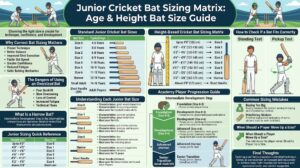
Why Correct Bat Sizing Matters
Many coaches consider bat sizing even more important than bat weight for junior players.
A correctly sized bat helps with:
- Proper technique
- Better balance
- Improved shot execution
- Faster bat speed
- Greater confidence
- Reduced fatigue
- Safer batting mechanics
Young players often try to imitate professional cricketers by using oversized bats. Unfortunately, this usually leads to technical problems and slower progress.
The Dangers of Using an Oversized Bat
Parents frequently buy a bat that is “slightly bigger so the child can grow into it.”
While understandable, this often causes issues.
A bat that is too large may result in:
Poor Backlift
The player struggles to lift the bat correctly.
Slow Downswing
The bat arrives late to the ball.
Loss of Control
Shot accuracy suffers.
Increased Fatigue
Arms and wrists tire quickly.
Technical Flaws
Players may develop bad habits that become difficult to correct later.
For junior development, control is always more important than size.
Standard Junior Cricket Bat Sizes
Junior cricket bats generally follow a standardized sizing system.
| Bat Size | Typical Age |
|---|---|
| Size 0 | 4-5 Years |
| Size 1 | 5-6 Years |
| Size 2 | 6-8 Years |
| Size 3 | 8-9 Years |
| Size 4 | 9-10 Years |
| Size 5 | 10-11 Years |
| Size 6 | 11-13 Years |
| Harrow | 12-14 Years |
| Small Adult | 14-16 Years |
| Short Handle (SH) | Adult Players |
These age ranges are only guidelines.
A player’s height remains the most reliable sizing reference.
Height-Based Cricket Bat Sizing Matrix
Height provides a more accurate fitting system because children develop at different rates.
Recommended Bat Size by Height
| Player Height | Recommended Bat Size |
|---|---|
| Up to 4’0″ (122 cm) | Size 0 |
| 4’0″ – 4’3″ (122-130 cm) | Size 1 |
| 4’3″ – 4’6″ (130-137 cm) | Size 2 |
| 4’6″ – 4’9″ (137-145 cm) | Size 3 |
| 4’9″ – 4’11” (145-150 cm) | Size 4 |
| 4’11” – 5’2″ (150-157 cm) | Size 5 |
| 5’2″ – 5’5″ (157-165 cm) | Size 6 |
| 5’5″ – 5’8″ (165-173 cm) | Harrow |
| Above 5’8″ (173 cm+) | Short Handle |
This chart is widely used by coaches and cricket retailers.
Understanding Each Junior Bat Size
Size 0
Typical Age
4-5 years
Characteristics
- Extremely lightweight
- Short blade
- Easy to maneuver
Ideal For
Young beginners learning basic batting movements.
Size 1
Typical Age
5-6 years
Characteristics
- Slightly larger profile
- Lightweight pickup
- Excellent control
Ideal For
Children beginning structured coaching.
Size 2
Typical Age
6-8 years
Characteristics
- Improved blade length
- Better reach
- Manageable weight
Ideal For
School and beginner club cricket.
Size 3
Typical Age
8-9 years
Characteristics
- Larger striking area
- Enhanced shot-making capability
Ideal For
Players growing in confidence and technical ability.
Size 4
Typical Age
9-10 years
Characteristics
- Increased blade size
- Larger sweet spot
- Better power potential
Ideal For
Developing academy cricketers.
Size 5
Typical Age
10-11 years
Characteristics
- Significant step toward full-sized bats
- Improved reach and leverage
Ideal For
Competitive youth cricket.
Size 6
Typical Age
11-13 years
Characteristics
- Closely resembles adult bats
- Increased performance potential
Ideal For
Serious junior players and academy programs.
Harrow
Typical Age
12-14 years
Characteristics
- Transitional size
- Adult-style profile
- Reduced overall dimensions
Ideal For
Young players approaching adult cricket.
What Is a Harrow Bat?
Many coaches consider the Harrow bat one of the most important stages in player development.
The Harrow size bridges the gap between junior and adult equipment.
Benefits include:
✅ Adult-style feel
✅ Better technique development
✅ Easier transition to senior cricket
✅ Improved balance for adolescents
For many academy players, Harrow becomes the ideal intermediate step.
Academy Player Progression Guide
Most academy pathways follow a gradual progression.
Foundation Stage
Size 0-3
Focus:
- Basic technique
- Hand-eye coordination
- Bat control
Development Stage
Size 4-6
Focus:
- Front-foot play
- Back-foot shots
- Shot selection
Advanced Stage
Harrow
Focus:
- Match performance
- Power generation
- Senior cricket preparation
Senior Transition
Small Adult or Short Handle
Focus:
- Full-sized equipment adaptation
- Competitive cricket
How to Check if a Bat Fits Correctly
A simple sizing test can help determine whether the bat is appropriate.
Standing Test
The player should stand upright while holding the bat vertically beside their leg.
Generally:
- The top of the bat should reach around the hip or waist region depending on age and development stage.
- The player should not struggle to lift the bat comfortably.
Pickup Test
Ask the player to perform several shadow batting swings.
A correctly sized bat should feel:
✅ Comfortable
✅ Controlled
✅ Natural
✅ Balanced
The player should not appear strained.
Weight Matters Too
Bat size and bat weight are connected but separate considerations.
Two bats of the same size can differ significantly in weight.
Junior players generally benefit from:
- Lightweight setups
- Good pickup
- Easy maneuverability
Choosing the heaviest bat available is rarely beneficial.
Common Sizing Mistakes
Buying Too Big
The most frequent mistake.
Parents often select larger bats for future growth.
This usually harms technique.
Following Friends
Every player develops differently.
Height matters more than age.
Ignoring Weight
Correct size with excessive weight can still create problems.
Prioritizing Stickers
A properly sized plain bat is better than an oversized premium model.
When Should a Player Move Up a Size?
Signs it may be time include:
✅ Bat appears noticeably small
✅ Player consistently outgrows height guidelines
✅ Reduced reach
✅ Advanced strength and coordination
✅ Coach recommendation
Moving up should be gradual and based on comfort.
Junior Sizing Quick Reference
| Height | Bat Size |
|---|---|
| Up to 122 cm | Size 0 |
| 122-130 cm | Size 1 |
| 130-137 cm | Size 2 |
| 137-145 cm | Size 3 |
| 145-150 cm | Size 4 |
| 150-157 cm | Size 5 |
| 157-165 cm | Size 6 |
| 165-173 cm | Harrow |
| 173 cm+ | Short Handle |
Final Thoughts
Selecting the correct cricket bat size is one of the most important investments in a young player’s development. While age-based recommendations provide a useful starting point, height remains the most reliable way to choose the right bat. A properly sized bat promotes better technique, faster bat speed, improved control, and greater confidence at the crease. Oversized bats may seem like a cost-saving solution, but they often create technical issues that can hinder progress.
For academy players and serious juniors, moving progressively from Size 0 through Harrow and eventually into adult bats ensures a smoother development pathway. The goal should never be to use the biggest bat possible, but rather the bat that feels balanced, comfortable, and easy to control. In youth cricket, good technique built with the right-sized bat is far more valuable than extra weight, bigger edges, or flashy stickers. A young cricketer who develops proper fundamentals with the correct equipment will always have a stronger foundation for future success. 🏏
See More: Cricket Bat Brand Comparisons: Kookaburra vs Gray-Nicolls vs SS vs Gunn & Moore