
A Size 2 cricket bat is designed for young players who have progressed beyond beginner-level equipment and are starting to develop more advanced batting skills. Typically aimed at children between 6 and 8 years old, a Size 2 bat offers the perfect balance between control, reach, and power while remaining lightweight enough for junior players to use comfortably.
Choosing the correct bat size at this stage is incredibly important. Children are often learning proper batting technique, developing hand-eye coordination, and beginning to play more structured cricket matches. A correctly sized bat helps build confidence and encourages good habits, while an oversized bat can hinder development and create technical flaws that become difficult to correct later.
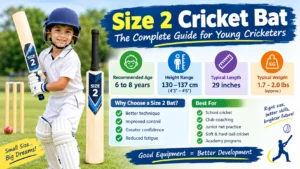
What Is a Size 2 Cricket Bat?
A Size 2 cricket bat sits in the middle of the junior bat sizing range and is generally recommended for children who have outgrown a Size 1 bat but are not yet ready for a Size 3.
These bats are specifically manufactured to suit younger players by reducing:
- Overall length
- Weight
- Handle dimensions
- Blade size
The result is a bat that feels comfortable and manageable for junior cricketers.
Recommended Age for a Size 2 Cricket Bat
A Size 2 bat is typically suitable for:
✅ Children aged 6 to 8 years
✅ Early school cricket participants
✅ Beginner and intermediate junior players
✅ Young academy cricketers
Age is useful as a guideline, but height remains a more accurate sizing measurement.
Height Guide for Size 2 Cricket Bats
Most coaches recommend a Size 2 bat for children approximately:
130 cm to 137 cm (4’3″ to 4’6″)
Height Conversion Chart
| Height | Recommended Size |
|---|---|
| Up to 122 cm | Size 0 |
| 122-130 cm | Size 1 |
| 130-137 cm | Size 2 |
| 137-145 cm | Size 3 |
If the player is approaching the upper end of the height range, it may be worth comparing both Size 2 and Size 3 bats before purchasing.
Typical Size 2 Cricket Bat Dimensions
Exact measurements vary between manufacturers, but most Size 2 bats feature:
| Specification | Typical Measurement |
|---|---|
| Length | 29 inches |
| Weight | 1.7-2.0 lbs |
| Handle | Junior Handle |
| Blade Width | Reduced Proportion |
The lightweight construction helps young players develop natural bat speed.
Why Bat Size Matters
Many parents focus on brand names or willow grades when shopping for junior bats.
However, bat size has a much greater impact on a child’s development.
A properly fitted bat supports:
Better Technique
Young players can execute shots correctly without compensating for excessive weight.
Improved Control
The bat remains easier to maneuver during drives, cuts, pulls, and defensive shots.
Greater Confidence
Children are more likely to enjoy batting when they can swing the bat comfortably.
Reduced Fatigue
A lighter bat helps prevent arm and wrist strain during long practice sessions.
Signs That a Size 2 Bat Is the Right Choice
A Size 2 bat is often ideal if the player:
✅ Can comfortably lift and swing the bat.
✅ Shows no signs of strain during practice.
✅ Maintains proper batting posture.
✅ Falls within the recommended height range.
✅ Is progressing through junior cricket programs.
Comfort should always be prioritized over using a larger bat.
Common Mistake: Buying a Bat That’s Too Big
Many parents purchase larger bats because they want equipment that will last several years.
While understandable, this can negatively affect development.
Oversized bats often result in:
- Slow bat speed
- Poor backlift
- Reduced control
- Technical errors
- Early fatigue
Using the correct size is far more important than buying a bat the child can “grow into.”
Choosing Between Kashmir Willow and English Willow
At Size 2 level, most players do not require expensive professional-grade willow.
Kashmir Willow
Advantages:
✅ Durable
✅ Affordable
✅ Great for beginners
✅ Ideal for school cricket
English Willow
Advantages:
✅ Better performance
✅ Improved ping
✅ Lighter pickup
✅ Suitable for advanced academy players
For most children using a Size 2 bat, a quality Kashmir willow model provides excellent value.
Best Training Uses for a Size 2 Bat
A Size 2 cricket bat works well for:
- School cricket
- Club coaching sessions
- Junior net practice
- Soft-ball cricket
- Hard-ball introductory cricket
- Academy development programs
The size helps bridge the gap between beginner cricket and more competitive environments.
How to Check the Fit of a Size 2 Bat
A quick fit test can help ensure the bat is appropriate.
Standing Test
Place the bat next to the child’s leg while standing upright.
The bat should reach approximately the hip area.
Swing Test
Ask the player to perform several shadow batting swings.
The bat should:
✅ Feel balanced
✅ Move naturally
✅ Allow a smooth backlift
✅ Not cause strain
If the player struggles to control the bat, consider a smaller size.
See More: Size 0 Cricket Bat
When Should a Player Move to Size 3?
A player may be ready to progress when:
- Height exceeds 137 cm (4’6″)
- The current bat feels noticeably small
- Reach becomes limited
- The player demonstrates strong control and technique
Progression should occur gradually and comfortably.
Benefits of a Properly Sized Size 2 Bat
Faster Bat Speed
Children can react more quickly to deliveries.
Improved Timing
Batters can meet the ball more consistently.
Better Confidence
Success at the crease builds enthusiasm for the game.
Long-Term Development
Correct sizing supports proper mechanics that will benefit players for years.
Size 2 Cricket Bat vs Size 3 Cricket Bat
| Feature | Size 2 | Size 3 |
|---|---|---|
| Age | 6-8 Years | 8-9 Years |
| Height | 130-137 cm | 137-145 cm |
| Weight | Lighter | Slightly Heavier |
| Control | Excellent | Good |
| Reach | Moderate | Greater |
| Power Potential | Moderate | Higher |
Choosing between them should be based primarily on the player’s height and comfort level.
Final Thoughts
A Size 2 cricket bat is one of the most important stepping stones in a young cricketer’s development. Designed for children aged approximately 6 to 8 years and between 130 cm and 137 cm tall, it provides the ideal combination of control, comfort, and manageable weight. At this stage, young players are learning crucial batting skills, and using the correct-sized bat helps build proper technique, confidence, and enjoyment of the game.
While premium brands and willow grades may be tempting, the most important factor remains fit. A lightweight, well-balanced Size 2 bat that suits the player’s height and strength will contribute far more to long-term success than an oversized bat chosen for future growth. For young cricketers, mastering fundamentals with the right equipment is the foundation on which every future innings is built. 🏏
See More: Size 1 Cricket Bat