
Cricket bats are no longer designed with a one-size-fits-all philosophy. Modern bat makers understand that different players have different responsibilities, and those responsibilities directly influence what type of bat works best. A T20 finisher trying to clear the boundary every second ball has very different requirements from an opening batter tasked with building an innings and batting for 40 overs.
As a result, modern cricket bats are often built around specific roles. Some are engineered for explosive power, massive sweet spots, and maximum boundary-hitting ability. Others prioritize balance, pickup, control, and precise timing.
Understanding the differences between power-hitter bats and anchor bats can help players choose equipment that complements their strengths and playing style.
Why Bat Selection Should Match Your Role
One of the biggest mistakes players make is choosing a bat simply because their favorite professional uses it.
What works for a T20 six-hitter may not work for a technically sound opening batter.
Bat selection should reflect:
- Batting position
- Playing style
- Format
- Physical strength
- Shot preference
- Match responsibilities
A player who selects a bat suited to their role often performs far better than one who simply follows trends.
The Rise of Specialized Bats
Modern cricket has evolved dramatically.
T20 cricket has created a greater demand for bats that offer:
✅ Bigger sweet spots
✅ Massive edges
✅ Faster boundary-scoring potential
At the same time, traditional batting roles still require:
✅ Precision
✅ Timing
✅ Endurance
✅ Consistency
Manufacturers now produce bats specifically targeting these different needs.
What Is a T20 Power-Hitter Bat?
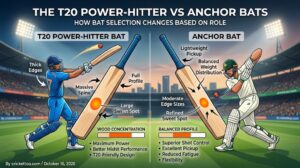
A T20 power-hitter bat is designed to maximize ball striking and boundary power.
These bats often feature:
- Thick edges
- Massive spines
- Full profiles
- Large sweet spots
- Significant wood behind the hitting area
The goal is simple:
Deliver maximum power with every swing.
Characteristics of a Power-Hitter Bat
Thick Edges
Modern power bats frequently feature very large edges.
Benefits include:
✅ Larger effective hitting zone
✅ Greater forgiveness
✅ Increased confidence
✅ Better performance on mishits
Even shots struck away from the middle often travel significant distances.
Massive Spine
A large spine concentrates extra willow in key hitting areas.
Advantages:
- Greater energy transfer
- Enhanced rebound
- Improved shot penetration
This construction helps generate explosive power.
Full Profiles
Power bats often retain substantial wood throughout the blade.
Unlike heavily concaved bats, they prioritize mass and hitting potential.
Benefits:
✅ More willow behind the ball
✅ Stronger impact sensation
✅ Increased momentum
Large Sweet Spot
Boundary hitters want a forgiving hitting area.
A large sweet spot helps:
- Maintain performance during aggressive play
- Minimize punishment for slight mishits
- Increase consistency
This feature is particularly valuable in T20 cricket.
Advantages of T20 Power-Hitter Bats
Maximum Power
This is the primary goal.
The profile is optimized for:
- Six hitting
- Boundary clearing
- Aggressive stroke play
Better Mishit Performance
Modern power bats often carry mishits farther than traditional bats.
Confidence at the Crease
Many players feel more aggressive knowing their bat offers significant hitting potential.
T20-Friendly Design
These bats suit:
- Death overs
- Powerplays
- Finishing roles
- High-risk batting
Potential Drawbacks
No equipment is perfect.
Power bats may present some disadvantages.
Heavier Feel
Some large-profile bats can feel substantial during long innings.
Reduced Maneuverability
Quick hand adjustments may become more challenging.
Less Refined Pickup
Some players prefer lighter, more responsive bats.
What Is an Anchor Bat?
An anchor bat is designed for players who prioritize:
- Timing
- Placement
- Consistency
- Control
The anchor’s role is often to:
- Build an innings
- Rotate strike
- Bat long periods
- Minimize risk
Their bat requirements are different from those of a power hitter.
Characteristics of an Anchor Bat
Lightweight Pickup
Perhaps the most important attribute.
Anchor bats often feel exceptionally light in the hands.
Benefits include:
✅ Quick reactions
✅ Better timing
✅ Reduced fatigue
✅ Easier shot control
Balanced Weight Distribution
These bats are designed to feel responsive throughout the swing.
A well-balanced bat helps players:
- Adjust late
- Play with soft hands
- Execute technical strokes
Moderate Edge Sizes
While still modern, anchor bats usually prioritize balance over huge edges.
This helps maintain maneuverability.
Refined Sweet Spot
Sweet spots often focus on timing rather than brute force.
Players receive excellent feedback and control.
Advantages of Anchor Bats
Superior Shot Control
Anchor bats reward technical batting.
Benefits include:
- Better placement
- Improved strike rotation
- Consistent timing
Excellent Pickup
The bat feels effortless to move through the ball.
Reduced Fatigue
Long innings become easier to sustain.
Flexibility
Anchor bats often perform exceptionally well across multiple formats.
Potential Drawbacks
Less Raw Power
While still capable of clearing boundaries, they may not provide the same explosive feel as dedicated power bats.
Smaller Margin for Error
Power bats often forgive mishits more readily.
Less Intimidating Profiles
Some players simply prefer the visual confidence of larger bats.
Weight Distribution: The Key Difference
The biggest distinction often comes down to where the willow is positioned.
Power-Hitter Bat
WOOD CONCENTRATION

██████████
██████████
██████████
██████████
██████████
Substantial mass remains throughout the blade.
Anchor Bat
BALANCED PROFILE

████████
█████████
█████████
████████
███████
Wood is distributed more carefully to optimize pickup.
See More: Size 5 Cricket Bat
Bat Weight Comparison
Typical Power Bats
Often preferred in:
- Medium-heavy weights
- Large profiles
- Full-bodied shapes
Typical Anchor Bats
Often feature:
- Lightweight pickup
- Balanced feel
- Easier maneuverability
Actual weight varies, but pickup is usually the deciding factor.
Which Profile Suits an Opener?
The answer depends on the opener’s style.
Aggressive Opener
May prefer:
✅ Modern power profile
✅ Large sweet spot
✅ Thick edges
Traditional Opener
May prefer:
✅ Balanced bat
✅ Faster pickup
✅ Enhanced control
Which Profile Suits a Finisher?
Most finishers generally benefit from:
✅ Big edges
✅ Large spine
✅ Massive sweet spot
✅ Maximum willow behind the ball
Their job often revolves around boundary-hitting power.
Which Profile Suits a Number 3 or 4?
Many middle-order players choose compromise bats.
These bats combine:
- Good pickup
- Reasonable power
- Versatility
Such profiles often perform well across formats.
T20 Power-Hitter vs Anchor: Head-to-Head
| Feature | T20 Power-Hitter Bat | Anchor Bat |
|---|---|---|
| Edge Size | ⭐⭐⭐⭐⭐ | ⭐⭐⭐ |
| Sweet Spot Size | ⭐⭐⭐⭐⭐ | ⭐⭐⭐⭐ |
| Pickup | ⭐⭐⭐ | ⭐⭐⭐⭐⭐ |
| Power Potential | ⭐⭐⭐⭐⭐ | ⭐⭐⭐⭐ |
| Control | ⭐⭐⭐⭐ | ⭐⭐⭐⭐⭐ |
| Timing | ⭐⭐⭐⭐ | ⭐⭐⭐⭐⭐ |
| Maneuverability | ⭐⭐⭐ | ⭐⭐⭐⭐⭐ |
| Long Innings Comfort | ⭐⭐⭐ | ⭐⭐⭐⭐⭐ |
| Boundary Hitting | ⭐⭐⭐⭐⭐ | ⭐⭐⭐⭐ |
Can One Bat Do Both?
Many modern bats attempt to bridge the gap.
Features such as:
- Duckbill profiles
- Mid sweet spots
- Balanced spines
- Controlled edge sizes
allow players to enjoy both power and pickup.
For all-format cricketers, these hybrid designs can be extremely effective.
How Professional Players Choose
Elite players don’t simply choose the biggest bat available.
They carefully evaluate:
- Pickup
- Balance
- Sweet spot placement
- Batting role
- Match conditions
A T20 finisher often seeks maximum hitting potential.
An anchor often prioritizes consistency and control.
Their bats reflect those responsibilities.
Final Thoughts
The difference between a T20 power-hitter bat and an anchor bat comes down to purpose. Power-hitter bats are built for aggression, featuring thick edges, substantial spines, massive sweet spots, and significant wood behind the ball to maximize boundary-hitting potential. Anchor bats, by contrast, emphasize balance, lightweight pickup, timing, and control, helping players build innings and manipulate the field with precision.
Neither design is inherently better. The ideal choice depends entirely on the player’s role and batting philosophy. A destructive finisher may benefit from a large-profile power bat that turns good strikes into sixes, while a stroke player may score more runs with a lighter, beautifully balanced bat that rewards timing and placement. Ultimately, the best cricket bat is not the one with the biggest edges or the lightest pickup, but the one that helps you perform your role most effectively when you walk to the crease.