
Cricket bats are often judged by their appearance, pickup, and power, but one of the most important engineering features lies hidden beneath the grip: the handle. While the blade delivers the striking force, the handle acts as a sophisticated shock absorption system designed to manage vibrations, improve comfort, enhance control, and protect a player’s hands from injury.
Every cricketer has experienced “sting” at some point. A mistimed shot struck away from the sweet spot can send a sharp, painful vibration through the bat and into the hands. This sensation may last only seconds, but repeated exposure can lead to discomfort, bruising, reduced confidence, and even long-term strain. To combat this problem, bat manufacturers have spent decades refining handle construction, utilizing combinations of cane and rubber to create an effective vibration-dampening system.
Understanding how different handle configurations work requires a closer look at the physics of impact, vibration transfer, and energy absorption.
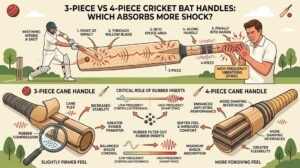
What Causes “Sting” in a Cricket Bat?
When a cricket ball strikes the bat, a large amount of kinetic energy is transferred in a fraction of a second. Ideally, contact occurs in the sweet spot, where the bat’s natural vibration modes are minimized.
However, when the ball strikes outside this optimal zone, excess vibration travels throughout the bat structure.
These vibrations move from:
- The point of impact
- Through the willow blade
- Into the splice area
- Along the handle
- Finally into the batter’s hands
The sudden transmission of these high-frequency vibrations creates the painful sensation commonly called sting.
The greater the vibration reaching the hands, the stronger the discomfort experienced by the player.
The Science of Vibration Transfer
From a physics perspective, a cricket bat behaves much like a vibrating beam.
When impact occurs:
- The blade flexes slightly.
- Energy travels as mechanical waves.
- Vibrations move through the structure.
- Different frequencies travel simultaneously.
Without a shock-absorbing handle, much of this energy would be delivered directly into the player’s palms and wrists.
Manufacturers therefore design handles to interrupt, absorb, and dissipate vibration before it reaches the hands.
This process is known as damping.
Why Cane Is Used in Cricket Bat Handles
Most professional cricket bats use Singapore cane rather than solid willow for handle construction.
Cane possesses several properties that make it uniquely suitable:
Flexibility
Unlike rigid hardwoods, cane bends slightly under load.
This flexibility absorbs impact energy by allowing microscopic movement within the handle structure.
Rather than transmitting all force directly upward, some energy is dispersed through controlled flexing.
Elastic Recovery
Cane naturally returns to its original shape after deformation.
This characteristic allows the handle to repeatedly absorb shocks without permanent structural damage.
Strength-to-Weight Ratio
Cane provides excellent strength while adding minimal weight.
As a result, manufacturers can create handles that are both durable and responsive.
Natural Damping Properties
The fibrous structure of cane naturally reduces vibration transmission compared to many alternative materials.
This makes it an ideal foundation for modern anti-sting handle systems.
The Evolution of Multi-Piece Cane Handles
Early cricket bats often used simpler handle constructions. As understanding of impact dynamics improved, manufacturers introduced multi-piece cane designs.
Modern bats generally feature either:
- 3-piece cane handles
- 4-piece cane handles
- Semi-oval variations
- Custom hybrid constructions
The number of cane pieces directly influences flexibility and vibration management.
How a 3-Piece Cane Handle Works
A traditional 3-piece handle consists of three cane segments bonded together with rubber inserts positioned between them.
This design provides:
- Strong structural integrity
- Moderate flexibility
- Good power transfer
- Reliable shock absorption
Many batsmen prefer 3-piece handles because they offer a slightly firmer feel.
Advantages include:
Increased Stability
The handle contains fewer flex points, creating a more direct connection between player and blade.
Greater Power Transfer
Less handle movement means energy generated by the swing is transferred efficiently into the ball.
Balanced Shock Control
The rubber inserts still absorb significant vibration while maintaining a traditional batting feel.
For players who favor powerful drives and aggressive stroke play, the 3-piece configuration often provides an appealing combination of responsiveness and comfort.
How a 4-Piece Cane Handle Works
A 4-piece handle contains four cane strips separated by multiple rubber layers.
This design increases the number of energy-dissipating interfaces throughout the handle.
As vibration travels upward, it encounters additional damping zones.
Each interface absorbs and disperses part of the vibrational energy.
The result is:
- Greater flexibility
- Enhanced vibration reduction
- Softer feel
- Improved comfort
Many players notice that 4-piece handles feel more forgiving on off-center strikes.
Enhanced Anti-Sting Performance
The additional split within the cane structure creates another opportunity for vibration damping.
This often reduces the sharpness of impact sensations reaching the hands.
Better Comfort Over Long Innings
Repeated impacts generate cumulative stress on the hands and forearms.
A more flexible handle can reduce fatigue during extended batting sessions.
Increased Shock Absorption
The handle behaves somewhat like a suspension system, filtering higher-frequency vibrations before they reach the player.
The Critical Role of Rubber Inserts
While cane receives most of the attention, rubber inserts are equally important.
These thin layers positioned between cane strips perform the majority of vibration-dampening work.
Rubber is classified as a viscoelastic material.
This means it behaves partly like:
- An elastic spring
- A viscous damper
When vibration enters the handle:
- The cane flexes.
- The rubber compresses.
- Friction within the rubber converts some mechanical energy into heat.
- Vibration amplitude decreases.
The process repeats along the handle structure, progressively reducing the energy transmitted to the hands.
In simple terms, rubber turns painful vibration into harmless microscopic thermal energy.
Low-Frequency vs High-Frequency Vibrations
Not all vibrations feel the same.
Low-frequency vibrations are typically felt as:
- Soft flex
- Controlled feedback
- Comfortable bat response
High-frequency vibrations create:
- Sharp sting
- Painful impact sensations
- Hand discomfort
Rubber inserts are particularly effective at suppressing higher-frequency vibrations.
This selective filtering allows players to maintain feel and feedback while minimizing discomfort.
Handle Flex and Sweet Spot Perception
An interesting aspect of bat physics is that handle design can influence how players perceive the sweet spot.
More flexible handles often make bats feel:
- Softer
- More forgiving
- Easier on mishits
Stiffer handles provide:
- More immediate feedback
- Stronger response
- Greater perception of power
Neither approach is universally superior.
Professional players frequently select handle types based on personal preference and playing style.
Preventing Hand and Wrist Injuries
Shock absorption is not simply a matter of comfort.
Repeated vibration exposure can contribute to:
- Palm bruising
- Finger soreness
- Wrist strain
- Forearm fatigue
- Reduced grip strength
Modern handle technology helps reduce these risks.
By lowering peak vibration levels, manufacturers create a safer interface between the bat and the player.
For young cricketers, whose muscles and joints are still developing, effective vibration damping can be especially beneficial.
The Relationship Between Handle Design and Bat Performance
One common misconception is that softer handles automatically reduce performance.
In reality, manufacturers carefully balance:
- Power
- Feel
- Flexibility
- Comfort
- Durability
Too much flexibility can reduce shot crispness.
Too much rigidity can increase sting.
The best handle designs occupy a middle ground where sufficient energy reaches the ball while excessive vibration is absorbed before reaching the hands.
This balance explains why different bat models often feature different handle specifications despite using similar willow grades.
Modern Innovations in Handle Technology
Leading bat manufacturers continue refining handle construction through research and player feedback.
Recent developments include:
- Variable-density rubber inserts
- Hybrid cane arrangements
- Reinforced splice systems
- Enhanced bonding adhesives
- Customized flex profiles
These innovations enable manufacturers to tailor vibration characteristics for different playing styles.
Some bats prioritize maximum comfort, while others focus on responsiveness and power.
Why Handle Construction Matters More Than Ever
As cricket becomes faster and players generate greater bat speeds, managing impact forces has become increasingly important.
Modern cricket balls travel at higher speeds than ever before, increasing the energy involved in every shot.
The handle is no longer merely a component connecting the blade to the player. It functions as a highly engineered shock-management system.
Whether using a traditional 3-piece cane handle or a more flexible 4-piece design, the objective remains the same: absorb harmful vibrations, preserve performance, and protect the batter from discomfort.
Conclusion
The science behind cricket bat handles is a fascinating blend of physics, material engineering, and player ergonomics. Every time a ball strikes the bat, mechanical energy travels through the blade in the form of vibrations. Without an effective damping system, these vibrations would be felt directly in the hands as a painful sting.
Through the use of cane segments, flexible construction methods, and strategically placed rubber inserts, manufacturers have developed sophisticated handle designs that absorb impact energy and reduce vibration transmission. Traditional 3-piece handles provide firmness and power, while 4-piece configurations offer additional flexibility and enhanced shock absorption. Both are carefully engineered to optimize comfort, control, and performance.
In many ways, the handle is cricket bat technology’s unsung hero. Hidden beneath the grip, it quietly performs the crucial task of transforming harsh impacts into manageable feedback, allowing players to bat longer, play more confidently, and protect their hands from unnecessary injury.