
Cricket bats are not one‑size‑fits‑all. The ideal bat depends on your playing style, pitch conditions, and ball type. Power‑hitters need explosive rebound and thick edges, while defensive openers rely on balance, control, and precision. This article explores the best bat profiles, willow grades, and design features for both styles.
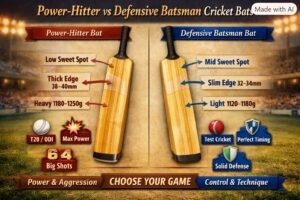
🔥 Aggressive Power‑Hitters
Power‑hitters dominate short formats — T20s and limited‑overs matches — where boundaries matter more than patience. Their bats are built for maximum impact and momentum.
🪵 Ideal Bat Features
| Feature | Specification | Purpose |
|---|---|---|
| Willow Type | Grade 1 English or Premium Kashmir | Delivers explosive rebound and durability |
| Profile | Full spine, thick edges, low‑to‑mid sweet spot | Generates immense hitting power |
| Weight | 1180–1250 g | Adds momentum for lofted shots |
| Handle | Semi‑oval, stiff cane | Transfers energy efficiently |
| Toe Guard | Mandatory | Protects against yorkers and toe cracks |
⚙️ Recommended Models
- SS Ton Gladiator – Massive edges, ideal for T20 hitters.
- MRF Chase Master – Used by Virat Kohli; balanced yet powerful.
- Gray‑Nicolls Legend – Full profile, exceptional rebound.
- Kookaburra Kahuna Pro – Iconic design for aggressive stroke play.
💡 Performance Tip
Power‑hitters should choose bats with concave profiles and pressed willow, ensuring maximum energy transfer on impact.
🧠 Defensive Opening Batsmen
Openers face the new ball, demanding technique and patience. Their bats prioritize balance, control, and precision over brute force.
🪵 Ideal Bat Features
| Feature | Specification | Purpose |
|---|---|---|
| Willow Type | Grade 2–3 English | Offers consistent grain and soft feel |
| Profile | Balanced spine, mid‑sweet spot | Enhances timing and control |
| Weight | 1120–1180 g | Allows quick maneuverability |
| Handle | Round or semi‑oval | Improves grip for defensive strokes |
| Face Cover | Optional PU sheet | Protects against surface wear |
⚙️ Recommended Models
- SG Sunny Tonny – Classic balance, perfect for Test openers.
- Gray‑Nicolls Imperia Pro – Reduced vibration, ideal for long innings.
- CA Plus 15000 – Smooth pickup, reliable for front‑foot play.
- New Balance Burn – Lightweight design for quick reactions.
💡 Performance Tip
Defensive players should focus on grain alignment and handle flexibility — these factors improve control and reduce shock absorption during long sessions.
⚖️ Comparison Table
| Aspect | Power‑Hitters | Defensive Openers |
|---|---|---|
| Sweet Spot | Low‑to‑mid | Mid |
| Edge Thickness | 38–40 mm | 32–34 mm |
| Weight Range | 1180–1250 g | 1120–1180 g |
| Pickup | Heavy, momentum‑based | Light, balanced |
| Ideal Format | T20, ODI | Test, long innings |
| Preferred Willow | Grade 1 English | Grade 2–3 English |
| Handle Type | Semi‑oval, stiff | Round, flexible |
🧴 Maintenance and Longevity
Regardless of style, proper care ensures consistent performance:
- Oil lightly with raw linseed oil every few months.
- Store in moderate humidity to prevent drying.
- Use toe guards and anti‑scuff sheets for protection.
- Avoid switching between heavy and light bats frequently — it affects timing.
🏁 Conclusion: Style Defines the Blade
Aggressive bats are weapons of momentum, built for explosive boundaries. Defensive bats are tools of precision, crafted for patience and technique.
Choosing the right bat means understanding your role, pitch conditions, and rhythm. A power‑hitter thrives on weight and rebound; an opener succeeds through balance and control.
In cricket, the bat is more than equipment — it’s an extension of your playing identity.
See More: Legal Types of Protective Face Covers (Anti‑Scuff Sheets) in Cricket