
For more than a century, cricket bats have been synonymous with willow. The phrase “the sound of leather on willow” is deeply embedded in the sport’s culture, and generations of players have trusted English willow and Kashmir willow to deliver the performance needed at every level of the game.
However, as cricket continues to grow globally, questions are emerging about the future sustainability and affordability of willow. Rising demand, environmental pressures, and increasing bat prices have encouraged manufacturers, researchers, and engineers to explore alternative materials. Among the most discussed options are bamboo and poplar.
Can these materials genuinely challenge willow? Are they simply cheap substitutes, or could they represent the future of cricket bat manufacturing?
The answer is more complicated than many players realize.
Why Willow Became the Standard
Before examining alternatives, it is important to understand why willow became the preferred material in the first place.
Willow possesses a rare combination of characteristics that make it perfect for cricket bats:
- Relatively lightweight
- Naturally shock-absorbent
- Excellent ball rebound
- Easy to shape
- Good durability
- Comfortable vibration control
Few woods provide this unique balance between strength and flexibility.
Over decades, bat makers refined their manufacturing methods around willow’s properties, helping establish English willow as the gold standard.
The Growing Search for Alternatives
Cricket is expanding rapidly across the world.
Millions of players require affordable equipment, while climate and agricultural changes have increased concerns about the long-term availability of quality willow.
Manufacturers and researchers therefore face an important question:
Can another material deliver similar or better performance while being cheaper and more sustainable?
This search has primarily focused on bamboo and, to a lesser extent, poplar.
Bamboo Cricket Bats
Among all willow alternatives, bamboo has generated the most excitement.
Unlike traditional willow bats, bamboo bats are generally constructed using laminated bamboo strips that are bonded together under pressure.
The result is a dense and highly engineered cricket bat.
Why Bamboo Is Attracting Attention
Bamboo offers several advantages over traditional timber.
Extremely Fast Growth
While willow trees require years to mature, bamboo matures much more quickly.
This gives bamboo significant sustainability advantages.
Benefits include:
✅ Faster replenishment
✅ Lower environmental impact
✅ Greater resource availability
✅ Potentially lower production costs
For an expanding global sport, these advantages are difficult to ignore.
Strength Advantages
Bamboo is known for its impressive structural properties.
Compared with many traditional woods, bamboo is:
- Stronger
- More resistant to cracking
- More durable under repeated stress
- Highly resilient
These characteristics make it attractive for sports equipment.
Some engineers believe that bamboo’s inherent strength could allow bats to remain thinner while still maintaining excellent durability.
Bamboo and Bat Performance
One of the biggest questions surrounding bamboo is whether it can actually perform like willow.
Historically, many alternative materials have failed because they lacked the feel, responsiveness, or sound that players expected.
Bamboo appears different.
Research and prototype testing have indicated that bamboo bats can offer:
- Strong ball rebound
- Large sweet spots
- Excellent energy transfer
- High durability
Some prototypes have even demonstrated sweet spot characteristics that compare favorably to conventional willow bats.
This has generated significant interest among bat designers.
The Challenges of Bamboo Bats
Despite its promise, bamboo still faces several hurdles.
Feel and Tradition
Cricketers are notoriously traditional.
Players often spend years finding the perfect bat and become extremely sensitive to:
- Pickup
- Balance
- Sound
- Vibration feedback
Even if bamboo performs similarly on paper, many players still prefer the familiar feel of willow.
Manufacturing Complexity
Unlike willow bats, which are produced from solid clefts, bamboo bats require a more sophisticated manufacturing process involving:
- Lamination
- Adhesives
- Compression
- Engineering controls
This increases complexity and requires additional quality assurance.
Regulatory Questions
If bamboo bats consistently outperform willow bats, governing bodies may eventually need to decide whether performance advantages remain within acceptable limits.
The sport has historically been careful about technologies that could alter the balance between bat and ball.
Could Bamboo Replace Willow?
Many experts believe bamboo is the strongest candidate to become cricket’s first true alternative to willow.
It offers:
✅ Excellent strength
✅ Sustainability
✅ Durability
✅ Strong performance potential
✅ Global availability
If future generations embrace bamboo as readily as current players embrace willow, bamboo could become a major force in bat manufacturing.
For now, however, willow remains king.
Poplar Cricket Bats
Poplar is a very different story.
Unlike bamboo, which is being explored as a serious performance alternative, poplar is primarily used for low-cost recreational cricket products.
In many markets, poplar bats are commonly found in:
- Street cricket
- Tennis-ball cricket
- School equipment
- Beginner-level kits
Why Manufacturers Use Poplar
The primary reason is cost.
Poplar grows relatively quickly and is widely available.
Advantages include:
✅ Low manufacturing cost
✅ Easy availability
✅ Lightweight structure
✅ Suitable for entry-level players
For casual cricket, these factors make poplar an attractive material.
Performance Limitations of Poplar
The problem is that poplar does not possess the same characteristics that make willow special.
Compared with willow, poplar generally offers:
- Reduced rebound
- Inferior ping
- Lower durability
- Greater wear under leather-ball impact
This limits its use in competitive cricket.
The Sweet Spot Problem
A quality cricket bat relies heavily on sweet spot performance.
Willow’s unique fiber structure helps create a zone of efficient energy transfer.
Poplar struggles to replicate this.
As a result:
- Shots often feel less powerful
- Ball rebound is reduced
- Timing feels less forgiving
These shortcomings become increasingly noticeable as playing standards rise.
Durability Concerns
Leather cricket balls generate enormous forces at impact.
Repeated impacts can quickly expose weaknesses in lower-grade materials.
Compared with premium willow, poplar may experience:
- Faster compression
- Increased denting
- Structural fatigue
- Reduced lifespan
For this reason, serious players rarely consider poplar a long-term solution.
Why Professionals Do Not Use Poplar
Professional players demand:
- Consistency
- Durability
- Large sweet spots
- Predictable response
Willow delivers these characteristics more effectively than poplar.
As a result, poplar remains largely confined to entry-level and recreational markets.
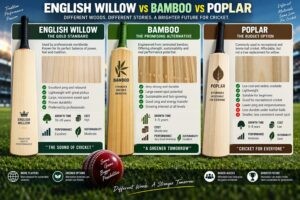
How Bamboo, Poplar, and Willow Compare
| Feature | English Willow | Bamboo | Poplar |
|---|---|---|---|
| Professional Acceptance | Excellent | Experimental | Very Limited |
| Sustainability | Good | Excellent | Good |
| Sweet Spot Quality | Excellent | Potentially Excellent | Moderate |
| Durability | Very Good | Excellent | Fair |
| Traditional Feel | Excellent | Different | Different |
| Manufacturing Maturity | Established | Developing | Established |
| Performance Level | Elite | Promising | Recreational |
| Future Potential | High | Very High | Low |
What Would It Take to Replace Willow?
To truly replace Willow, another material would need to satisfy several requirements:
Performance
The bat must produce elite-level ping and power.
Durability
It must survive years of competitive use.
Player Acceptance
Professionals and amateurs must trust it.
Governing Body Approval
The material must comply with cricket laws and performance expectations.
Commercial Viability
Manufacturers must be able to produce the bats at scale.
At present, bamboo is the only serious alternative that appears capable of meeting most of these requirements.
The Future of Cricket Bat Materials
The next decade may prove fascinating for bat technology.
Willow has dominated cricket for generations, but the sport is changing.
Increased participation, environmental concerns, and advances in material science are encouraging innovation like never before.
While poplar is likely to remain a niche material for budget cricket products, bamboo has genuine potential to reshape the industry.
Whether players eventually embrace the sound of “leather on bamboo” remains to be seen.
Final Thoughts
Yes, cricket bats are already being made from both bamboo and poplar, but their roles in the market are very different. Poplar serves mostly as an affordable option for casual and recreational cricket, offering low costs but limited performance compared to willow. Bamboo, on the other hand, has emerged as a serious contender for the future. Its exceptional strength, sustainability, and promising performance characteristics have attracted enormous interest from researchers and bat manufacturers around the world.
For now, English willow remains the undisputed benchmark for elite cricket bats. Its unique combination of ping, balance, durability, and tradition continues to make it the preferred choice for professional players and serious amateurs. However, if cricket ever embraces a true alternative, bamboo appears far more likely than poplar to become the next major chapter in the evolution of the cricket bat.
See More: English Willow Cricket Bat Manufacturing: From Cleft to Finished Bat