
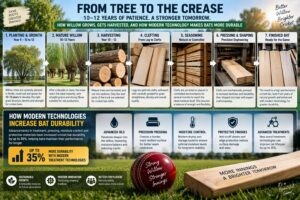
Every time a batter walks onto the field with a new English willow cricket bat, they are carrying far more than a piece of sporting equipment. That bat represents more than a decade of careful cultivation, patient harvesting, expert craftsmanship, and increasingly sophisticated treatment technologies.
Most cricketers admire the grains, stickers, and sweet spot of a bat without realizing the extraordinary journey behind its creation. The willow tree that produces a professional cricket bat may have spent 10 to 12 years growing before a bat maker ever touches it. Even then, the cleft undergoes careful seasoning, pressing, moisture management, and finishing processes before becoming match-ready.
In recent years, manufacturers have embraced advanced treatments and preparation techniques that have dramatically improved bat lifespan and performance. Modern maintenance and treatment technologies are reported to extend equipment longevity substantially, with well-maintained bats retaining performance characteristics significantly longer than neglected equipment.
The combination of improved willow cultivation and modern treatment methods is helping today’s bats last longer than many of their predecessors while maintaining the powerful performance players expect.
Why Cricket Bats Are Made from Willow
For generations, cricket bat makers have relied on Salix Alba Caerulea, commonly known as English willow.
Willow possesses a rare combination of characteristics:
- Lightweight structure
- Natural shock absorption
- Excellent rebound properties
- Flexibility under impact
- Easy workability
- Strong energy transfer
No other traditional timber has consistently matched this balance.
This unique combination allows willow to endure thousands of high-impact collisions with hard leather cricket balls while still producing the responsive “ping” that batters love.
The Beginning: Planting a Willow Tree
A cricket bat’s journey begins many years before it reaches a cricket store.
Commercial willow growers carefully select:
- Suitable soil conditions
- Consistent water availability
- Favorable climate
- Disease-resistant stock
Willow thrives in moist environments and often grows near rivers and wetlands where soil conditions support healthy root development.
Unlike many timber species harvested for furniture or construction, cricket bat willow is grown specifically for performance characteristics rather than simple timber production.
The 10- to 12-Year Harvesting Cycle
One of the most fascinating aspects of cricket bat production is the amount of time required to grow suitable willow.
A typical bat-quality willow tree may spend approximately 10 to 12 years maturing before harvest.
During this period, the grower carefully monitors:
- Growth rate
- Trunk diameter
- Grain development
- Tree health
- Moisture conditions
Each growing season influences the eventual grain structure visible on the finished bat.
See More: Bamboo and Poplar Cricket Bats: Could They Replace Traditional Willow?
Why Growth Speed Matters
The rate at which willow grows affects:
Grain Width
Slower growth generally produces tighter grain patterns.
Faster growth often creates wider grain spacing.
Neither automatically guarantees superior performance, but growth characteristics influence the willow’s final appearance and grading.
Density
Consistent growth supports more uniform fiber development.
The resulting wood often provides greater consistency throughout the bat.
Structural Integrity
A healthy growth cycle helps ensure the cellular strength needed to withstand repeated impacts from cricket balls.
Harvesting the Tree
Once the willow reaches maturity, harvesting begins.
This stage requires careful selection because not every section of the tree is suitable for bat production.
Manufacturers inspect the trunk for:
- Straight grain orientation
- Uniform density
- Minimal defects
- Suitable dimensions
The best sections are reserved for cricket bat clefts.
From Log to Cleft
After harvesting, the trunk is processed into sections.
These sections are then split into individual clefts.
WILLOW TREE
      ↓
      LOG
      ↓
 BAT-GRADE TIMBER
      ↓
     CLEFT
      ↓
 CRICKET BAT
Each cleft represents the starting point of a future cricket bat.
At this stage, the wood still contains substantial natural moisture and cannot yet be used for play.
The Seasoning Process
Fresh willow is far too wet to become a quality cricket bat.
The clefts must undergo seasoning.
Seasoning allows moisture levels to stabilize while preserving the willow’s natural elasticity.
This process is critical because:
Excess Moisture Causes
- Heavy pickup
- Reduced ping
- Lower responsiveness
Excess Dryness Causes
- Brittleness
- Cracking
- Reduced lifespan
Master bat makers seek the ideal balance.
Traditional Air Seasoning
Historically, many manufacturers relied on natural seasoning.
During this process:
- Clefts are stacked carefully
- Air circulates through the timber
- Moisture gradually evaporates
- Internal stresses reduce naturally
The process may take several months depending on climate and conditions.
Many traditional bat makers still prefer slower seasoning methods because they maintain wood quality.
The Evolution of Bat Manufacturing
The modern cricket bat industry has changed dramatically during the past two decades.
Improved manufacturing techniques have allowed bat makers to:
- Better manage moisture
- Improve fiber compression
- Enhance surface protection
- Increase durability
- Improve sweet spot resilience
The result is a new generation of bats that often remain responsive for much longer periods.
Advanced Mechanical Pressing
Pressing remains one of the most important stages in bat production.
Raw willow is too soft for match use.
Manufacturers use specialized rollers and presses to compress the surface fibers.
Benefits include:
✅ Enhanced durability
✅ Better seam mark resistance
✅ Improved resilience
✅ Stronger sweet spot
✅ Consistent performance
Modern pressing systems provide far greater control than older equipment.
Bat makers can now fine-tune hardness levels to suit specific bat profiles.
Improved Moisture Management Technologies
One of the biggest advancements in bat manufacturing involves moisture control.
Modern manufacturers increasingly rely on:
- Climate-controlled storage
- Moisture monitoring systems
- Precision seasoning environments
- Controlled drying processes
These systems help produce bats that maintain optimal moisture levels throughout manufacturing.
A more stable moisture profile generally leads to:
- Greater longevity
- More consistent performance
- Reduced cracking risk
- Better durability
Surface Treatments and Protective Technologies
Modern bats often benefit from protective technologies unavailable to previous generations.
Examples include:
Advanced Oils
Modern conditioning treatments are designed to penetrate willow fibers more effectively than traditional applications.
Protective Facing Materials
Many players apply anti-scuff sheets that:
- Reduce surface damage
- Minimize cracking
- Protect grains from lifting
Edge Protection
Modern bat preparation frequently includes additional protection around high-impact areas.
Benefits:
- Reduced edge splitting
- Better shock resistance
- Extended bat lifespan
How Technology Has Improved Durability
Perhaps the most exciting development is the cumulative effect of multiple innovations working together.
Modern manufacturers combine:
- Better willow selection
- Improved seasoning
- Precision pressing
- Enhanced moisture management
- Advanced surface treatments
- Protective maintenance systems
The result is significantly longer-lasting bats than many previous generations experienced.
Industry reports on modern bat maintenance and technology suggest that improved care techniques and newer maintenance innovations can substantially extend equipment lifespan and preserve sweet-spot responsiveness longer than traditional maintenance approaches.
The Science Behind Durability Improvements
A cricket bat deteriorates because repeated impacts gradually damage willow fibers.
Key problems include:
- Compression
- Surface cracking
- Fiber fatigue
- Moisture fluctuations
Modern treatments aim to slow all four processes.
Better Fiber Stability
Enhanced pressing improves resistance to compression.
Improved Moisture Retention
Advanced oils help stabilize internal moisture levels.
Reduced Surface Damage
Protective films absorb part of the impact stress.
Stronger Edge Protection
High-risk impact areas survive longer.
Together, these improvements produce a bat that can maintain performance for a greater portion of its lifespan.
Why Modern Bats Still Need Maintenance
Despite technological improvements, willow remains a natural material.
No treatment can make a bat indestructible.
Players should still:
- Knock in new bats properly
- Apply oil appropriately
- Avoid over-oiling
- Store bats correctly
- Repair damage early
- Use anti-scuff protection
Technology enhances durability, but proper care remains essential.
What This Means for Players
Today’s cricketers benefit from both traditional craftsmanship and modern science.
Compared with bats from previous eras, modern bats often provide:
✅ More consistent sweet spots
✅ Better compression resistance
✅ Improved edge durability
✅ Greater protection against environmental factors
✅ Longer peak performance periods
This allows players to get more value from their investment.
The Future of Willow Technology
Innovation continues to reshape cricket bat manufacturing.
Future developments may include:
- Enhanced nano-scale wood treatments
- Smarter moisture monitoring
- More advanced protective coatings
- Improved fiber reinforcement systems
- Sustainable manufacturing techniques
Yet regardless of technological advances, the journey still starts with a willow tree growing patiently for over a decade.
Final Thoughts
The story of a cricket bat begins long before a player takes guard at the crease. A bat-quality willow tree may spend 10 to 12 years growing before harvest, developing the grain structure, density, and strength required for elite performance. After harvesting, the willow undergoes careful seasoning, shaping, pressing, and preparation before eventually becoming a finished cricket bat.
Modern manufacturing has added a new chapter to this story. Precision pressing, improved moisture control, advanced oils, anti-scuff protection, and enhanced maintenance technologies have significantly improved the durability and consistency of today’s bats. While willow remains a natural material that requires proper care, modern treatment methods allow players to enjoy longer-lasting performance than ever before.
Every powerful drive, elegant cover shot, and match-winning century is therefore the result of a remarkable process that begins more than a decade earlier in a carefully cultivated willow plantation, where patience, craftsmanship, and innovation come together to create cricket’s most iconic piece of equipment.
See More: Science Behind Bat Performance