
Cricket bats have evolved dramatically over the centuries. From the curved, hockey-stick-shaped bats of the 18th century to today’s thick-edged power bats, manufacturers have continuously pushed the boundaries of design and innovation. However, despite the advances in bat-making technology, every cricket bat used in professional cricket must comply with strict regulations established by the Marylebone Cricket Club (MCC) Laws of Cricket and enforced by the International Cricket Council (ICC). The laws define maximum bat dimensions to maintain a fair balance between bat and ball and ensure consistency across all levels of the game.
Whether you’re a club cricketer, junior player, coach, or equipment enthusiast, understanding the legal dimensions of a cricket bat can help you make better purchasing decisions and appreciate the science behind modern bat design.
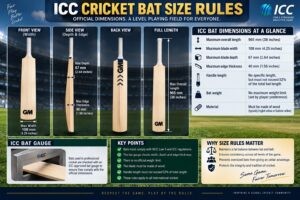
Why Cricket Bat Dimensions Matter
The size of a cricket bat directly influences how the game is played.
A larger bat offers:
- A bigger sweet spot
- Greater margin for error
- Increased power generation
- Enhanced boundary-hitting ability
Without regulations, manufacturers could continually increase bat size, making batting significantly easier and potentially disrupting the balance between bat and ball.
To prevent this, the MCC and ICC have established precise size limits that all bats must follow.
The Official ICC Cricket Bat Size Limits
According to current regulations, a cricket bat must not exceed the following dimensions:
| Component | Maximum Allowed Size |
|---|---|
| Total Length | 38 inches (965 mm) |
| Blade Width | 4.25 inches (108 mm) |
| Blade Depth | 2.64 inches (67 mm) |
| Edge Thickness | 1.56 inches (40 mm) |
These specifications are checked using official bat gauges during professional competitions.
Maximum Bat Length
The maximum permitted bat length is:
38 inches (96.5 cm or 965 mm).
This measurement includes:
- The blade
- The handle
- The grip
Most professional bats fall close to this limit because players seek maximum reach without sacrificing control.
See More:
Why Length Is Restricted
Longer bats could provide:
- Greater reach against fast bowling
- Additional leverage
- Increased hitting power
By restricting length, regulators ensure players compete on equal terms and maintain the traditional skill requirements of batting.
Maximum Blade Width
A cricket bat’s blade must not exceed:
4.25 inches (108 mm).
This rule limits the total striking area available to the batter.
The Importance of Width Regulation
A significantly wider bat would:
- Make edges less risky
- Increase scoring potential
- Reduce the need for precise shot-making
The 4.25-inch dimension has become one of cricket’s most recognizable equipment standards.
Maximum Blade Depth
Modern power bats feature incredibly thick profiles.
To control this trend, regulations specify a maximum blade depth of:
67 mm (2.64 inches).
Blade depth refers to the thickness of the bat from face to back.
This measurement became particularly important as manufacturers developed larger sweet spots and more aggressive modern profiles.
See More: How Willow Growth and Modern Technology Improve Cricket Bats?
Why Depth Restrictions Were Introduced
Advances in willow processing allowed manufacturers to produce bats with substantial wood behind the sweet spot.
This improved:
- Rebound
- Power
- Forgiveness on mishits
Eventually, concerns arose about the growing advantage given to batters, leading to formal depth restrictions.
Maximum Edge Thickness
One of the most discussed bat dimensions in modern cricket is edge thickness.
The legal maximum is:
40 mm (1.56 inches).
Prior to the introduction of edge limits, some bats featured extremely thick edges designed to maximize performance.
The Rise of Thick-Edge Bats
Over the last two decades, manufacturers increasingly promoted bats with:
- Massive edges
- Large spines
- Expanded sweet spots
Many of these bats greatly increased forgiveness on imperfect strikes.
To maintain balance, the MCC introduced a maximum edge thickness rule.
The Bat Gauge Test
Professional cricket uses a simple but effective method to verify bat legality.
Officials use a specialized ICC-approved bat gauge.
A legal bat must pass through the gauge without obstruction.
The device checks:
- Width
- Depth
- Edge thickness
If the bat fails the test, it cannot be used in the match.
Does the ICC Limit Bat Weight?
Interestingly, there is no official maximum bat weight under current cricket laws.
This surprises many players because dimensions are strictly controlled.
Instead, weight remains a matter of personal preference.
Typical Professional Bat Weights
Most adult cricket bats weigh:
Approximately 2.7 to 3.0 pounds (1.2 to 1.36 kg).
Some players prefer lighter bats for:
- Faster bat speed
- Better maneuverability
- Quick stroke play
Others choose heavier bats for:
- Increased momentum
- More power
- Stronger boundary hitting
Materials Allowed Under Cricket Laws
The blade of a cricket bat must be made of wood.
Traditionally, this means:
English Willow
The preferred material for professional cricket.
Advantages include:
- Superior ping
- Excellent balance
- Premium performance
Kashmir Willow
A popular alternative for recreational and club cricket.
Advantages include:
- Lower cost
- Greater durability
- Wider availability
Alternative blade materials such as aluminum, carbon fiber, or plastic are not permitted under the Laws of Cricket.
Junior Cricket Bat Sizes
While ICC regulations define maximum dimensions for adult cricket, junior players use smaller bats designed for their height and age.
Common junior bat sizes include:
| Bat Size | Typical Age |
|---|---|
| Size 0 | 4-5 Years |
| Size 1 | 5-6 Years |
| Size 2 | 6-8 Years |
| Size 3 | 8-9 Years |
| Size 4 | 9-10 Years |
| Size 5 | 10-11 Years |
| Size 6 | 11-13 Years |
| Harrow | 12-14 Years |
| Short Handle | Adults |
| Long Handle | Taller Adults |
These sizes help young players develop proper technique and bat control.
How Modern Bat Makers Maximize Performance Within the Rules
Today’s manufacturers operate within strict dimensional constraints.
As a result, innovation focuses on:
Profile Engineering
Redistributing willow to optimize balance.
Spine Design
Increasing wood concentration in the hitting zone.
Weight Distribution
Improving pickup while maintaining power.
Pressing Techniques
Enhancing sweet spot performance and durability.
Rather than increasing size, modern bat makers improve efficiency within legal limits.
Common Misconceptions About Bat Size
More Grains Mean Bigger Bat
False.
Grains affect willow appearance and characteristics but do not determine dimensions.
Bigger Edges Always Mean More Power
Not necessarily.
Bat balance, pressing, and pickup often influence performance more than edge size alone.
Heavier Bats Hit Further
Partially true.
While mass contributes to power, bat speed remains equally important.
Many modern players achieve exceptional power using relatively lightweight bats.
The Future of Bat Regulations
Cricket continues to evolve, and bat technology advances every year.
Manufacturers constantly seek:
- Larger sweet spots
- Better pickup
- Improved durability
- Enhanced power
Future law changes could occur if bat technology significantly alters the balance between bat and ball, but current ICC regulations continue to provide a framework that encourages innovation while preserving fairness.
Final Thoughts
The modern cricket bat is a remarkable piece of sporting equipment. While manufacturers continuously refine bat profiles, pressing techniques, and willow preparation methods, all bats used in professional cricket must remain within the strict dimensions established by the MCC and enforced by the ICC. A legal bat may be no longer than 38 inches, no wider than 4.25 inches, no deeper than 67 mm, and must not have edges thicker than 40 mm.
These regulations ensure that skill remains at the heart of cricket. Whether facing a 90 mph fast bowler or attempting to clear the boundary in a T20 match, players rely not only on technology but also on timing, technique, and decision-making. The bat may evolve, but the challenge of mastering it remains one of cricket’s greatest attractions.
See More: Cricket Bat Specifications — Materials, Dimensions, and ICC Rules