
Modern cricket bat design is a constant balancing act. Players want enormous edges, massive sweet spots, and plenty of power, yet they also want bats that feel light and easy to maneuver. Traditionally, these goals were difficult to achieve simultaneously. Adding more wood generally meant adding more weight.
To solve this problem, bat makers developed one of the most influential profile innovations in modern cricket: the duckbill profile.
Used by numerous professional and amateur cricketers around the world, the duckbill design redistributes willow in a way that creates the illusion of a lighter bat without significantly sacrificing power. By removing excess wood from the toe area and relocating volume toward the middle of the blade, manufacturers can produce bats with huge sweet spots and excellent pickup characteristics.
Understanding how duckbill profiles work helps explain why so many modern bats feel surprisingly light despite having large edges and substantial spines.
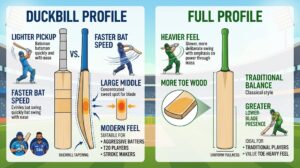
What Is a Duckbill Profile?
A duckbill profile refers to a bat shape in which the back of the blade tapers significantly toward the toe.
Viewed from the side, the lower section resembles the beak of a duck, giving the profile its name.
Simplified example:
Traditional Profile
==========
==========
==========
==========
==========
Duckbill Profile
==========
==========
========
======
====
==
Rather than carrying substantial wood all the way to the toe, the profile gradually removes material from the lower part of the bat.
Why Bat Makers Developed the Duckbill Design
Cricket bat buyers often want two things:
✅ A massive sweet spot
✅ A lightweight pickup
Historically, achieving both was difficult.
Large sweet spots required more wood.
More wood increased bat weight.
As modern cricket evolved, particularly with the rise of limited-overs formats, players began demanding bats that delivered explosive power while remaining easy to swing.
The duckbill profile emerged as a solution.
Understanding Pickup vs Actual Weight
Before discussing duckbill performance, it’s important to understand a crucial concept:
Actual Weight
The weight shown on a scale.
Pickup
How heavy or light the bat feels when swung.
The two are not always identical.
A bat weighing 2 lb 10 oz can feel lighter than a 2 lb 8 oz bat if its balance is superior.
The duckbill profile primarily affects pickup rather than simply reducing overall weight.
The Physics of Weight Distribution
A bat’s balance depends heavily on where its mass is located.
Weight positioned far from the hands contributes more strongly to perceived heaviness.
The toe sits at the greatest distance from the handle.
As a result:
Toe Weight Has a Major Impact
Even small amounts of wood added near the toe can make the bat feel noticeably heavier.
Conversely:
Removing Toe Weight Improves Pickup
This is the fundamental principle behind duckbill profiles.
How the Duckbill Profile Works
The duckbill shape intentionally removes wood from the lower section of the blade.
This achieves several goals:
Less Weight at the Furthest Point
The toe becomes lighter.
Improved Balance Point
The center of mass shifts upward.
Faster Bat Speed
The bat feels easier to accelerate.
Enhanced Maneuverability
Players can react more quickly.
Even if the scale weight remains relatively high, the bat often feels significantly lighter in the hands.
See More: Size 6 Cricket Bat
Preserving the Middle
The genius of duckbill design lies in what bat makers do with the removed willow.
Rather than simply reducing overall bat size, they redistribute wood toward the middle of the blade.
Benefits include:
✅ Large sweet spot
✅ Strong spine
✅ Powerful middle
✅ Excellent energy transfer
The player enjoys the advantages of a substantial hitting area without carrying unnecessary toe mass.
The Effect on Bat Speed
Bat speed is one of the most important factors in modern cricket.
A faster swing allows players to:
- React later
- Generate more power
- Play innovative shots
- Manipulate field placements
By reducing resistance during the swing, the duckbill profile often helps players generate higher bat speeds.
Especially in T20 cricket, this can be extremely valuable.
Why Power Hitters Like Duckbill Bats
Many people assume power hitters always prefer heavy bats.
This isn’t necessarily true.
Modern power hitters often seek:
- High bat speed
- Large sweet spots
- Efficient weight distribution
Duckbill designs provide exactly that combination.
The reduced toe weight allows players to swing aggressively without feeling burdened by excessive mass.
Benefits of Duckbill Profiles
Lighter Pickup
This is the biggest advantage.
Many duckbill bats feel significantly lighter than their actual weight.
Larger Sweet Spot
The redistributed wood helps maintain a powerful middle.
Players often experience:
✅ Improved timing
✅ Better rebound
✅ Greater forgiveness
Faster Hands
The bat becomes easier to maneuver.
Benefits include:
- Quicker reactions
- Better back-foot play
- Enhanced shot versatility
Improved Balance
The upward shift in mass creates a more comfortable balance point.
Many players immediately notice this characteristic.
Modern Playing Style Compatibility
Duckbill profiles suit:
- T20 cricket
- One-day cricket
- Aggressive batting
- Modern stroke play
Are There Any Downsides?
No bat design is perfect.
Duckbill bats also have limitations.
Potentially Less Toe Strength
Removing wood from the toe reduces mass in that area.
As a result:
- Toe durability may become more important
- Mishits low on the blade can feel different
This does not automatically mean weaker performance but may alter feel.
Different Balance Preference
Some traditional players prefer substantial toe presence.
These batters often enjoy:
- A weighted swing
- Greater momentum through the ball
For them, duckbill bats can sometimes feel too light.
Not Ideal for Everyone
Bat pickup is highly personal.
A profile that feels perfect for one player may feel unusual to another.
Testing remains important.
Duckbill vs Full Profile Bats
Duckbill Profile
Characteristics:
✅ Lighter pickup
✅ Faster bat speed
✅ Large middle
✅ Modern feel
Ideal for:
- Aggressive batters
- T20 players
- Stroke makers
Full Profile
Characteristics:
✅ More toe wood
✅ Heavier feel
✅ Traditional balance
✅ Greater lower-blade presence
Ideal for:
- Traditional players
- Power through momentum
- Preference for substantial pickup
Sweet Spot Placement in Duckbill Bats
Most duckbill bats feature:
Mid Sweet Spot
Excellent all-round versatility.
Mid-Low Sweet Spot
Popular for front-foot players.
The concentrated wood in these areas helps maximize energy transfer during impact.
Why Manufacturers Love Duckbill Designs
From a design perspective, duckbill profiles solve a major challenge.
They allow manufacturers to advertise:
✅ Bigger edges
✅ Larger spines
✅ Powerful middles
while still maintaining:
✅ Manageable pickup
✅ Good balance
✅ Comfortable swing weight
This combination has become extremely attractive to modern cricketers.
Professional Usage
Many modern professional players use bats featuring some variation of the duckbill profile.
The exact implementation varies between manufacturers, but the concept remains consistent:
Remove unnecessary toe mass while preserving performance in the sweet spot region.
This approach aligns perfectly with the demands of contemporary cricket.
Who Should Consider a Duckbill Bat?
Duckbill profiles are particularly suited to:
Stroke Makers
Players who value bat speed and timing.
T20 Batters
Those who rely on quick hands.
Academy Players
Cricketers transitioning toward modern bat shapes.
Players Wanting Bigger Profiles
Those who want large edges without excessive pickup.
Who Might Prefer Another Profile?
Some players may prefer more traditional profiles if they:
- Like weighted swings
- Value toe-heavy feel
- Prefer old-school bat balance
- Generate power through mass rather than speed
As always, personal preference matters.
The Biggest Myth About Duckbill Bats
A common misconception is:
“Duckbill bats are lighter because they contain less willow.”
This isn’t always true.
Many duckbill bats weigh the same as traditional models.
The difference lies in where the willow is located, not necessarily how much exists.
That distinction is what makes the profile so effective.
Final Thoughts
The duckbill profile represents one of the most successful innovations in modern cricket bat design. By strategically removing willow from the toe and redistributing it toward the middle of the blade, manufacturers create bats that feel lighter, swing faster, and remain incredibly powerful through the sweet spot. The result is a profile that combines massive middles and substantial edges with excellent pickup, giving players the best of both worlds.
For modern batters, particularly those who value fast hands and aggressive stroke play, duckbill profiles offer a compelling balance of power and maneuverability. While traditional players may still prefer fuller profiles with more toe presence, the duckbill design has proven that intelligent weight distribution can achieve what simple weight reduction cannot. Ultimately, the success of the duckbill profile demonstrates a key principle of bat making: it’s not just how much willow is in the bat that matters, but where that willow is placed.
See More: Size 7 Cricket Bat