
One of the most common questions from parents and junior cricketers is whether there is a Size 7 cricket bat. The answer is simple:
No, there is no officially recognized Size 7 cricket bat in standard cricket bat sizing.
The traditional progression used by most manufacturers is:
- Size 0
- Size 1
- Size 2
- Size 3
- Size 4
- Size 5
- Size 6
- Harrow
- Short Handle (SH)
- Long Handle (LH)
After a player outgrows a Size 6 bat, the next step is typically a Harrow bat, not a Size 7.
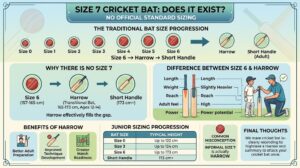
Why There Is No Size 7
The Harrow bat effectively fills the gap between junior and adult cricket bats.
Manufacturers developed the Harrow size to help young players transition gradually toward adult equipment without jumping straight from a junior bat to a full-sized Short Handle bat.
As a result:
Size 6
   ↓
Harrow
   ↓
Short Handle
A Size 7 category was never needed because the Harrow already serves that purpose.
What Is a Harrow Bat?
A Harrow bat is a transitional cricket bat designed for older juniors and academy players.
It is generally suitable for:
✅ Players aged 12-14 years
✅ Height between 165 cm and 173 cm
✅ School first-team players
✅ Academy cricketers
✅ Junior representative players
The Harrow bat feels much closer to an adult bat than a Size 6.
Difference Between Size 6 and Harrow
| Feature | Size 6 | Harrow |
|---|---|---|
| Typical Age | 11-13 Years | 12-14 Years |
| Height | 157-165 cm | 165-173 cm |
| Length | Smaller | Larger |
| Weight | Lighter | Slightly Heavier |
| Reach | Very Good | Better |
| Adult Feel | Moderate | High |
| Power Potential | Good | Better |
Many players mistakenly call a Harrow bat a “Size 7,” but this is not an official sizing category.
See More: Size 6 cricket bat
Why Harrow Is Better Than a Hypothetical Size 7
The Harrow size gives players:
Better Adult Preparation
It closely resembles the pickup and feel of senior bats.
Improved Technique Development
Young players learn to handle a larger blade without the challenge of a full adult bat.
Greater Match Readiness
The bat prepares players for:
- School first XI cricket
- Senior club cricket
- Academy competition
When Should a Player Move From Size 6 to Harrow?
A player may be ready when:
✅ Height exceeds approximately 165 cm
✅ The Size 6 bat feels noticeably short
✅ Reach becomes limited
✅ Strength and coordination improve
✅ Coaches recommend moving up
The move should be based primarily on height and comfort rather than age alone.
Harrow vs Short Handle
Many ambitious juniors want to skip straight to an adult bat.
This often creates problems.
Moving Too Early Can Cause:
- Reduced bat speed
- Poor timing
- Fatigue
- Technical flaws
- Loss of confidence
For many academy players, a Harrow bat provides a much smoother transition.
Common Misconception
A common myth is:
“Size 7 is the bat after Size 6.”
In reality:
The official progression goes from Size 6 directly to Harrow.
Some retailers may informally refer to Harrow as a “Size 7” for simplicity, but this is not part of the standard cricket bat sizing system.
Junior Sizing Progression
| Bat Size | Typical Height |
|---|---|
| Size 0 | Up to 122 cm |
| Size 1 | 122-130 cm |
| Size 2 | 130-137 cm |
| Size 3 | 137-145 cm |
| Size 4 | 145-150 cm |
| Size 5 | 150-157 cm |
| Size 6 | 157-165 cm |
| Harrow | 165-173 cm |
| Short Handle | 173 cm+ |
Final Thoughts
There is no official Size 7 cricket bat in the standard cricket bat sizing system. Once a player outgrows a Size 6, the next step is usually a Harrow bat, which bridges the gap between junior and adult equipment. Harrow bats offer greater reach, more power, and a more adult-like feel while remaining manageable for developing players. For most academy and school cricketers, the transition from Size 6 to Harrow provides the ideal pathway toward full-sized adult bats and competitive senior cricket.
See More: Size 6 Cricket Bat