
Modern cricket bat manufacturing is all about solving one challenge: how do you create a bat with a huge sweet spot and powerful profile without making it feel excessively heavy?
For years, bat makers faced a difficult compromise. Players wanted massive edges, large middles, and explosive power, but they also wanted quick hands and comfortable pickup. Traditionally, adding more willow meant adding more weight.
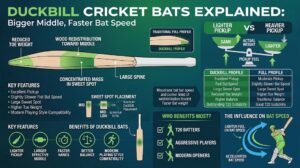
The solution came in the form of the duckbill profile, one of the most influential innovations in modern bat design. By strategically removing wood from the lower toe area and redistributing it toward the middle of the blade, manufacturers created bats that feel lighter in the hands while maintaining exceptional power through the hitting zone.
Today, duckbill profiles are found in numerous professional and club-level bats because they offer an ideal balance of pickup, maneuverability, and performance.
What Is a Duckbill Profile?
A duckbill profile refers to a bat shape where the back of the blade tapers significantly toward the toe.
When viewed from the side, the profile resembles the bill of a duck, which is how the design got its name.
Instead of carrying a large amount of willow all the way to the bottom of the blade, the profile gradually removes material from the toe area while maintaining a thick middle and spine.
The result is a bat that often appears powerful but feels surprisingly light when picked up.
Why Bat Makers Developed the Duckbill Design
Cricketers constantly ask for three things:
✅ Bigger sweet spots
✅ More power
✅ Lighter pickup
The challenge is that those goals naturally conflict with each other.
A larger sweet spot requires more willow.
More willow increases overall weight.
Increased weight can reduce bat speed and maneuverability.
The duckbill profile addresses this issue by moving wood to the areas where it’s most valuable while removing unnecessary mass from the areas where it contributes less to performance.
Understanding Pickup vs Actual Weight
To understand why duckbill bats are effective, it’s important to distinguish between weight and pickup.
Actual Weight
The weight measured on a scale.
Pickup
How heavy or light a bat feels when swung.
Two bats can weigh the same yet feel completely different during use.
For example:
- Bat A = 2 lb 9 oz
- Bat B = 2 lb 9 oz
Despite identical scale weights, one bat may feel noticeably lighter due to superior weight distribution.
Duckbill profiles are primarily designed to improve pickup rather than simply reduce total weight.
Why Toe Weight Matters
The toe sits furthest away from the player’s hands.
Because of this, weight placed in the toe has a significant effect on perceived heaviness.
Think of holding a hammer:
- Hold it near the hammerhead and it feels light.
- Hold it by the handle and it feels much heavier.
The same principle applies to cricket bats.
A small amount of weight removed from the toe often creates a much bigger change in pickup than removing the same amount of willow elsewhere.
See More:
The Science Behind the Duckbill Shape
The duckbill profile works through strategic weight redistribution.
Instead of maintaining a thick toe section, manufacturers:
- Remove excess willow from the bottom.
- Shift wood toward the middle.
- Preserve spine volume.
- Retain sweet spot size.
This creates several performance benefits:
✅ Less toe-heavy feel
✅ Faster bat acceleration
✅ Improved balance
✅ Better maneuverability
✅ Strong middle performance
The bat effectively “feels lighter” without sacrificing much power.
How Duckbill Profiles Preserve Power
Many players assume removing willow equals reduced performance.
However, duckbill designs don’t simply remove wood.
They relocate it.
Most of the willow removed from the toe is compensated for by maintaining:
- Thicker middles
- Larger spines
- Substantial sweet spots
Because most shots are struck in the middle region rather than on the extreme toe, concentrating mass in the primary hitting area often improves efficiency.
This is why many duckbill bats remain extremely powerful despite their lighter pickup.
The Influence on Bat Speed
Bat speed plays a major role in modern cricket.
Fast bat speed helps players:
- React later
- Generate power
- Play innovative shots
- Handle pace bowling
- Clear boundaries
A bat that feels lighter during the swing often allows players to accelerate more quickly.
Duckbill bats excel in this area because the reduced toe mass creates less resistance throughout the swing.
This characteristic has made the design particularly popular in T20 cricket.
Why Modern T20 Players Like Duckbill Profiles
T20 cricket demands aggressive batting.
Players often need to:
- Access all areas of the ground
- Generate quick bat speed
- Play unconventional strokes
- Score rapidly
Duckbill profiles support these requirements by providing:
✅ Faster swing speed
✅ Better handling
✅ Large sweet spots
✅ Strong hitting zones
✅ Easier maneuverability
The combination of power and responsiveness makes them attractive for aggressive stroke players.
Advantages of a Duckbill Cricket Bat
Lighter Pickup
The biggest benefit is improved pickup.
Most players notice that a duckbill bat feels lighter than expected when they first lift it.
Larger Effective Middle
The profile retains substantial wood in the most important hitting zone.
Benefits include:
- Excellent rebound
- Strong sweet spot
- Consistent performance
Faster Hands
Quick bat movement helps players:
- Handle fast bowling
- Play late
- Adjust during the downswing
This improves versatility.
Better Balance
The upward shift in mass generally produces a more comfortable balance point.
Many batsmen find this makes the bat easier to control.
Modern Playing Style Compatibility
Duckbill bats work particularly well for:
- T20 batters
- One-day players
- Aggressive openers
- Dynamic middle-order players
Potential Drawbacks
Although duckbill profiles are popular, they may not suit everyone.
Reduced Toe Presence
Players who frequently strike the ball very low on the blade may prefer more wood in the toe area.
Different Swing Feel
Traditional cricketers sometimes prefer heavier pickup because it creates a more substantial sensation through the shot.
Adjustment Period
Players moving from full-profile bats occasionally need time to adapt to the lighter feel.
Duckbill vs Traditional Full Profiles
| Feature | Duckbill Profile | Full Profile |
|---|---|---|
| Pickup | Excellent | Moderate |
| Bat Speed | Fast | Slightly Slower |
| Sweet Spot | Large | Large |
| Toe Weight | Reduced | Higher |
| Balance | High | Traditional |
| Maneuverability | Excellent | Good |
| Power Potential | Excellent | Excellent |
| T20 Suitability | Outstanding | Good |
Both designs can perform exceptionally well, but they prioritize different aspects of batting.
Sweet Spot Placement in Duckbill Bats
Most duckbill bats feature either:
Mid Sweet Spot
Ideal for all-format players.
Mid-Low Sweet Spot
Popular among front-foot players and power hitters.
Because additional wood is concentrated around these zones, energy transfer remains extremely efficient.
Who Should Use a Duckbill Bat?
Duckbill profiles are particularly suited to:
T20 Batters
Players seeking maximum bat speed.
Aggressive Stroke Makers
Those who value quick hands and fast scoring.
Modern Openers
Batters looking to combine power with maneuverability.
Club Cricketers
Players wanting a large profile without excessive pickup.
Who Might Prefer a Full Profile Bat?
Traditional batters may prefer full profiles if they:
- Like substantial pickup
- Value toe weight
- Prefer a heavier swing feel
- Generate power through momentum
Personal preference remains an important factor.
The Biggest Myth About Duckbill Bats
One common misconception is:
“Duckbill bats are lighter because they contain less willow.”
This is not necessarily true.
Many duckbill bats weigh the same as comparable traditional bats.
The difference lies in where the willow is positioned, not simply how much willow is present.
This intelligent weight distribution is what creates the characteristic lighter pickup.
Final Thoughts
The duckbill profile is one of the most successful developments in modern cricket bat manufacturing. By reducing weight in the toe area and concentrating willow in the middle of the blade, manufacturers have created bats that feel lighter, swing faster, and retain powerful sweet spots. The design allows players to enjoy the best of both worlds: a massive middle for confident shot-making and a comfortable pickup that enhances bat speed and maneuverability.
For modern cricketers, particularly those playing limited-overs formats, the duckbill profile offers a compelling combination of balance, power, and responsiveness. While traditional full-profile bats still have their place, the popularity of duckbill designs shows how intelligent engineering can transform the way a cricket bat feels without sacrificing the performance players demand.
See More: Wet English Willow Cricket Bat: Risks and Prevention