
Walk into a cricket store today, and you will often see bats displaying beautifully straight grains running from shoulder to toe. For decades, visible grain count has been associated with quality, and many players instinctively assume that more grains automatically indicate better willow. This perception has become so powerful that some manufacturers have begun using modern technologies to enhance the appearance of bat faces.
One of the most discussed developments in recent years is the use of laser graining, sometimes referred to as laser-grain or laser-engraved grain effects, where artificial grain lines are added to the bat face to create the appearance of premium willow. While these bats may still be perfectly usable cricket bats, they raise important questions about transparency, value, and how players evaluate quality.
Understanding how laser-grained bats are produced can help buyers make informed decisions and avoid paying premium prices for cosmetic enhancements.
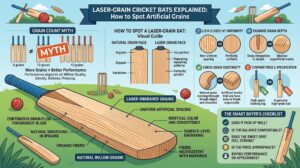
Why Grain Count Matters to Players
Before examining laser graining, it’s important to understand why bat grains attract so much attention.
The visible lines on a cricket bat are growth rings from the willow tree.
Traditionally, players have used grain appearance as one indicator of willow quality.
A bat with:
- Straight grains
- Even spacing
- Consistent appearance
often creates a strong first impression.
Many buyers associate higher grain counts with:
✅ Premium willow
✅ Better performance
✅ Professional quality
✅ Greater value
However, grain count alone has never guaranteed performance.
The Grain Count Myth
One of the biggest misconceptions in cricket equipment is:
More grains automatically mean a better bat.
In reality, performance depends on many factors:
- Willow density
- Pressing quality
- Moisture content
- Balance
- Pickup
- Profile design
- Bat preparation
Some outstanding bats have six grains.
Others may have twelve or more.
The bat’s performance comes from the overall quality of the willow rather than grain count alone.
What Is Laser Graining?
Laser graining is a manufacturing process in which laser technology is used to create grain-like markings on the face of a cricket bat.
These markings are designed to imitate the appearance of naturally occurring willow grains.
The process can:
- Add additional visible grain lines
- Enhance faint grain patterns
- Improve visual uniformity
- Create a premium cosmetic appearance
To inexperienced buyers, the bat may appear similar to naturally high-grained willow.
Why Manufacturers Use Laser Graining
The answer is simple:
Consumer Demand
Many players judge bats based on appearance before ever picking them up.
As a result, cosmetic presentation can influence purchasing decisions.
Manufacturers may use laser graining to:
✅ Improve shelf appeal
✅ Enhance lower-grade willow appearance
✅ Create visual consistency
✅ Meet customer expectations
The practice is largely driven by market demand for attractive-looking bats.
How Laser Graining Works
Modern laser systems can lightly mark the face of the willow.
The process creates thin vertical lines intended to resemble natural grain structure.
Effects may include:
- Darker visual grain definition
- Additional grain-like markings
- More uniform appearance
Importantly:
The laser affects appearance rather than fundamentally changing the willow itself.
The process does not automatically improve performance.
Does Laser Graining Improve Bat Performance?
The simple answer is:
No
Laser graining is primarily cosmetic.
It does not:
❌ Increase sweet spot size
❌ Improve ping
❌ Enhance balance
❌ Create more power
❌ Increase durability
The bat will still perform according to:
- Willow quality
- Pressing
- Construction
- Profile design
A laser-grained bat may look premium, but appearance and performance remain separate issues.
Why Buyers Can Be Misled
The challenge arises when visual appearance influences pricing.
Many buyers assume:
- More grains equals higher-grade willow.
- Higher grade willow equals a better bat.
- Better-looking bat equals better value.
Laser graining can strengthen those assumptions.
As a result:
Some players may pay premium prices based on cosmetics rather than actual performance characteristics.
Natural Grains vs Laser Grains
Understanding the differences helps buyers make informed decisions.
Natural Willow Grains
Natural grains generally:
✅ Flow continuously through the blade
✅ Display subtle variation
✅ Have organic spacing
✅ Change slightly in width
✅ Follow the willow’s natural structure
Natural grain patterns rarely appear perfectly identical.
Laser-Generated Grain Effects
Laser-created grain lines may show:
⚠ Extremely consistent spacing
⚠ Repetitive appearance
⚠ Uniform darkness
⚠ Less natural variation
⚠ Cosmetic symmetry
While these characteristics are not always obvious, experienced buyers can often identify them.
How to Spot a Laser-Grain Bat
Look Closely at Grain Uniformity
Natural willow contains subtle imperfections.
If every grain appears:
- Perfectly straight
- Equally spaced
- Identically colored
further inspection may be worthwhile.
Nature is rarely perfect.
Examine Grain Depth
Natural grains are part of the wood itself.
Laser markings may appear more superficial.
Under certain lighting conditions, the markings can seem to sit on the surface rather than emerge naturally from the willow.
Check Grain Continuity
Natural grains generally continue consistently through visible areas of the blade.
Artificial effects may occasionally appear less organic in transition zones.
Compare Price and Specification
A bat marketed as:
- Elite grade
- Professional specification
- Extremely high grain count
while being unusually inexpensive should encourage caution.
The overall package should make sense.
Evaluate the Entire Bat
Never judge a bat solely on grain count.
Instead, assess:
✅ Pickup
✅ Balance
✅ Feel
✅ Weight distribution
✅ Sweet spot responsiveness
Performance matters more than appearance.
Why Some Laser-Grain Bats Perform Well
An important point is that laser graining does not automatically mean the bat is poor quality.
Some laser-grained bats may:
- Perform very well
- Offer excellent value
- Contain quality willow
The issue is not necessarily the technology itself.
The concern arises when cosmetic enhancements are mistaken for genuine indicators of premium willow.
The Role of Bat Grading
Traditional grading systems consider:
- Grain appearance
- Color consistency
- Cosmetic blemishes
- Visual presentation
Laser graining can make lower-grade willow appear more attractive.
However:
Professional players rarely choose bats based solely on appearance.
Most prioritize:
- Pickup
- Performance
- Confidence
- Balance
These characteristics remain far more important.
How Professional Bat Makers View Grain Count
Experienced bat makers often evaluate:
Density
How compact the willow fibers are.
Pressing Response
How the willow behaves during preparation.
Pickup
How the bat feels during use.
Performance Potential
How efficiently the sweet spot transfers energy.
These characteristics often matter more than grain aesthetics alone.
Should Buyers Avoid Laser-Grained Bats?
Not necessarily.
A laser-grained bat can still be:
✅ Well made
✅ Durable
✅ Excellent value
✅ High performing
The key is understanding what you’re buying.
If the bat performs well and the price is fair, cosmetic enhancement may not matter.
Problems only arise when appearance drives unrealistic pricing or expectations.
The Smart Buyer’s Checklist
Before buying any cricket bat, ask:
Does It Pick Up Well?
Pickup influences performance more than grain count.
Is the Balance Comfortable?
A balanced bat inspires confidence.
Does the Sweet Spot Feel Strong?
Bat response matters more than visuals.
Is the Price Appropriate?
Don’t pay solely for cosmetic appeal.
Are You Buying Performance or Appearance?
This simple question often prevents poor purchasing decisions.
The Future of Cricket Bat Cosmetics
As manufacturing technology advances, aesthetic enhancement techniques will likely become more sophisticated.
Future developments may include:
- Enhanced laser technologies
- Surface treatments
- Visual grain enhancement systems
- Cosmetic customization
These innovations may improve presentation, but they will not replace the fundamentals of quality bat making.
Performance will always depend on the willow itself.
Final Thoughts
The rise of laser-grain cricket bats highlights how modern manufacturing increasingly blends technology with consumer expectations. By using laser engraving techniques to mimic the appearance of premium grain structures, manufacturers can make lower-grade willow look more visually appealing. While this may improve shelf appeal and marketing potential, it does not automatically improve the bat’s performance, durability, or overall quality.
For buyers, the most important lesson is to look beyond appearance. Grain count and visual perfection may attract attention, but pickup, balance, pressing quality, sweet spot performance, and overall feel remain far more important indicators of a great cricket bat. A beautifully laser-grained bat may perform wonderfully, and a cosmetically imperfect bat may outperform it. Ultimately, the best bat is not the one with the most attractive face, but the one that feels right in your hands and delivers when the ball meets the middle. 🏏
See More: Duckbill Cricket Bats