
Modern cricket bat manufacturing involves countless variables, but one of the most important and least understood is how the willow is dried before becoming a bat. Long before a bat receives its stickers, handle, or finishing touches, the willow must lose a significant amount of moisture. The method used to achieve this can influence how the bat feels, performs, and ages over time.
The two primary approaches are kiln drying and air drying. Both methods aim to reduce moisture in the willow, but they do so in very different ways. Some players believe air-dried bats offer superior feel and longevity, while others argue that modern kiln-drying technology delivers excellent consistency without compromising performance.
So does the drying method affect a bat’s ping? Can moisture retention influence durability? And is one approach actually better than the other?
Let’s examine the science behind both processes.
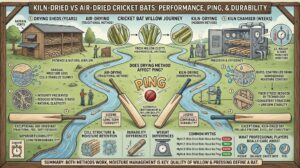
Why Cricket Bat Willow Must Be Dried
Freshly harvested willow contains a large amount of water.
Immediately after cutting, the wood is:
- Too heavy
- Too soft
- Structurally unstable
- Unsuitable for bat making
Before a bat can be shaped and pressed, the willow must reach an appropriate moisture level. If excess moisture remains:
- Weight increases
- Performance suffers
- Cracking risks rise
- Pressing becomes less effective
Proper drying creates the balance needed for both durability and rebound performance.
What Is Air Drying?
Air drying is the traditional approach.
After cutting, willow clefts are stored in carefully controlled environments where moisture gradually leaves the wood over an extended period.
The process relies on:
- Natural airflow
- Ambient conditions
- Gradual moisture reduction
Because the process occurs slowly, moisture leaves the willow in a more natural manner.
For generations, many craftsmen regarded air drying as the gold standard.
How Air Drying Works
The clefts are placed in drying sheds or storage areas with controlled ventilation.
Over time:
Fresh Willow
      ↓
Gradual Moisture Loss
      ↓
Moisture Equalization
      ↓
Stable Willow
The key characteristic is patience.
Moisture exits slowly rather than being forced out.
What Is Kiln Drying?
Kiln drying uses specialized drying chambers.
Inside a kiln, manufacturers carefully control:
- Temperature
- Humidity
- Air circulation
The objective is to remove moisture much faster than traditional air drying.
Modern willow suppliers commonly use kiln drying because it allows better consistency and production scheduling. Proper moisture control through kiln drying is a critical part of preparing cricket bat clefts. J.S. Wright & Sons, one of the largest English willow suppliers, dries its clefts in kilns and monitors moisture carefully during the process.
Why Manufacturers Prefer Kiln Drying
Modern cricket bat demand is enormous.
Manufacturers require:
✅ Predictable production
✅ Consistent moisture control
✅ Reliable inventory management
✅ Reduced drying times
Kiln drying helps achieve all of these goals.
Instead of waiting extended periods for natural drying, manufacturers can achieve target moisture levels under controlled conditions.
See More: Matrix vs Chevron vs Octopus Cricket Grips Compared
Does Drying Method Affect Ping?
This is the question that interests most players.
The short answer is:
Yes, but not always in the way people think.
The “ping” of a cricket bat depends on several factors:
- Willow quality
- Density
- Pressing
- Moisture content
- Profile
- Preparation
Drying method influences some of these variables.
However, drying alone does not determine whether a bat will perform exceptionally.
Air-Dried Willow and Ping
Supporters of air drying argue that gradual moisture removal helps preserve the natural structure of the willow fibers.
Potential advantages may include:
✅ Natural fiber integrity
✅ Consistent rebound characteristics
✅ Traditional feel
✅ Excellent feedback
Many bat enthusiasts believe air-dried willow produces a softer and more responsive sensation during impact.
Kiln-Dried Willow and Ping
Modern kiln drying has improved dramatically.
High-quality kiln drying aims to achieve:
✅ Uniform moisture content
✅ Consistent preparation
✅ Stable performance
✅ Reliable pressing response
When performed correctly, many players cannot distinguish between kiln-dried and air-dried willow purely from performance.
The quality of the drying process matters more than the drying method itself.
Cell Structure and Moisture Retention
To understand the debate, it helps to look at willow on a microscopic level.
Wood consists of countless cells and fibers.
These cells naturally contain moisture.
Drying changes:
- Cell moisture content
- Fiber stability
- Internal stresses
The goal is to reach an ideal moisture level without damaging the structure.
This balance directly affects how the willow responds when struck by a cricket ball.
The Air-Drying Argument
Advocates of air drying often claim the process:
- Preserves cell structure better
- Reduces internal stress
- Produces more natural elasticity
The theory is that gradual drying allows fibers to adapt slowly.
This may result in:
✅ Excellent feel
✅ Good responsiveness
✅ Long-term stability
However, actual performance still depends heavily on the quality of the willow itself.
The Kiln-Drying Argument
Supporters of kiln drying highlight modern technology.
Advanced systems allow manufacturers to:
- Monitor moisture precisely
- Maintain consistency
- Reduce variability
High-quality kiln drying minimizes many of the risks associated with rapid moisture removal.
As a result, modern kiln-dried bats can perform at an extremely high level.
Which Method Produces Better Ping?
There is no universal winner.
In practice:
Exceptional Air-Dried Bat
May outperform an average kiln-dried bat.
Exceptional Kiln-Dried Bat
May outperform an average air-dried bat.
Factors such as:
- Willow quality
- Density
- Pressing
- Finishing
usually play a bigger role than drying method alone.
Durability Differences
Durability is where the discussion becomes particularly interesting.
Air-Dried Willow
Advantages often cited include:
✅ Reduced internal stress
✅ Gradual stabilization
✅ Long-term consistency
Some craftsmen believe slow drying contributes to longevity.
Kiln-Dried Willow
Advantages include:
✅ Uniform moisture control
✅ Consistent preparation
✅ Predictable manufacturing results
When moisture is properly managed, durability can be excellent.
What Happens If Willow Is Dried Incorrectly?
Problems emerge when either method is poorly executed.
Potential issues include:
Over-Drying
Can result in:
- Brittle fibers
- Reduced durability
- Increased cracking risk
Uneven Drying
Can lead to:
- Moisture pockets
- Structural instability
- Performance inconsistency
The real enemy is poor moisture management, not necessarily the drying method itself.
Weight Differences
Moisture plays a significant role in overall bat weight.
More moisture generally means:
- Heavier pickup
- Reduced maneuverability
Less moisture often creates:
- Better pickup
- Faster bat speed
Successful drying seeks the ideal balance.
A bat that is excessively dry may become vulnerable, while a bat retaining too much moisture may feel sluggish.
Why Moisture Control Matters So Much
Professional suppliers place enormous emphasis on moisture management because moisture directly influences:
✅ Weight
✅ Durability
✅ Performance
✅ Stability
J.S. Wright & Sons notes that improper moisture control can result in clefts that are either too heavy or too light and potentially prone to breakage.
What Professional Players Really Care About
Most elite players rarely ask:
“Was this bat kiln-dried or air-dried?”
Instead, they focus on:
- Pickup
- Balance
- Sweet spot
- Feel
- Performance
These characteristics matter far more during actual match play.
Common Myths About Bat Drying
Myth 1: Air-Dried Always Means Better
Not necessarily.
Poor-quality air drying can still produce weak willow.
Myth 2: Kiln-Dried Bats Have No Ping
False.
Many professional bats use kiln-dried willow and perform exceptionally well.
Myth 3: Drying Method Is the Most Important Factor
False.
Willow quality and pressing usually have a greater impact.
Myth 4: Moisture Doesn’t Matter
False.
Moisture management is one of the most important aspects of cricket bat production.
Final Verdict
The debate between kiln-dried and air-dried cricket bats is often more nuanced than many players realize. Air drying offers a traditional, gradual approach that many craftsmen believe helps preserve the natural characteristics of willow, while modern kiln drying provides consistency, efficiency, and precise moisture control. Both methods can produce excellent cricket bats when executed properly.
Ultimately, the biggest determinants of performance remain the quality of the willow, the pressing process, the bat’s profile, and overall craftsmanship. While drying method influences moisture retention, structural stability, and potentially the feel of a bat, it is rarely the sole factor responsible for exceptional ping or durability. For most players, a well-made bat from quality willow will outperform a poorly prepared bat regardless of whether the wood was air-dried or kiln-dried. The real key is not how the moisture leaves the willow, but how carefully the entire bat is prepared before it reaches the crease.
See More: Where Does Cricket Bat Willow Come From?