
Every time a batter walks to the crease with a brand-new cricket bat, there is a good chance that the willow in that bat began its journey in the English countryside. While brands such as MRF, SG, SS, Gray-Nicolls, Gunn & Moore, Kookaburra, DSC, CA, and New Balance compete fiercely for customers, many of them rely on a surprisingly small number of suppliers for the most important ingredient of all: English cricket bat willow.
At the center of this supply chain sits J.S. Wright & Sons, an Essex-based company widely regarded as one of the world’s largest and oldest suppliers of English cricket bat willow. Founded in 1894, the family-run business processes willow for cricket bat manufacturers around the globe.
For many cricket fans, the logo on the front of the bat tells the story. In reality, the story often starts decades earlier in a willow plantation in England.
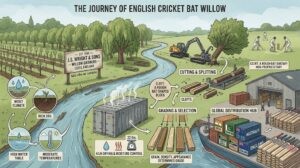
The Wood Behind Cricket’s Most Important Tool
Not all willow is suitable for making cricket bats.
Professional cricket bats are traditionally produced from a specific variety known as:
Salix alba var. caerulea
Commonly referred to as English cricket bat willow. This willow is prized because it combines:
- Low weight
- High resilience
- Excellent shock absorption
- Strong rebound characteristics
These properties make it uniquely suited to striking a cricket ball repeatedly at high speed.
Why England Produces the Best Cricket Bat Willow
Although cricket is played across the world, the most sought-after willow still comes from England.
The country’s combination of:
- Moist climate
- Rich soil
- High water tables
- Moderate temperatures
creates ideal growing conditions for cricket bat willow. According to industry sources, Essex has long been considered one of the major centers of willow cultivation, though trees are grown across England and Wales.
This natural advantage is difficult to replicate elsewhere.
Meet J.S. Wright & Sons
Located near Great Leighs in Essex, J.S. Wright & Sons has been involved in willow production since 1894 and remains one of the most influential businesses in the cricket bat industry. The company purchases standing trees, harvests them, processes them into clefts, dries them, grades them, and supplies bat makers worldwide.
While many cricketers may never have heard of the company, bat manufacturers certainly have.
In many ways, Wright’s operates behind the scenes, supplying the raw material that eventually becomes bats used from local club grounds to international stadiums.
Why Some Call It a Monopoly
Within cricket equipment circles, J.S. Wright & Sons is often viewed as the dominant force in English willow supply.
The reason is simple:
The company operates at an enormous scale and supplies willow to manufacturers across multiple countries. Its long-established relationships with growers and bat makers have helped position it as one of the most influential companies in the industry.
Although other suppliers exist, Wright’s scale and global reach mean its influence extends throughout the cricket bat market.
From Tree to Bat: The Willow Journey
Most cricket lovers see only the finished product.
The real journey is far longer.
Step 1: Growing the Willow
A cricket bat begins as a young willow sapling planted in carefully managed English farmland.
Growing a suitable tree requires patience.
According to industry sources, cricket bat willow typically takes around 15 to 20 years to reach harvesting maturity.
During this period, farmers must:
- Monitor growth
- Control disease
- Manage spacing
- Protect young trees
A single tree represents years of investment before producing any return.
Step 2: Harvesting
When the tree reaches sufficient size, specialist contractors fell it.
The harvested log is transported to processing facilities where it is inspected and prepared.
At this point, the wood still resembles an ordinary log.
The transformation into a cricket bat is only beginning.
Step 3: Cutting the Log
After arriving at the yard, the trunk is cross-cut into manageable sections.
These pieces are then split into rough bat-shaped blocks known as:
Clefts
A cleft forms the blade of a future cricket bat.
According to J.S. Wright & Sons, an average tree can produce roughly 38 to 40 clefts.
Step 4: Drying the Willow
Perhaps the most important stage in the process is drying.
Freshly cut willow contains substantial moisture.
A newly cut cleft may weigh up to 22 pounds before drying. During kiln drying, it loses more than half that weight.
If moisture is not controlled properly:
- Cracks may develop
- Performance suffers
- Structural stability declines
This is why moisture management remains one of the industry’s most closely guarded processes.
Step 5: Grading
After drying, the clefts are graded.
Factors considered include:
- Grain structure
- Cosmetic appearance
- Density
- Color
- Consistency
This grading process influences how the finished bat may be marketed, although cosmetics do not necessarily determine performance.
Step 6: Exporting Worldwide
Once prepared, the clefts are sold to bat manufacturers across the world.
This is where the global supply chain becomes fascinating.
The willow itself may come from Essex, but the finished bat may ultimately be sold in:
- India
- Pakistan
- Australia
- South Africa
- New Zealand
- England
and many other cricket-playing countries.
Why India and Pakistan Matter So Much
Modern demand for cricket bats is increasingly driven by South Asia.
Industry reports indicate that a large proportion of English willow products are exported to India and Pakistan, where cricket participation continues to grow rapidly.
As more players purchase their own equipment and cricket participation expands, demand for quality willow continues to rise.
The result is that willow grown in English fields often ends up in bats sold thousands of miles away.
How Global Brands Depend on English Willow
Many famous bat brands compete fiercely in the marketplace.
Their bats feature different:
- Stickers
- Profiles
- Pressing techniques
- Handle constructions
- Weight distributions
Yet many begin with English willow sourced from the same region.
Once the clefts leave suppliers such as J.S. Wright & Sons, manufacturers shape, press, finish, and brand the bats according to their own specifications.
This means two bats made from willow originating from the same supplier can feel completely different after manufacturing.
Why English Willow Remains the Gold Standard
Alternative materials and willow sources exist, including Kashmir willow.
However, English willow continues to dominate the premium market because of its unique blend of:
✅ Lightness
✅ Strength
✅ Rebound
✅ Workability
✅ Performance consistency
These characteristics explain why professional cricketers overwhelmingly continue to choose English willow bats.
The Challenge of Meeting Future Demand
The cricket bat industry faces a unique challenge.
Demand can increase rapidly.
Supply cannot.
A willow tree requires up to two decades to mature.
This means producers must plan years before demand materializes.
Planting decisions made today may not influence the market for another fifteen to twenty years.
Few sporting industries operate on such a timeline.
Not All Willow Becomes Premium Bats
Another often-overlooked reality is that only a fraction of harvested willow becomes top-grade bat material.
Different sections of each tree may be suitable for:
- Grade 1 willow
- Lower-grade cricket bats
- Training bats
- Other wood products
Careful selection is essential throughout the process.
Why Most Players Never See This Industry
When purchasing a cricket bat, players typically focus on:
- Brand
- Weight
- Profile
- Stickers
- Professional endorsements
Very few think about:
- Willow farming
- Harvesting
- Drying
- Timber processing
- Global supply chains
Yet without these stages, no cricket bat would exist.
The sport depends on a network of growers, harvesters, processors, and suppliers working years in advance.
Final Thoughts
When people ask where cricket bat willow comes from, the answer often leads back to the fields of England and the specialist companies that have spent generations cultivating, harvesting, and processing cricket bat willow. Among them, J.S. Wright & Sons stands as one of the most influential names in the industry, supplying English willow to bat makers around the world and helping form the foundation of countless cricket brands.
The journey from Essex farmland to a professional cricket bat is remarkably complex. A tree may spend 15 to 20 years growing before it is harvested, processed into clefts, dried, graded, and exported to manufacturers worldwide. By the time a finished bat reaches a player, it represents decades of planning, craftsmanship, and agricultural expertise. The next time a batter raises a bat after reaching a century, there is a good chance the story began years earlier in an English willow plantation, long before a single run was ever scored.
See More: Matrix vs Chevron vs Octopus Cricket Grips Compared