
Not all cricket pitches behave the same way, and neither should your bat. A cricket bat that dominates on bouncy Australian or South African tracks may feel awkward on slower subcontinental wickets. One of the most important factors to consider is the sweet spot position, which determines where the bat performs best and how effectively it transfers energy to the ball.
Understanding the difference between high- and low-sweet-spot bats can help players choose equipment that matches their playing conditions and batting style.
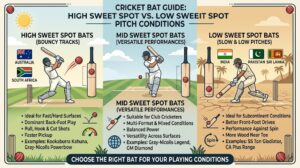
Understanding the Sweet Spot
The sweet spot is the area on the blade that produces the best combination of:
- Power
- Ball rebound
- Feel
- Reduced vibration
When the ball strikes this region, maximum energy transfer occurs and players experience the bat’s best performance.
Manufacturers position the sweet spot differently depending on the conditions the bat is intended for.
High Sweet Spot Bats for Bouncy Tracks
A high sweet spot is typically located between the middle and upper-middle section of the blade.
These bats are designed for surfaces where the ball rises sharply after pitching.
Ideal Conditions
High sweet spot bats excel on:
- Australian wickets
- South African pitches
- English summer wickets with pace and bounce
- Synthetic pitches
- Hard turf surfaces
On these wickets, batters often meet the ball higher up the blade due to extra bounce.
Advantages of High Sweet Spot Bats
Better Back-Foot Play
Shots such as:
- Pull shots
- Hooks
- Cuts
- Back-foot punches
often make contact higher on the blade.
A high sweet spot ensures maximum power in these situations.
Improved Bat Speed
Many high-middle bats feature slightly redistributed willow, producing a lighter pickup despite maintaining substantial edge thickness.
Suited to Modern Aggressive Cricket
T20 and one-day players frequently prefer high sweet spot bats because they facilitate attacking stroke play against short-pitched bowling.
Bat Characteristics
High sweet spot bats often feature:
- Higher middle profile
- Thick edges
- Generous spine height
- Slightly rounded toe
- Balanced pickup
Popular High Sweet Spot Bat Examples
Kookaburra Kahuna
One of the world’s most famous high-middle bats.
Features:
- Elevated sweet spot
- Thick profile
- Excellent back-foot performance
- Popular in Australia
Gray-Nicolls Powerbow
Known for:
- Mid-to-high sweet spot
- Strong pickup
- Excellent bounce-friendly performance
MRF Genius
Favored by many attacking players due to:
- Powerful mid-high profile
- Excellent response on hard surfaces
New Balance DC Series
Designed with:
- High middle
- Explosive power
- Aggressive stroke-making capability
Low Sweet Spot Bats for Slow Low Pitches
A low sweet spot is positioned closer to the toe.
These bats are engineered for pitches where the ball remains low after bouncing.
Ideal Conditions
Low sweet spot bats perform best on:
- Indian wickets
- Pakistani pitches
- Bangladeshi surfaces
- Sri Lankan tracks
- Slow club wickets
On these surfaces, batters often strike the ball lower on the blade.
See More: How Many Grains Should an Ideal English Willow Bat Have?
Advantages of Low Sweet Spot Bats
Better Front-Foot Play
Drives become easier because contact generally occurs lower on the bat.
These bats excel for:
- Cover drives
- Straight drives
- Flicks
- On-drives
Enhanced Performance Against Spin
Subcontinental pitches often assist spin bowling.
A low sweet spot helps batters generate power while playing:
- Sweeps
- Reverse sweeps
- Advances down the wicket
Improved Timing on Slow Surfaces
As the ball loses pace after pitching, lower-middle bats help generate momentum through the shot.
Bat Characteristics
Low sweet spot bats usually include:
- Fuller profile through the lower blade
- Larger toe area
- Strong lower-middle
- Significant wood concentration near the toe
Popular Low Sweet Spot Bat Examples
SS Ton Gladiator
Features:
- Pronounced low-middle profile
- Excellent front-foot feel
- Popular on Asian wickets
SG Sunny Tonny
Known for:
- Powerful lower blade
- Traditional subcontinental setup
- Exceptional drive performance
CA Plus Range
Designed to:
- Maximize lower-middle power
- Support stroke play on slower pitches
GM Mana
Offers:
- Low to mid sweet spot
- Excellent balance
- Strong performance against spin
Mid Sweet Spot: The Best of Both Worlds
Some players regularly play on different surfaces throughout the season.
A mid-sweet-spot bat offers versatility.
Suitable for:
- Club cricketers
- All-round players
- Multi-format cricket
- Mixed conditions
Popular examples include:
- Gray-Nicolls Legend
- GM Diamond
- Kookaburra Ghost
- New Balance Burn
These bats perform reasonably well across a variety of pitch conditions.
How Professional Players Choose
Professional batters often select sweet spots based on their home conditions.
Players on Bouncy Tracks Typically Prefer
- Higher middle profiles
- Faster pickup
- Back-foot dominance
Players on Lower Tracks Often Prefer
- Lower middles
- Fuller blades
- Enhanced front-foot power
Many international players even use different bats depending on the country they are touring.
Which Sweet Spot Is Right for You?
Choose a high sweet spot bat if you:
✅ Play on hard, bouncy wickets
✅ Score heavily square of the wicket
✅ Enjoy pull shots and cuts
✅ Prefer a lighter pickup
Choose a low sweet spot bat if you:
✅ Play mostly on slower pitches
✅ Play lots of drives
✅ Face significant spin bowling
✅ Want power lower in the blade
Choose a mid sweet spot bat if you:
✅ Play on varying surfaces
✅ Need versatility
✅ Want balanced performance all around
Conclusion
The “best” cricket bat depends heavily on the pitches you play on. High sweet spot bats thrive on fast, bouncy tracks where batters frequently meet the ball higher on the blade, making them ideal for Australian and South African conditions. Low sweet spot bats, meanwhile, excel on slower subcontinental surfaces by concentrating power closer to the toe, where contact is most commonly made.
By matching your bat’s sweet spot to your playing environment, you can improve timing, generate more power, and get the most out of every innings. Understanding this relationship between bat design and pitch behavior is one of the smartest ways to choose the right cricket bat for your game.