
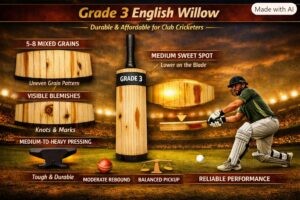
Grade 3 English willow bats represent the perfect middle ground between premium craftsmanship and everyday practicality. They are made from the same Salix alba Caerulea species used for elite bats but selected from clefts that show visible blemishes, mixed grains, and moderate redwood streaks. These bats are favored by club cricketers, students, and intermediate players who value durability, balance, and affordability over flawless aesthetics.
🌳 Origin and Selection
Grade 3 willow originates from the mid‑section of English willow trees, where the fibers are slightly denser and less uniform.
- Represents roughly 20 % of total harvested clefts.
- Selected for strength and resilience, not cosmetic perfection.
- Naturally seasoned for 6–12 months to maintain moisture and elasticity.
- Each cleft is inspected for grain consistency and fiber density before pressing.
This careful selection ensures that even though Grade 3 willow may not look flawless, it performs reliably under pressure.
🪵 Grain Structure and Appearance
| Feature | Grade 3 English Willow |
|---|---|
| Grain Count | 5–8 grains, slightly uneven |
| Grain Straightness | Mostly straight, minor waviness |
| Color Tone | Cream with light redwood streaks |
| Surface Quality | Visible specks and knots |
| Redwood Content | Moderate |
The grain pattern of Grade 3 willow reflects its natural growth rate — slightly faster than higher grades, resulting in wider grains and occasional redwood streaks. These marks are purely visual and do not affect the bat’s strength or rebound.
⚙️ Performance Characteristics
Grade 3 willow bats deliver consistent, dependable performance for club‑level matches and practice sessions.
- Sweet Spot: Medium‑sized, slightly lower on the blade — ideal for subcontinental pitches.
- Rebound: Moderate “ping,” offering solid feedback on contact.
- Pickup: Balanced, slightly heavier feel for controlled stroke play.
- Sound: Softer tone compared to Grade 1 or 2 willow.
This balance makes Grade 3 bats perfect for players who rely on timing and placement rather than sheer power.
🔬 Cellular Structure and Elasticity
Under microscopic analysis, Grade 3 willow shows:
- Smaller air cavities → firmer rebound and reduced spring.
- Thicker cell walls → higher density and durability.
- Moderate moisture retention → stable performance over time.
These characteristics make the bat slightly stiffer but more resistant to cracking and wear — ideal for long practice sessions.
🪶 Pressing and Preparation
Grade 3 willow undergoes medium‑to‑heavy pressing to enhance toughness.
- Deep pressing compresses fibers for longevity.
- Requires thorough knocking‑in before match use.
- Performs best after 4–6 hours of knocking‑in and oiling.
- Suitable for both turf and mat pitches.
This pressing technique ensures the bat maintains its shape and rebound even after extended use.
🧠 Ideal Player Profile
Grade 3 willow suits players who want reliable performance at a moderate price.
- Perfect for club cricketers, students, and intermediate players.
- Performs well on low‑bounce or dusty pitches.
- Ideal for all‑round stroke play — drives, cuts, and flicks.
- Great for players transitioning from training to competitive matches.
💰 Market and Value
- Price Range: $180 – $280 (≈ PKR 50,000 – 80,000).
- Longevity: 3–4 seasons with proper care.
- Investment: Excellent value for consistent performance.
- Availability: Common among brands like CA, GM, Gray‑Nicolls, and SS.
Grade 3 willow offers professional feel at a fraction of the cost, making it one of the most popular choices for club players worldwide.
🧩 Care and Maintenance
To preserve Grade 3 willow:
- Apply raw linseed oil every few weeks to prevent dryness.
- Knock‑in thoroughly before match use.
- Avoid moisture and direct sunlight.
- Store in a padded bat cover when not in use.
- Inspect regularly for cracks or seam splits.
Proper care ensures the bat retains its rebound and balance for multiple seasons.
🏟️ Comparative Overview
| Grade | Grain Quality | Blemishes | Rebound | Durability | Price Range (USD) |
|---|---|---|---|---|---|
| Grade 1 | 8–12 straight grains | Minimal | Excellent | Moderate | $400–$800 |
| Grade 2 | 6–10 straight grains | Minor | Very Good | Good | $250–$400 |
| Grade 3 | 5–8 mixed grains | Visible | Moderate | Excellent | $180–$280 |
| Grade 4 | 4–6 wide grains | Prominent | Fair | Very High | $100–$200 |
This table shows how Grade 3 willow sits comfortably between performance and durability, offering a practical balance for regular players.
🏁 Conclusion
Grade 3 English willow bats are the trusted workhorses of club cricket — strong, reliable, and affordable.
- Visible grains and blemishes add natural character.
- Moderate rebound suits controlled stroke play.
- Durable pressing ensures long‑term use.
- Accessible pricing makes it ideal for aspiring cricketers.
They may not have the flawless beauty of Grade 1 willow, but they embody the spirit of endurance and consistency — the qualities that define every dedicated player’s journey.
See More: Grade 2 English Willow Cricket Bats