
The cricket bat market has grown dramatically over the past two decades. With professional players endorsing major brands and premium English willow bats often costing hundreds or even thousands of dollars, counterfeit manufacturers have found a lucrative opportunity. Today, fake cricket bats are sold through online marketplaces, social media, unauthorized retailers, and even some physical sports stores.
To the untrained eye, a counterfeit bat may appear identical to the genuine product. The stickers look convincing, the branding seems accurate, and the price often appears attractive. However, beneath the surface, these bats frequently use inferior willow, poor craftsmanship, and misleading specifications that can result in disappointing performance and a significantly shorter lifespan.
Learning how to identify fake bats can protect your investment and ensure you receive the performance, durability, and quality that genuine manufacturers intend.
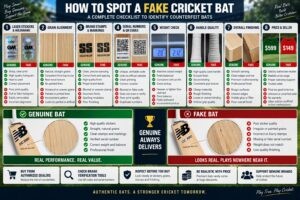
Why Counterfeit Cricket Bats Are a Growing Problem
Premium cricket bat brands have become highly recognizable worldwide.
Popular targets include:
- Gray-Nicolls
- Kookaburra
- Gunn & Moore (GM)
- New Balance
- MRF
- SS
- SG
- CA Sports
- DSC
- Spartan
Because professional-grade models command high prices, counterfeiters can generate significant profits by producing cheap imitations.
Many fake bats are sold using:
- Professional player names
- Replica stickers
- Forged serial numbers
- Misleading grain claims
- Fake grading labels
The result is a product that looks authentic but delivers far lower quality.
The Most Important Rule
Before examining technical details, remember this basic principle:
If the Deal Looks Too Good to Be True, It Usually Is
A genuine professional-grade English willow bat rarely sells at a fraction of its normal retail value.
For example:
If a current professional player edition bat normally costs $600 and appears online for $150, extreme caution is warranted.
Massive discounts are often the first warning sign.
Step 1: Inspect the Stickers Carefully
Counterfeit manufacturers have become increasingly skilled at copying graphics.
However, sticker quality remains one of the easiest ways to identify a fake bat.
Genuine Stickers
Authentic bat stickers typically feature:
✅ Sharp printing
✅ Consistent colors
✅ Clean edges
✅ Accurate logo placement
✅ High-quality materials
✅ Durable finishing
Premium manufacturers invest heavily in branding and quality control.
Fake Stickers
Counterfeit stickers often reveal:
❌ Blurry text
❌ Incorrect colors
❌ Uneven alignment
❌ Poor cutting
❌ Bubbling
❌ Low-quality printing
Examine the logo closely.
Even tiny differences in fonts or spacing can indicate forgery.
Laser Stickers and Holograms
Many manufacturers now use advanced anti-counterfeit technologies.
These may include:
- Laser engravings
- Security holograms
- Reflective authentication labels
- QR verification systems
- Unique serial numbers
Genuine security markings generally display:
✅ Consistent placement
✅ High-quality engraving
✅ Difficult-to-replicate effects
Warning Signs
Be suspicious of:
❌ Missing holograms
❌ Poor-quality holographic effects
❌ Crooked laser labels
❌ Easily removable identification marks
Counterfeiters often focus on appearance rather than precise security reproduction.
Step 2: Check Grain Alignment
One of the biggest clues lies in the willow itself.
While grain quality alone does not confirm authenticity, unusual grain patterns may raise concerns.
What Genuine Grains Usually Look Like
Most authentic English willow bats display:
- Natural variation
- Consistent grain flow
- Continuous grains from shoulder to toe
Example:
||||||||||||||
||||||||||||||
||||||||||||||
||||||||||||||
The grains generally run straight through the blade.
Potential Warning Signs
Look for:
❌ Artificially darkened grains
❌ Painted grain lines
❌ Interrupted patterns
❌ Highly unnatural spacing
❌ Perfectly identical artificial-looking lines
Some counterfeit manufacturers attempt to enhance appearance by adding cosmetic grain effects.
These often become obvious under close inspection.
Step 3: Examine the Willow Grade Claims
Counterfeit sellers frequently exaggerate willow grades.
Common marketing phrases include:
- Grade 1+
- Players Edition
- Pro Reserve
- Limited Edition
- International Series
Many fake bats display premium stickers while using low-grade wood.
Reality Check
If the bat claims:
- Grade 1+ English Willow
- 12 perfect grains
- Professional model
yet sells at an unusually low price, skepticism is justified.
Authentic premium willow is expensive.
True Grade 1+ clefts are limited in supply and rarely available at bargain prices.
Step 4: Inspect Manufacturer Stamps and Branding
Most major brands include additional identification marks beyond stickers.
These may include:
- Stamps
- Branding marks
- Laser etching
- Serial coding
Genuine Marks
Authentic markings usually display:
✅ Precise placement
✅ Consistent depth
✅ Professional finishing
✅ Clear readability
Fake Marks
Counterfeit examples often show:
❌ Uneven stamping
❌ Misaligned logos
❌ Incorrect fonts
❌ Poor engraving quality
❌ Spelling errors
Even a single misspelled word can instantly reveal a fake.
Step 5: Verify Serial Numbers
Many premium manufacturers assign unique serial numbers.
These help:
- Track production
- Verify authenticity
- Support warranty claims
A genuine serial number should generally appear:
- Professionally applied
- Consistently positioned
- Integrated into manufacturer systems
Red Flags
Watch for:
❌ Missing numbers
❌ Repeated numbers across multiple bats
❌ Poor-quality printing
❌ Easily scratched-off codes
Counterfeiters often overlook this level of detail.
See More: Cricket Bat Grips Explained: Matrix vs Chevron vs Octopus
Step 6: Evaluate Weight Claims
Weight discrepancies represent one of the most common signs of counterfeit bats.
Genuine Manufacturer Specifications
Reputable manufacturers carefully match:
- Bat profile
- Weight
- Pickup
- Willow density
A large-profile professional bat should generally feel consistent with its stated weight.
Fake Bat Weight Problems
Counterfeit bats often display:
❌ Incorrect weight labels
❌ Poor balance
❌ Excessively heavy pickup
❌ Unrealistically light specifications
For example:
A bat labeled 2 lb 8 oz may actually weigh 2 lb 11 oz or more.
Always weigh expensive bats independently when possible.
Step 7: Examine the Handle Construction
The handle is frequently overlooked by counterfeiters.
Premium manufacturers use carefully engineered handles incorporating:
- Multiple cane layers
- Rubber inserts
- Specialized binding
Genuine Handles
Look for:
✅ Smooth transitions
✅ Secure splices
✅ Quality binding
✅ Professional finishing
Fake Handles
Potential issues include:
❌ Rough finishing
❌ Poor alignment
❌ Inferior materials
❌ Excessive glue marks
❌ Visible manufacturing defects
Handle quality often reveals the true level of craftsmanship.
Step 8: Assess Bat Balance and Pickup
Professional bats are designed around performance characteristics.
When lifted, a genuine bat often feels surprisingly balanced.
Fake Bat Characteristics
Counterfeit bats may feel:
- Unusually heavy
- Awkwardly balanced
- Difficult to swing
- Inconsistent in pickup
Even if the weight appears reasonable, poor construction can create uncomfortable balance.
Step 9: Examine Finishing Quality
Premium manufacturers invest substantial effort in finishing.
Inspect:
- Edges
- Toe
- Spine
- Handle area
- Sticker placement
Genuine Finishing
✅ Smooth sanding
✅ Clean polish
✅ Uniform profile
✅ High-quality craftsmanship
Counterfeit Finishing
❌ Rough surfaces
❌ Uneven sanding
❌ Poor edge work
❌ Excess filler
❌ Visible imperfections
These flaws often become apparent upon close examination.
Step 10: Buy from Authorized Sellers
The easiest way to avoid counterfeit bats is simple:
Purchase through:
- Authorized retailers
- Official brand websites
- Reputable cricket specialists
Avoid:
- Unknown online sellers
- Social media marketplaces
- Unverified resellers
A trusted retailer remains your strongest protection.
Quick Fake Bat Checklist
Before purchasing, ask yourself:
Stickers
✅ Sharp printing
✅ Correct branding
✅ Professional quality
Security Features
✅ Hologram present
✅ Laser markings intact
✅ Serial numbers visible
Willow
✅ Natural grain pattern
✅ Consistent grain alignment
✅ Grade claim matches price
Weight
✅ Matches specification
✅ Feels balanced
✅ Reasonable pickup
Construction
✅ Quality handle
✅ Clean finishing
✅ Consistent craftsmanship
Seller
✅ Authorized retailer
✅ Positive reputation
✅ Verifiable source
Common Myths About Fake Bats
Myth 1: More Grains Mean Real Bat
False.
Grain count does not confirm authenticity.
Myth 2: Expensive Means Genuine
False.
Counterfeiters often inflate prices to appear legitimate.
Myth 3: Professional Stickers Guarantee Authenticity
False.
Stickers are among the easiest components to replicate.
Myth 4: A Fake Bat Cannot Perform Well
Not always.
Some counterfeits may perform reasonably initially.
However, durability, consistency, and long-term quality are usually far inferior.
Final Thoughts
Counterfeit cricket bats have become increasingly sophisticated, making authentication more important than ever. While fake bats may imitate professional stickers and premium branding, they frequently reveal themselves through poor-quality laser markings, unrealistic pricing, questionable grain patterns, inferior finishing, inaccurate weight specifications, and weak construction. Careful inspection of stickers, grain alignment, stamps, serial numbers, balance, and handle quality can significantly reduce the risk of purchasing a counterfeit product.
Ultimately, the safest approach is to buy from authorized dealers and reputable cricket equipment specialists. A genuine bat offers not only superior performance but also peace of mind, knowing that the willow, craftsmanship, and quality control behind the product are exactly what the manufacturer intended. In cricket, as in many sports, authenticity is worth paying for.
See More: How to Spot Fake Cricket Equipment