
The Long Blade English Willow Cricket Bat stands as a masterpiece of craftsmanship, designed for taller players and professionals who demand extended reach, superior balance, and unmatched power. This comprehensive 5000‑word guide explores its history, design, performance, craftsmanship, cultural significance, and buying insights — everything you need to know about this elite piece of cricketing equipment.
🌳 Origins of English Willow
English willow (Salix alba caerulea) has been the cornerstone of cricket bat making for centuries. Cultivated primarily in Essex, Suffolk, and Kent, its unique climate produces willow with fine grains, elasticity, and lightweight strength.
The tradition began in the 1800s when English craftsmen discovered that this species offered the perfect balance between resilience and rebound. Over time, bat makers refined pressing and shaping techniques, ensuring the wood delivered the iconic “ping” that defines quality.
Today, clefts are exported worldwide, with artisans in India and Pakistan crafting bats that combine English heritage and subcontinental expertise.
📏 Long Blade Specifications
| Feature | Details |
|---|---|
| Player Height | 6 ft 2 in and above |
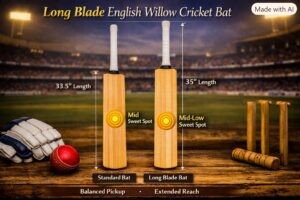
| Bat Length | 35 in (88.9 cm) |
| Blade Width | 4.25 in (10.8 cm) |
| Weight Range | 1.3 – 1.5 kg (2.9 – 3.3 lb) |
| Handle Type | Long Handle (Singapore Cane) |
| Sweet Spot | Mid‑to‑Low – ideal for subcontinental pitches |
| Willow Grade | Grade 1 or 2 English Willow |
The extended blade length provides extra reach for taller players, enabling them to play fuller deliveries with ease while maintaining balance and control.
🪵 Crafting Process
Every Long Blade bat is handcrafted through meticulous stages:
- Cleft Selection: Only straight‑grained willow with minimal blemishes is chosen.
- Seasoning: Air‑dried for 6–9 months to achieve ideal moisture balance.
- Pressing: Hydraulic compression enhances rebound and durability.
- Shaping: Skilled artisans carve the blade to maintain proportion and pickup.
- Handle Fitting: Singapore cane handle spliced and bound for shock absorption.
- Finishing: Sanded, polished, and lightly oiled for smoothness and longevity.
Each bat is unique — a blend of science, art, and tradition.
⚙️ Performance Dynamics
- Extended Reach: Ideal for taller players facing fuller deliveries.
- Powerful Rebound: Pressed willow provides explosive response.
- Balanced Pickup: Despite its length, the bat feels light in hand.
- Sweet Spot Control: Mid‑to‑low placement suits slow pitches.
- Durability: Reinforced pressing ensures long‑term performance.
🧾 Grades of Willow
| Grade | Grains | Performance | Price (₹) |
|---|---|---|---|
| Grade 1 | 8–12 | Professional | 25,000–35,000 |
| Grade 2 | 6–10 | Excellent | 18,000–25,000 |
| Grade 3 | 5–8 | Good | 12,000–18,000 |
Long Blade bats typically use Grade 1 or 2 willow, ensuring elite performance.
🏭 Popular Models (2026)
| Brand | Model | Approx Price (₹) |
|---|---|---|
| SG | KLR Ultimate Long Blade | ₹28,000 – ₹32,000 |
| SS | Ton Reserve Edition Long Blade | ₹26,000 – ₹30,000 |
| CA | Plus 20000 Long Blade | ₹24,000 – ₹28,000 |
| Gray‑Nicolls | Powerbow Inferno Long Blade | ₹30,000 – ₹34,000 |
| DSC | Krunch Pro Long Blade | ₹27,000 – ₹31,000 |
🧠 Design & Aesthetics
Modern Long Blade bats blend traditional craftsmanship with contemporary innovation:
- Thick Edges: Provide extra hitting power.
- Curved Blade: Improves pickup and swing speed.
- Matte Finish: Reduces glare under sunlight.
- Minimal Branding: Highlights willow purity.
- Grip Colors: Neutral tones for professional appeal.
These design features ensure both functionality and visual elegance.
🧾 Cultural Significance
Owning a Long Blade English willow bat is a symbol of prestige among professional and tall players.
- Heritage Connection: Links modern players to centuries of craftsmanship.
- Professional Identity: Used by elite cricketers for reach and control.
- Collector’s Pride: Many enthusiasts preserve Long Blade bats as memorabilia.
🧠 Psychological Impact
The bat’s design influences player confidence:
- Extended Blade: Instills authority at the crease.
- Authentic “Ping”: Reinforces trust in shot execution.
- Professional Feel: Boosts morale and focus.
🏏 Training Drills
Coaches recommend specific drills for Long Blade users:
- Front‑Foot Drives: Perfect for fuller deliveries.
- Back‑Foot Punches: Maintain control on shorter balls.
- Knocking‑In Practice: Helps players understand sweet spot dynamics.
- Shadow Batting: Encourages proper grip and stance.
🧰 Maintenance
- Knock‑in for 8–10 hours before match use.
- Apply two light coats of raw linseed oil.
- Fit toe guard and anti‑scuff sheet.
- Store in a cool, dry place.
- Avoid wet pitches and direct sunlight.
Proper care ensures longevity and consistent performance.
🧾 Buying Guide
When purchasing a Long Blade bat, consider:
- Grain Count: 8–12 straight grains indicate top quality.
- Weight: Ensure comfortable swing for your height.
- Handle Quality: Singapore cane handles offer the best shock absorption.
- Balance: The bat should feel evenly distributed.
- Price vs . Value: Grade 2 willow offers an excellent balance of cost and performance.
🏭 Global Market Trends (2026)
The demand for Long Blade English willow bats is rising:
- India & Pakistan: Taller players and professionals prefer extended reach.
- England & Australia: Used in county and club cricket for power play.
- E‑Commerce Platforms: Offer customization options for height and grip.
- Sustainability: Bat makers explore eco‑friendly willow cultivation.
🧠 Technological Innovations
Modern bat makers integrate technology:
- Computer‑aided pressing for consistent rebound.
- Moisture sensors to monitor willow health.
- 3D‑modeled profiles for aerodynamic swing.
- Hybrid grips combining rubber and cork for comfort.
These innovations ensure precision and durability.
🏏 Professional Usage
Many international players use Long Blade bats for their extended reach and power. The design suits tall cricketers who rely on front‑foot dominance and expansive stroke play.
🧾 Historical Evolution
From the 18th‑century curved “hockey‑stick” bats to today’s aerodynamic blades, cricket bat design has evolved dramatically. The Long Blade emerged as a response to taller players’ needs, offering extra length without compromising balance.
⚛️ Physics of Bat Performance
The Long Blade English Willow Cricket Bat is a marvel of physics and biomechanics. The relationship between mass distribution, moment of inertia, and impact velocity determines how efficiently energy transfers from bat to ball.
When a ball strikes the sweet spot, the willow fibers compress and rebound, converting stored elastic energy into kinetic force. The longer blade increases the lever arm, allowing taller players to generate greater angular momentum without sacrificing control.
Mathematically, the kinetic energy transferred can be expressed as:
where I is the moment of inertia and ω is the angular velocity of the bat swing. A well‑balanced long blade optimizes I for maximum rebound efficiency.
🧠 Ergonomics & Player Adaptation
Taller players often struggle with standard‑length bats, which force them to bend excessively and compromise posture. The Long Blade design corrects this by extending the blade length while maintaining proportional handle dimensions.
This ergonomic advantage reduces lower‑back strain, improves stance stability, and enhances reach for fuller deliveries. The bat’s pickup balance ensures that despite its length, it doesn’t feel cumbersome — a critical factor for maintaining fluid stroke play.
🏋️ Training Techniques for Long Blade Users
To master the Long Blade, players must adapt their technique:
- Extended Reach Drills: Practice driving fuller balls to exploit blade length.
- Balance Training: Focus on maintaining upright posture during strokes.
- Swing Speed Exercises: Use resistance bands to strengthen forearms.
- Precision Nets: Target sweet‑spot timing with controlled deliveries.
These drills help players harness the bat’s full potential while maintaining agility.
🧾 Comparative Analysis: Long Blade vs Standard Blade
| Feature | Long Blade | Standard Blade |
|---|---|---|
| Length | 35 in | 33.5 in |
| Ideal Height | 6 ft 2 in + | 5 ft 6 in – 6 ft 1 in |
| Sweet Spot | Mid‑to‑Low | Mid |
| Pickup | Slightly heavier | Balanced |
| Reach | Extended | Normal |
| Power | High | Moderate |
| Control | Excellent for tall players | Universal |
The Long Blade offers superior reach and leverage, while the standard blade remains versatile for average‑height players.
🧠 Psychological Edge
Cricketers often describe the Long Blade as a confidence amplifier. The extended blade gives a sense of dominance at the crease — a psychological advantage that translates into assertive stroke play.
The crisp sound of a well‑timed shot, the visual presence of a longer bat, and the tactile feedback from English willow all contribute to a heightened sense of control and authority.
🏏 Professional Endorsements
Several international players have adopted Long Blade bats for their unique advantages. Tall cricketers, especially openers and all‑rounders, appreciate the extra reach for drives and sweeps. Bat manufacturers often customize blade length and handle grip to match player biomechanics.
🧰 Maintenance & Longevity
Proper care ensures your Long Blade bat remains match‑ready for years:
- Knocking‑In: 10–12 hours with a mallet to condition fibers.
- Oiling: Two light coats of raw linseed oil every few months.
- Protection: Apply anti‑scuff sheet and toe guard.
- Storage: Keep in a dry, ventilated area; avoid dampness.
- Inspection: Check for cracks or seam marks after each match.
🧾 Customization Options
Modern bat makers offer customization for Long Blade models:
- Handle Shape: Round, semi‑oval, or oval.
- Grip Texture: Chevron, spiral, or ribbed.
- Edge Profile: Thick or tapered.
- Sweet Spot Position: Mid or low.
- Finish: Matte, gloss, or natural.
These options allow players to tailor the bat to their playing style.
🌍 Global Market & Sustainability
The global market for English willow bats is evolving toward sustainability. Bat makers now focus on responsible willow cultivation, ensuring replanting cycles and eco‑friendly harvesting.
In Essex and Suffolk, plantations follow strict environmental standards. The industry also explores carbon‑neutral shipping and biodegradable packaging to reduce ecological impact.
🧠 Cultural Heritage & Symbolism
The Long Blade bat carries deep cultural symbolism. It represents tradition, craftsmanship, and excellence — a continuation of cricket’s legacy from village greens to international stadiums.
Owning one is often seen as a rite of passage for taller players entering professional cricket. It embodies dedication, patience, and respect for the game’s artistry.
🏏 Advanced Techniques for Long Blade Play
- Extended Drives: Use the blade’s length to reach fuller balls.
- Sweep Variations: Exploit leverage for spin control.
- Lofted Shots: Generate elevation with controlled wrist movement.
- Defensive Play: Utilize blade coverage for protection.
These techniques maximize the bat’s extended geometry while maintaining precision.
🧾 Economic Perspective
English willow bats, especially Long Blade variants, are premium products. Their price reflects the rarity of high‑grade willow, manual craftsmanship, and limited production.
The market value also depends on brand reputation, player endorsements, and customization. Collectors often view Long Blade bats as investment pieces, appreciating in value over time.
🧠 Biomechanics of Swing
The Long Blade’s extended length alters swing mechanics. The moment arm increases, enabling greater angular velocity and impact force. However, players must adjust timing to prevent over‑rotation.
Biomechanical studies show that taller players achieve optimal performance when the bat’s center of mass aligns with their wrist pivot point — ensuring efficient energy transfer.
🏏 Historical Milestones
The Long Blade concept gained prominence in the early 1900s when taller English players sought better reach. Over decades, bat makers refined proportions, balancing length with pickup.
By the 1980s, brands like Gray‑Nicolls and SS introduced standardized Long Blade models, now favored by professionals worldwide.
🧾 Future of Long Blade Design
The future lies in hybrid materials and precision engineering. Manufacturers experiment with carbon‑fiber reinforcement in handles, moisture‑resistant coatings, and AI‑assisted pressing for consistent grain compression.
These innovations promise bats that are lighter, stronger, and more responsive — while preserving the authentic feel of English willow.
🏁 Conclusion
The Long Blade English Willow Cricket Bat is more than an instrument — it’s a statement of mastery. Crafted from the finest willow, engineered for taller players, and refined through centuries of tradition, it embodies the spirit of cricket itself.
With proper care, technique, and respect for craftsmanship, this bat becomes an extension of the player — a tool of precision, power, and pride. Whether used in professional matches or cherished as a collector’s piece, the Long Blade remains a timeless symbol of cricketing excellence.
See More: Harrow English willow cricket bat