
Knocking in is essential to prepare a cricket bat, but excessive or improper knocking in can damage the willow instead of strengthening it. Recognizing the warning signs early can help prevent reduced performance and premature bat failure.
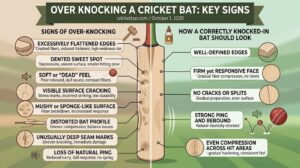
1. Excessively Flattened Edges
One of the clearest signs of over-knocking is unusually flat or compressed edges.
What it looks like:
- Sharp edge definition has disappeared.
- Edges appear heavily rounded or flattened.
- Willow fibers look overly compressed.
Why it happens:
Repeated heavy mallet blows concentrate too much force on the edges, crushing the wood fibers rather than gradually hardening them.
Impact:
- Reduced edge thickness.
- Less rebound off mishits.
- Increased risk of structural weakness.
2. Dented or Sunken Sweet Spot
A properly knocked-in bat should retain its profile.
Warning signs:
- Visible depressions in the middle.
- Uneven surface texture.
- Bat face appears slightly sunken.
Cause:
Using excessive force with a mallet or spending too much time on the same areas can permanently compress the willow.
Impact:
- Reduced power output.
- Smaller effective sweet spot.
- Loss of performance.
3. Soft or “Dead” Feel at Impact
Many players describe an over-knocked bat as feeling dead.
Physical indicators:
- Ball does not rebound strongly.
- Muted sound during impact.
- Lack of responsiveness.
Why it occurs:
The willow fibers become overly compacted, reducing the natural spring effect that generates power.
Impact:
- Shots require more effort.
- Reduced timing and distance.
- Lower overall bat performance.
4. Visible Surface Cracking from Incorrect Knocking
Incorrect knocking can damage the bat as much as insufficient preparation.
Signs:
- Hairline cracks spreading across the face.
- Splits near the edges.
- Stress marks around impact zones.
Common causes:
- Striking the edges directly at sharp angles.
- Using excessive force too early.
- Knocking a dry, unoiled bat.
Impact:
- Reduced durability.
- Potential structural failure.
- Increased risk of major splits during play.
5. Mushy or Sponge-Like Surface
The face should feel firm but responsive.
What to look for:
- Soft patches on the blade.
- Excessive indentation from a fingernail.
- Uneven firmness across the face.
Why it happens:
Over-compression breaks down fiber structure instead of strengthening it.
Impact:
- Reduced ball speed.
- Poor rebound characteristics.
- Inconsistent performance.
6. Distorted Bat Profile
A high-quality bat should maintain its original shape.
Warning signs:
- Spine looks compressed.
- Shoulders appear misshapen.
- Blade profile seems uneven.
Cause:
Aggressive knocking focused on one area rather than evenly across the striking surface.
Impact:
- Altered balance.
- Reduced pickup.
- Performance loss.
7. Unusually Deep Seam Marks During Early Use
A properly prepared bat should show only minor seam impressions.
Signs of incorrect knocking:
- Deep seam marks after soft-ball practice.
- Large dents appearing immediately.
- Markings concentrated in certain areas.
What it indicates:
The bat may have been knocked unevenly, leaving some sections under-prepared while others are over-compressed.
8. Loss of Natural Ping
“Ping” refers to the bat’s rebound and liveliness.
Symptoms:
- Dull sound on ball contact.
- Reduced carry during drives.
- Lack of explosive response.
Cause:
Over-knocking can compact the wood fibers beyond their optimal point, reducing the bat’s natural elasticity.
Impact:
Even well-timed shots may not travel as expected.
How a Correctly Knocked-In Bat Should Look
A properly prepared bat will typically have:
✅ Slight seam impressions but no deep dents
✅ Firm yet responsive face
✅ Well-defined edges
✅ No cracks or splits
✅ Strong ping and rebound
✅ Original profile retained
✅ Even compression across the hitting area
Conclusion
The most common physical signs of a bat that has been knocked in too much or incorrectly are flattened edges, a depressed sweet spot, reduced ping, a mushy surface, uneven compression, and visible cracking. Proper knocking-in is about gradual compression of the willow fibers, not excessive force. A well-prepared bat should feel lively and responsive, whereas an over-knocked bat often feels dull, soft, and less powerful despite appearing well-used.
See More: High Sweet Spots of Bats for Bouncy Australian and English Tracks