
Cricket has entered the age of data. Professional teams now rely on performance analytics to optimize everything from bowling workloads to fielding positions. Batting is no different. While coaches once depended solely on observation and video footage, modern technology allows players to measure their batting mechanics with extraordinary accuracy.
One of the most exciting developments in modern cricket equipment is the rise of smart cricket bats. These systems use compact IoT (Internet of Things) sensors attached to or embedded within the bat to track swing mechanics, bat speed, impact quality, backlift angles, and numerous other performance metrics. Products such as StanceBeam have helped make this technology accessible to club cricketers, academy players, and professionals alike. Modern smart-bat systems can measure metrics such as bat speed, impact timing, swing angle, shot efficiency, and power generation through motion sensors and connected mobile applications.
What once required an elite biomechanics laboratory can now fit inside a bat handle.
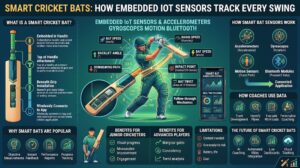
What Is a Smart Cricket Bat?
A smart cricket bat is a standard cricket bat enhanced with electronic sensors that measure movement during batting.
Depending on the system, the sensor may be:
- Embedded inside the handle
- Attached to the top of the handle
- Installed beneath the grip
- Connected wirelessly to a mobile application
These sensors collect real-time performance data while the player trains or plays.
The objective is simple:
Turn every swing into measurable data.
What Does IoT Mean in Cricket?
IoT stands for:
Internet of Things
In cricket, this refers to equipment containing sensors that communicate with digital devices.
A smart bat system typically includes:
- Sensor hardware
- Motion-tracking technology
- Mobile application
- Performance analytics platform
Once connected via Bluetooth, the bat can transmit information directly to a smartphone or tablet.
Why Smart Bats Have Become Popular
Modern players are always looking for ways to improve.
Traditionally, coaches relied on:
- Observation
- Experience
- Video analysis
While effective, these methods can be subjective.
Smart bat technology offers:
✅ Objective measurements
✅ Instant feedback
✅ Detailed performance reports
✅ Progress tracking over time
The result is a more data-driven approach to batting development.
See More: https://crickettop.com/are-bamboo-cricket-bats-legal/
How Smart Bat Sensors Work
Most smart bat systems contain miniature sensor packages.
These typically include:
Accelerometers
Measure acceleration during the swing.
Gyroscopes
Measure rotation and angular movement.
Motion Sensors
Track bat path and orientation.
Bluetooth Modules
Transmit data to external devices.
The information is processed and displayed through a connected application.
See More: Kiln-Dried vs Air-Dried Cricket Bats
Tracking Bat Speed
One of the most popular smart-bat metrics is bat speed.
Bat speed influences:
- Timing
- Power
- Reaction capability
- Boundary-hitting potential
The sensor measures how quickly the bat travels through the hitting zone.
Benefits include:
✅ Objective performance tracking
✅ Comparison between sessions
✅ Technique optimization
✅ Training evaluation
Many players are surprised to see how small technical changes affect swing speed.
Measuring Swing Angles
Smart sensors can also analyze the path of the bat.
This includes:
- Backlift angle
- Downswing path
- Impact trajectory
- Follow-through mechanics
These measurements help players understand whether their swing remains consistent.
For coaches, this provides valuable technical insight that may be difficult to observe with the naked eye.
Understanding Bat Twist
Bat twist is one of the most useful metrics offered by modern smart bats.
Twist occurs when the ball impacts away from the middle.
Sensors can identify:
- Amount of blade rotation
- Off-center contact
- Stability during impact
Benefits include:
✅ Better sweet-spot awareness
✅ Improved shot consistency
✅ Reduced mishit frequency
This is particularly useful for developing players learning to find the middle of the bat more consistently.
Measuring Power
Many smart bat applications provide a “power” score.
Although different manufacturers calculate the metric differently, power typically combines factors such as:
- Bat speed
- Acceleration
- Impact quality
- Swing efficiency
The resulting score gives players an indication of how effectively they transfer energy into the shot.
This helps identify opportunities for technical improvement.
Swing Efficiency Analysis
A powerful swing is not always an efficient swing.
Smart bat systems often assess:
- Movement efficiency
- Swing consistency
- Energy transfer
- Timing quality
Two players may generate similar bat speeds but achieve different outcomes due to variations in technique.
Data helps reveal those differences.
Training with Real-Time Feedback
One reason smart bats have become popular is instant feedback.
Instead of waiting for video review, players can immediately see:
✅ Bat speed
✅ Swing angle
✅ Control metrics
✅ Shot quality
This creates a more engaging training experience.
Many young players find the technology particularly motivating.
How Coaches Use Smart Bat Data
Elite coaching increasingly blends traditional expertise with technology.
Smart bat data helps coaches:
Track Development
Monitor improvement over weeks or months.
Identify Technical Flaws
Detect swing inconsistencies.
Evaluate Workloads
Measure training intensity.
Personalize Coaching
Tailor drills to specific weaknesses.
Data never replaces coaching judgment, but it provides another valuable tool.
Benefits for Junior Cricketers
Young players often struggle to understand technical feedback.
Smart bat systems can simplify learning.
Advantages include:
✅ Visual progress indicators
✅ Measurable improvement
✅ Increased engagement
✅ Better understanding of mechanics
Instead of hearing “swing faster,” players can see exactly how much improvement occurs.
Benefits for Advanced Players
Experienced players use smart sensors differently.
They often analyze:
- Marginal gains
- Shot consistency
- Bat speed trends
- Impact efficiency
At higher levels, even small improvements can make a significant difference.
Can Smart Bats Improve Performance?
The sensor itself does not improve performance.
What improves performance is how players use the data.
Benefits may include:
- Better self-awareness
- More efficient practice
- Improved technique
- Faster skill development
Technology provides information.
Players and coaches still apply that information.
Limitations of Smart Bat Technology
Despite its advantages, smart technology is not perfect.
Data Without Context
Numbers alone cannot explain everything.
A coach’s judgment remains important.
Overanalysis
Some players become excessively focused on metrics.
This can distract from natural batting instincts.
Battery Dependence
Like any electronic device, sensors require charging and maintenance.
Cost
Smart bat systems generally cost more than traditional training methods.
The Future of Smart Cricket Bats
Technology continues to evolve rapidly.
Future smart bats may include:
- Advanced impact mapping
- AI-powered coaching feedback
- Automated video integration
- Live performance dashboards
- Cloud-based skill tracking
The line between sports equipment and sports analytics is becoming increasingly blurred.
Smart Bats vs Traditional Coaching
Some people worry technology may replace coaches.
This is highly unlikely.
Coaches provide:
- Experience
- Tactical understanding
- Communication
- Motivation
Smart bats simply provide additional information.
The best results usually come from combining both approaches.
Are Smart Cricket Bats Worth It?
For casual players, a traditional bat may be all that’s needed.
For serious cricketers interested in measurable improvement, smart bat systems can provide valuable insights.
They are particularly useful for:
✅ Academy players
✅ Club cricketers
✅ High-performance programs
✅ Data-driven coaching environments
The value ultimately depends on how actively the information is used.
Final Thoughts
Smart cricket bats represent one of the most exciting intersections between technology and sport. By incorporating IoT sensors capable of measuring bat speed, twist, swing angles, power output, and shot efficiency, these systems provide players with detailed insights that were previously unavailable outside professional performance laboratories. What was once based largely on observation can now be supported with objective, measurable data.
While technology will never replace coaching expertise or natural batting instincts, smart bat analytics offer an additional layer of understanding that can accelerate improvement. Whether used by academy players working on technique or advanced cricketers chasing marginal gains, smart cricket bats demonstrate how data-driven training is reshaping the future of batting development. As sensor technology and artificial intelligence continue to evolve, the next generation of cricket bats may become even smarter, helping players unlock new levels of performance one swing at a time.
See More: Are Bamboo Cricket Bats Legal? MCC Rules, Performance & Future