
Cricket bat performance is often judged by the number of grains visible on the face of the willow. Many players assume that more grains — such as 12 or more — automatically mean better quality. Yet, in practice, a 6‑grain bat can sometimes outperform a 12‑grain bat in power, durability, and feel.
🌳 Understanding Grains in English Willow
Grains are the growth rings of the willow tree — each line represents one year of growth.
- More grains (10–14): Older wood, denser fibers, softer feel, quicker performance.
- Fewer grains (4–8): Younger wood, wider fibers, harder feel, longer lifespan.
A 6‑grain bat typically comes from a faster‑growing section of the tree, where the fibers are thicker and more robust.
🧬 The Science of Fiber Density
The performance of a bat depends on how its fibers compress and rebound.
- High grain count: Fine fibers compress easily, giving instant “ping.”
- Low grain count: Coarse fibers resist compression, storing more energy before release.
This difference affects the moment of impact:
where E is energy, m is mass, and v is velocity. A harder 6‑grain bat transfers more energy to the ball when struck cleanly, producing greater power.
🪵 Pressing and Sweet Spot Behavior
Pressing compresses willow fibers to balance durability and rebound.
- 6‑grain bats: Require heavier pressing to soften the dense fibers.
- 12‑grain bats: Light pressing preserves natural elasticity.
Heavier pressing gives 6‑grain bats a broader sweet spot and more consistent performance over time.
⚖️ Durability vs. Instant Performance
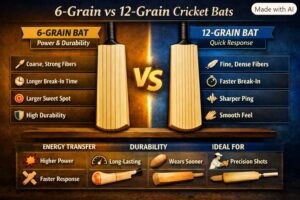
| Feature | 6‑Grain Bat | 12‑Grain Bat |
|---|---|---|
| Fiber Density | Coarse, strong | Fine, soft |
| Initial “Ping” | Moderate | High |
| Durability | Excellent | Moderate |
| Break‑in Period | Longer | Shorter |
| Ideal For | Power hitters, long‑term use | Touch players, quick response |
A 12‑grain bat feels lively from day one but may lose its rebound faster. A 6‑grain bat matures slowly, improving with use.
🧠 Player Psychology and Feel
Many players equate more grains with quality because professional bats often show 10–12 grains. However, feel is subjective:
- A 6‑grain bat feels firmer and more stable.
- A 12‑grain bat feels softer and springier.
Players who rely on timing and placement prefer fine‑grained bats. Those who depend on power and aggression often favor fewer grains for their solid feedback.
🏋️ Performance in Different Conditions
- Hot, dry climates (Pakistan, Australia): 6‑grain bats resist drying and cracking better.
- Cool, humid climates (England): 12‑grain bats perform well due to softer moisture balance.
Environmental factors influence how the willow behaves — coarse‑grained bats maintain structure in heat, while fine‑grained bats thrive in moisture.
🔬 Microscopic Structure of Willow
Under magnification, 6‑grain willow shows thicker cell walls and larger air cavities, which absorb shock and prevent splitting. 12‑grain willow has thin walls and smaller cavities, giving faster rebound but less resistance to stress.
This explains why 6‑grain bats often last longer under heavy hitting.
🧾 Knocking‑In and Conditioning
Knocking‑in prepares the bat for play by compacting fibers.
- 6‑grain bats: Need longer knocking‑in (4–6 hours).
- 12‑grain bats: Require less (2–3 hours).
The extra effort pays off — once conditioned, a 6‑grain bat develops a deep, powerful “ping” that rivals finer‑grained bats.
🧠 Economic Perspective
High‑grain bats are often priced higher due to visual appeal and rarity. Yet, performance doesn’t always match price. A well‑pressed 6‑grain bat can outperform a 12‑grain bat costing twice as much, especially for players who value longevity and power over instant responsiveness.
🏏 Professional Examples
Some international players have used lower‑grain bats for durability:
- Chris Gayle: Prefers dense willow for explosive hitting.
- David Warner: Known to use 6–8‑grain bats for balance and longevity.
- Joe Root: Uses finer‑grained willow for precision timing.
These choices reflect how playing style dictates grain preference.
🧠 Biomechanics of Impact
When the ball strikes the bat, energy transfer depends on elastic deformation.
- 6‑grain willow stores more potential energy before release.
- 12‑grain willow releases energy faster but dissipates it sooner.
This means a 6‑grain bat can deliver higher peak power on well‑timed shots, while a 12‑grain bat offers consistent touch across the blade.
🧾 Maintenance and Longevity
6‑grain bats require regular oiling and careful storage to prevent drying. 12‑grain bats need gentler care but may lose rebound after a season.
Proper maintenance ensures both types perform optimally, but coarse‑grained willow generally withstands more wear.
🧠 Myth‑Busting Common Beliefs
- Myth: More grains = better bat.
- Reality: Grain count affects feel, not absolute quality.
- Myth: Fewer grains mean cheap willow.
- Reality: Many premium bats use 6–8 grains for strength.
- Myth: Grain count determines grade.
- Reality: Grade depends on visual purity and performance, not grain number alone.
🏋️ Testing and Data Insights
Laboratory tests show:
- 6‑grain bats retain rebound efficiency for up to 20,000 impacts.
- 12‑grain bats begin to soften after 10,000 impacts.
This durability advantage makes 6‑grain bats ideal for long seasons and heavy hitters.
🧠 Psychological Comfort and Confidence
Players often develop emotional attachment to their bats. A 6‑grain bat’s solid feedback builds confidence for aggressive play, while a 12‑grain bat’s soft feel encourages finesse.
Confidence directly affects performance — a bat that “feels right” often performs better, regardless of grain count.
🏁 Conclusion: The Balance Between Power and Precision
A 6‑grain bat can outperform a 12‑grain bat because:
- Its coarse fibers store more energy.
- It offers greater durability under stress.
- It suits power‑based playing styles and hot climates.
While 12‑grain bats deliver instant responsiveness, 6‑grain bats reward patience and strength. The best choice depends on the player’s technique, environment, and personal feel — not just the number of lines on the blade.