
Cricket bat technology has evolved dramatically over the last century. From larger edges and thicker spines to carbon-reinforced handles and advanced pressing techniques, manufacturers constantly search for ways to improve performance. One of the most controversial innovations in recent years has been the development of bamboo cricket bats.
Supporters argue that bamboo bats are stronger, more sustainable, and potentially offer larger sweet spots than traditional willow bats. Critics believe they could fundamentally alter the balance between bat and ball. The debate has become so significant that the cricketing world’s lawmakers have taken notice.
So, are bamboo cricket bats legal? Why are they attracting attention? And could they eventually replace willow as cricket’s preferred bat material?
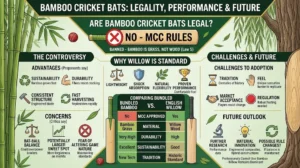
What Is a Bamboo Cricket Bat?
Unlike traditional cricket bats, which are carved from a single cleft of willow, bamboo bats are generally manufactured by bonding together multiple strips of compressed bamboo.
The resulting blade is engineered rather than naturally shaped from a single piece of wood.
Manufacturers chose bamboo because it offers several attractive properties:
- Exceptional strength
- High durability
- Fast growth rates
- Environmental sustainability
- Consistent structure
The concept is relatively simple:
Instead of relying on a tree that takes decades to mature, bamboo can be harvested much more quickly and replenished rapidly.
Why Willow Became the Standard
For centuries, cricket bats have been made primarily from English willow.
The reasons are well known:
✅ Lightweight
✅ Excellent shock absorption
✅ Natural flexibility
✅ Strong rebound characteristics
✅ Comfortable feel
English willow has traditionally offered the ideal balance between power and control.
This explains why nearly every professional cricketer still uses willow bats today.
See More: Where Does Cricket Bat Willow Come From?
Why Manufacturers Became Interested in Bamboo
The push toward bamboo developed for several reasons.
Sustainability
English willow trees typically require many years to reach harvesting maturity.
Bamboo grows much faster and is considered a renewable resource.
Durability
Bamboo fibers are naturally very strong.
Manufacturers believed this could reduce cracking and extend bat lifespan.
Innovation
Cricket equipment companies are always looking for performance advantages.
Bamboo presented an opportunity to rethink traditional bat construction.
The Science Behind Bamboo
Bamboo is technically a grass, not a tree.
Despite this classification, it possesses impressive mechanical properties.
Its structure contains long, dense fibers which provide:
- High tensile strength
- Excellent durability
- Resistance to splitting
When compressed and laminated together, bamboo can become extremely strong.
This makes it attractive for sporting equipment.
Do Bamboo Bats Perform Better?
This question sits at the center of the debate.
Several studies and prototype tests have suggested bamboo bats may offer advantages over conventional willow bats.
Potential benefits include:
✅ Larger sweet spots
✅ Improved durability
✅ More consistent performance
✅ Strong rebound characteristics
Because bamboo can be engineered rather than naturally shaped, manufacturers can potentially control performance characteristics more precisely.
The Sweet Spot Advantage
One of the most frequently discussed benefits is sweet spot size.
A larger sweet spot means:
- Better forgiveness
- More consistent timing
- Improved performance on mishits
Supporters argue that bamboo’s structural characteristics allow energy to spread more efficiently through the blade.
This may result in a larger effective hitting area.
For power hitters, this could be a significant advantage.
Durability Benefits
Traditional willow bats inevitably develop:
- Surface cracks
- Grain lifting
- Edge damage
Even premium English willow can suffer wear after extensive use.
Bamboo’s fiber structure may help reduce some of these issues.
Potential advantages include:
✅ Greater resistance to cracking
✅ Enhanced structural strength
✅ Longer lifespan
✅ Reduced maintenance requirements
This durability is one of bamboo’s strongest selling points.
Environmental Benefits
Perhaps the biggest argument in bamboo’s favor is sustainability.
English willow production requires:
- Long growth cycles
- Significant land use
- Careful cultivation
By contrast, bamboo:
✅ Grows extremely quickly
✅ Regenerates naturally
✅ Requires less land
✅ Can be harvested repeatedly
For environmentally conscious players, these advantages are compelling.
Why the MCC Bans Bamboo Cricket Bats
Despite the excitement surrounding bamboo technology, bamboo bats are currently not permitted under the Laws of Cricket.
The reason lies within bat construction rules.
The Marylebone Cricket Club (MCC) requires the blade of a cricket bat to be made entirely of wood. Bamboo is a grass rather than wood, placing it outside the traditional definition used within the laws governing bat construction.
The concern is not simply classification.
Officials are also concerned about maintaining the balance between:
- Bat and ball
- Traditional equipment standards
- Fair competition
The governing bodies must ensure that technological advancements do not dramatically alter the nature of the game.
The Bat-and-Ball Balance Debate
Cricket has long struggled to maintain balance.
Whenever bats become more powerful:
- Scores tend to increase
- Bowlers face additional disadvantages
- Traditional strategies may change
Many observers worry that bamboo bats could amplify this trend.
If bamboo provides:
- Larger sweet spots
- Greater durability
- Enhanced rebound
then batting could potentially become easier.
This issue remains central to ongoing discussions.
Comparing Bamboo and Willow
| Feature | Bamboo Bat | Willow Bat |
|---|---|---|
| Legality | Not MCC Approved | Fully Approved |
| Material | Bamboo Grass | Willow Wood |
| Durability | Very High | High |
| Sustainability | Excellent | Good |
| Tradition | New Technology | Historic Standard |
| Sweet Spot Potential | Potentially Larger | Proven Standard |
| Professional Use | Not Permitted | Universal |
Why Professional Players Cannot Use Bamboo
Since bamboo bats are not currently recognized under cricket’s equipment regulations, they cannot be used in official cricket played under MCC Laws.
This means:
❌ International cricket
❌ First-class cricket
❌ Most organized competitions
Players participating in sanctioned matches must continue using approved willow bats.
Could the Rules Change?
This is the question many manufacturers are asking.
The cricket equipment industry continues to evolve.
Possible future developments include:
- Further research
- Performance testing
- Regulatory review
- Material innovation
If governing bodies become convinced that bamboo maintains competitive balance, future rule changes are certainly possible.
However, any change would likely require extensive testing and consultation.
Challenges Facing Bamboo Adoption
Even if regulations changed tomorrow, several obstacles would remain.
Tradition
Cricket has centuries of history tied to willow bats.
Many players value tradition.
Feel
Willow provides a unique batting sensation.
Replicating that feel may be difficult.
Market Acceptance
Players often resist major equipment changes.
Convincing professionals and consumers would take time.
Regulation
Any approval process would require robust performance evaluation.
Why Some Experts Remain Skeptical
Many experienced bat makers argue that willow remains difficult to beat.
They point out that English willow already provides:
- Excellent balance
- Proven performance
- Superior touch
- Exceptional feel
While bamboo offers exciting possibilities, replacing centuries of refinement will not be easy.
The Future of Cricket Bat Materials
Bamboo is unlikely to be the last alternative material proposed for cricket bats.
Future innovations may involve:
- Engineered composites
- Sustainable materials
- Hybrid constructions
- Advanced manufacturing methods
Cricket equipment technology will continue evolving.
The challenge will be doing so without compromising the spirit of the game.
Final Thoughts
Bamboo cricket bats have sparked one of the most fascinating equipment debates in modern cricket. Their potential advantages, including increased durability, environmental sustainability, and possibly larger sweet spots, make them attractive alternatives to traditional willow. For manufacturers and innovators, bamboo represents an exciting glimpse into the future of bat technology.
However, cricket remains a sport that values both innovation and tradition. Because bamboo is not currently accepted under MCC bat regulations, it remains outside mainstream competitive play. Until the laws change, English willow will continue to dominate professional cricket. Whether bamboo eventually becomes part of the game’s future remains uncertain, but one thing is clear: the discussion has already challenged long-held assumptions about what a cricket bat should be and what materials may shape the next generation of cricket equipment.
See More: Kiln-Dried vs Air-Dried Cricket Bats