
Cricket bat technology has evolved dramatically over the past few decades. While traditional English willow remains the heart of every cricket bat, manufacturers have experimented with numerous innovations to improve durability, reduce vibration, and enhance performance. One of the most debated developments has been the use of carbon fiber reinforcement in cricket bat handles.
Many modern bats advertise carbon fiber technology, carbon inserts, or carbon-reinforced handles. This naturally raises an important question:
Are carbon fiber handles actually legal under MCC Laws of Cricket?
The answer is more complex than many players realize. While certain forms of carbon fiber reinforcement are permitted, others have been restricted or effectively prohibited because of concerns about unfair performance advantages and preserving the balance between bat and ball.
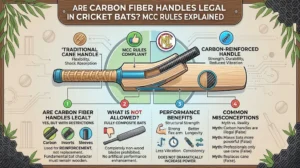
Why Manufacturers Started Using Carbon Fiber
Traditional cricket bat handles are built from:
- Cane strips
- Rubber inserts
- Adhesives
- Binding materials
This construction has been used successfully for generations because it provides:
✅ Flexibility
✅ Shock absorption
✅ Comfort
✅ Control
As modern bats became larger and more powerful, manufacturers began searching for ways to strengthen handles without adding excessive weight.
Carbon fiber appeared to provide the perfect solution.
Its advantages include:
- High strength
- Extremely low weight
- Excellent stiffness
- Resistance to fatigue
These characteristics made it attractive for bat manufacturers seeking durability improvements.
What Does Carbon Fiber Do in a Cricket Bat Handle?
Most legal carbon fiber applications focus on reinforcement, not replacement.
Manufacturers use carbon fiber to:
Increase Strength
Carbon fiber can help reduce handle failure under repeated impact.
Improve Durability
The handle may resist wear and fatigue more effectively.
Reduce Vibration
Certain designs help minimize harsh feedback from mishits.
Maintain Consistency
The handle retains its characteristics over longer periods.
In these situations, carbon fiber acts as a supporting material rather than fundamentally changing bat performance.
The MCC and Cricket Bat Laws
The Marylebone Cricket Club (MCC) is the custodian of the Laws of Cricket.
The MCC regulates:
- Bat dimensions
- Bat construction
- Materials
- Equipment legality
The goal is to ensure that technological advancements do not provide unfair advantages that fundamentally alter the game.
Historically, the MCC has intervened whenever bat technology threatened to shift the balance too heavily toward batters.
Why Carbon Fiber Became Controversial
The controversy emerged when manufacturers explored using carbon fiber not simply for reinforcement but as a substantial structural component.
Concerns included:
- Increased power generation
- Reduced energy loss
- Excessive stiffness
- Artificial performance enhancement
Critics argued that if composite materials became too dominant, bats could behave more like engineered sporting equipment than traditional cricket bats.
This prompted regulators to examine the issue more closely.
Are Carbon Fiber Handles Legal?
Yes, But With Restrictions
Modern cricket bats can use limited carbon fiber reinforcement in the handle, as long as they comply with MCC regulations governing bat construction.
Manufacturers commonly use:
✅ Carbon fiber strips
✅ Carbon fiber inserts
✅ Reinforcement sleeves
✅ Composite support structures
These applications are generally intended to strengthen the handle rather than replace the traditional cane-based design.
What Is Not Allowed?
The MCC’s primary concern is preventing significant non-wood materials from dominating the bat’s construction.
Cricket bats must remain fundamentally wooden bats.
Therefore, manufacturers cannot simply create:
❌ Composite cricket bats
❌ Primarily carbon fiber blades
❌ Fully engineered composite hitting surfaces
❌ Materials that fundamentally alter the character of the bat
The blade itself must remain compliant with cricket bat construction rules.
Why the Blade Matters More Than the Handle
When regulating equipment, the MCC focuses particularly on the blade.
This is because the blade determines:
- Energy transfer
- Rebound characteristics
- Performance potential
- Bat-ball interaction
A reinforced handle generally has less impact on performance than a composite blade.
As a result, carefully controlled handle reinforcement is viewed differently from major structural changes to the striking surface.
Performance Advantages of Carbon Fiber Handles
Even within legal limits, carbon reinforcement can provide several practical benefits.
Improved Structural Strength
Modern bats are larger than ever.
Extra reinforcement helps prevent handle damage.
Better Longevity
Frequent players often appreciate additional durability.
Reduced Vibration
Many players report:
✅ Improved comfort
✅ Less sting
✅ Better feel on mishits
Consistent Performance
The handle may maintain its characteristics longer during heavy use.
Do Carbon Handles Increase Power?
This remains one of the biggest myths.
In reality:
Not Dramatically
A carbon-reinforced handle alone does not transform a bat into a boundary-hitting machine.
Performance is still largely driven by:
- Willow quality
- Pressing
- Profile design
- Sweet spot characteristics
- Bat balance
While carbon reinforcement may contribute to stability and efficiency, it does not create unlimited additional power.
See More: Is Your Cricket Bat Dead? How to Spot Internal Wood Rot
Why Professional Players Use Carbon-Reinforced Handles
Many professional cricketers use bats with some form of modern handle reinforcement.
The reasons usually include:
✅ Reliability
✅ Comfort
✅ Durability
✅ Reduced vibration
✅ Consistency
Professional players are often more concerned with feel and longevity than marketing claims.
Carbon Fiber vs Traditional Cane Handles
| Feature | Traditional Cane | Carbon-Reinforced |
|---|---|---|
| Feel | Traditional | Slightly firmer |
| Vibration Control | Good | Often improved |
| Durability | Excellent | Often superior |
| Weight | Light | Very light |
| Performance | Excellent | Excellent |
| Legality | Fully legal | Legal when compliant |
The differences are often more subtle than many players expect.
The Future of Cricket Bat Technology
Carbon fiber is unlikely to be the last technological innovation to challenge traditional cricket equipment.
Manufacturers continue experimenting with:
- Advanced composites
- Sensor technology
- Smart bat systems
- New reinforcement methods
However, the MCC remains focused on preserving the essential nature of the game.
Future innovations will almost certainly continue to face close regulatory scrutiny.
Common Misconceptions
Myth 1: Carbon Fiber Handles Are Illegal
False.
Many carbon-reinforced handles are legal and widely used.
Myth 2: Carbon Fiber Makes Bats More Powerful
Not necessarily.
Most performance differences arise from willow quality and bat design.
Myth 3: Professionals Only Use Traditional Handles
False.
Many modern professional bats include reinforcement technologies.
Myth 4: Carbon Fiber Replaces Cane
False.
Most designs combine traditional cane construction with limited carbon reinforcement.
Final Thoughts
Carbon fiber handles represent an interesting compromise between tradition and innovation. While the MCC continues to require cricket bats to remain fundamentally wooden in construction, limited carbon fiber reinforcement in the handle is generally accepted when it serves a structural and durability purpose rather than fundamentally altering bat performance. Modern manufacturers use carbon fiber to reduce vibration, strengthen handles, and improve longevity without changing the essential character of the cricket bat.
For players, the most important takeaway is that carbon-reinforced handles are not magic performance boosters. Their greatest benefits usually come in durability, comfort, and consistency rather than raw power. As cricket bat technology continues to evolve, carbon fiber is likely to remain an important part of modern handle design, provided it stays within the boundaries established to protect the balance and integrity of the game.
See More: Knots in Cricket Bats: Do They Ruin Performance or Ping?