
Walk into any cricket store, and you’ll often hear players inspecting a bat face and immediately rejecting it after spotting a knot. For many buyers, knots are viewed as defects that weaken the willow, reduce performance, and increase the risk of cracking. Others argue that some of the best-performing cricket bats ever made have contained knots.
So who is right?
The truth is that not all knots are created equal. Some are completely harmless cosmetic features, while others can affect durability depending on their size and location. Understanding the differences between pin knots, sound knots, and running knots can help players make better purchasing decisions and avoid dismissing an excellent bat based solely on appearance.
What Is a Knot in Cricket Bat Willow?
A knot forms where a branch or shoot once grew from the willow tree.
As the tree develops, the surrounding wood grows around that branch point.
When the tree is eventually cut and processed into cricket bat clefts, traces of these branch connections may remain visible within the willow.
These appear as:
- Small dark spots
- Circular marks
- Elongated streaks
- Grain disruptions
The type, size, and position of the knot determine whether it has any practical significance.
Why Knots Create Concern
Cricket bats experience thousands of impacts during their lifetime.
A perfect piece of willow ideally contains:
✅ Straight grains
✅ Consistent density
✅ Uniform fiber structure
A knot interrupts that structure.
Because of this, players often worry that knots may:
- Reduce performance
- Weaken the blade
- Affect ping
- Increase crack risk
However, the reality is more nuanced.
Do Knots Affect Bat Performance?
In many cases:
No.
Small knots frequently have little or no measurable impact on how a bat performs.
Bat performance is influenced much more heavily by:
- Willow density
- Pressing quality
- Moisture content
- Profile design
- Balance
- Sweet spot placement
A visually perfect bat may perform poorly, while a bat with visible knots may perform exceptionally well.
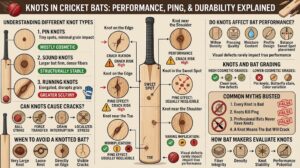
Understanding Different Types of Knots
Bat makers typically classify knots into several categories.
Pin Knots
Pin knots are the smallest and most common knot type found in cricket bats.
They usually appear as:
- Tiny dark spots
- Small circular marks
- Minimal grain disruption
Characteristics:
✅ Mostly cosmetic
✅ Common in quality willow
✅ Rarely affect performance
✅ Generally acceptable in many grades
Pin knots are often so small that players may never notice them once the bat is in use.
See More: Smart Cricket Bats: How Embedded IoT Sensors Track Every Swing
Sound Knots
A sound knot is a larger knot that remains structurally stable.
Characteristics include:
✅ Firm attachment
✅ Dense surrounding fibers
✅ Limited structural weakness
✅ Stable performance
Sound knots can appear more noticeable than pin knots, but they are not automatically problematic.
Many experienced bat makers are comfortable using clefts containing sound knots if the surrounding willow quality remains high.
Running Knots
Running knots are generally the most concerning variety.
These knots extend deeper into the willow and may follow the grain structure.
Characteristics can include:
❌ Extended grain disruption
❌ Greater structural interruption
❌ Increased stress concentration
❌ Potential durability concerns
Although not all running knots create problems, they receive greater scrutiny during grading and selection.
The Importance of Knot Location
The position of a knot often matters more than its presence.
Knot on the Edge
Edge impacts generate significant force.
A knot located directly on the edge may experience repeated stress.
Potential risks:
- Increased crack susceptibility
- Higher stress concentration
- Reduced durability
Large edge knots deserve careful inspection.
Knot in the Sweet Spot
A knot located directly within the main hitting zone receives frequent impact.
Possible consequences include:
- Slightly altered rebound characteristics
- Localized stress accumulation
However, many small knots in the sweet spot still perform perfectly well.
Knot Near the Toe
Toe areas naturally absorb moisture and impact stress.
Large defects in this region may contribute to durability concerns.
Knot Near the Shoulder
This is often one of the least concerning locations because the area experiences relatively little direct impact.
Do Knots Affect Ping?
This is one of the most frequently asked questions.
The short answer:
Usually Not Significantly
The “ping” of a cricket bat depends primarily upon:
- Fiber structure
- Pressing quality
- Moisture balance
- Density
- Sweet spot characteristics
A small pin knot typically has negligible influence on rebound.
In fact, many bats with visible knots produce outstanding ping.
Why Some Knotted Bats Perform Brilliantly
Performance depends on the entire cleft rather than a single cosmetic feature.
A bat containing:
- Excellent density
- Strong fiber structure
- Proper moisture levels
- Quality pressing
may easily outperform a visually flawless bat.
This explains why experienced bat makers focus on overall willow characteristics rather than obsessing over minor knots.
Knots and Bat Grading
Cosmetics influence cricket bat grading.
Generally:
High Cosmetic Grades
Feature:
- Cleaner appearance
- Fewer visible defects
- Minimal knot presence
Lower Cosmetic Grades
May contain:
- Pin knots
- Butterfly stain
- Minor specks
- Color variation
Importantly:
Lower cosmetic grade does not automatically mean lower performance.
Many excellent value bats contain visual imperfections.
Can Knots Cause Cracks?
Sometimes.
Large or poorly positioned knots can create areas where stress becomes concentrated.
When a cricket ball impacts nearby:
BALL STRIKE
      ↓
FORCE TRANSFER
      ↓
GRAIN INTERRUPTION
      ↓
LOCALIZED STRESS
The risk depends on:
- Knot size
- Knot type
- Knot location
- Willow quality
Not every knot creates cracking problems.
Signs a Knot May Be Problematic
Be cautious if a knot appears:
❌ Large
❌ Loose
❌ Raised
❌ Surrounded by cracks
❌ Located directly on a vulnerable edge
Such characteristics warrant closer inspection.
How Professional Bat Makers Evaluate Knots
Experienced bat makers rarely view knots in isolation.
They assess:
Fiber Integrity
How well surrounding fibers are connected.
Density
Overall willow quality.
Knot Stability
Whether the knot is firmly integrated.
Performance Potential
How the cleft responds during manufacturing.
Their decision often depends on the complete picture rather than appearance alone.
Common Myths About Knots
Myth 1: Every Knot Is Bad
False.
Many knots are purely cosmetic.
Myth 2: Knots Kill Ping
False.
Small stable knots rarely affect rebound noticeably.
Myth 3: Professional Bats Never Have Knots
False.
Even premium willow occasionally contains minor knots.
Myth 4: A Knot Means the Bat Will Crack
False.
Location and stability matter far more than simple presence.
When Should You Avoid a Knotted Bat?
You may want to be cautious when:
- The knot is very large.
- The knot sits directly on the edge.
- Visible cracking already surrounds it.
- The knot feels loose.
- Structural weakness is evident.
Otherwise, many knots are no reason to reject an otherwise excellent bat.
Final Thoughts
Knots in cricket bats are often misunderstood. While they represent natural imperfections in the willow, they do not automatically ruin performance, kill ping, or guarantee future cracking. Small pin knots and stable sound knots are frequently cosmetic features that have little impact on how a bat feels or performs. Even some premium-performing bats contain minor knotting that never causes issues throughout their playing life.
The key is understanding the type, size, and location of the knot. Running knots, large edge knots, and knots surrounded by existing cracks deserve more attention because they can create localized stress points under repeated impact. Ultimately, evaluating a cricket bat should involve much more than looking for visual perfection. Pickup, balance, pressing quality, sweet spot response, and overall willow integrity remain far better indicators of performance than the presence of a small knot. A bat wins matches because of how it plays, not because it looks flawless on the rack.
See More: Is Your Cricket Bat Dead? How to Spot Internal Wood Rot