
One of the most misunderstood topics in cricket bat buying is the difference between heartwood (red wood) and sapwood (white wood). Many cricketers automatically assume that a clean, creamy-white blade is superior, while any red or brown discoloration must indicate lower quality. This belief has influenced bat grading, appearance preferences, and even pricing for decades.
However, experienced bat-makers often have a very different perspective.
The reality is that heartwood and sapwood differ visually and structurally, but the relationship between appearance and performance is far more complex than many players realize. Some bats with visible heartwood have produced outstanding performances at both professional and club levels, while perfectly white bats are not automatically guaranteed to perform better.
Understanding what heartwood and sapwood actually are can help players make smarter decisions and avoid paying extra simply for cosmetic appeal.
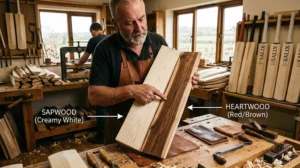
Understanding the Structure of a Willow Tree
A willow tree consists of several layers that develop as the tree grows.
Moving from the outside toward the center, the tree contains:
- Bark
- Cambium layer
- Sapwood
- Heartwood
When a bat cleft is cut from the tree, portions of either sapwood or heartwood may be visible depending on the section selected.
These natural differences create the color variations players see on cricket bats.
What Is Sapwood?
Sapwood is the lighter-colored outer section of the tree.
This area actively transports water and nutrients throughout the growing tree.
Characteristics include:
✅ Creamy white color
✅ Light appearance
✅ Traditional bat aesthetic
✅ Most commonly seen on premium bat faces
When most people imagine an English willow cricket bat, they picture sapwood.
What Is Heartwood?
Heartwood is the darker inner section of the tree.
As the tree matures, the central wood stops transporting sap and gradually develops different coloration.
Characteristics include:
✅ Reddish-brown appearance
✅ Dark streaks or patches
✅ Often called “red wood”
✅ More noticeable cosmetic variation
Heartwood may appear as:
- Thin red strips
- Edge discoloration
- Larger patches
- Butterfly-like patterns
Many players mistakenly interpret these features as defects.
Why Heartwood Appears in Cricket Bats
Heartwood is a completely natural part of the willow tree.
Its appearance often depends on:
- Tree age
- Growth conditions
- Position of the cleft
- Cutting orientation
The presence of heartwood does not automatically indicate poor-quality willow.
In many cases, it simply reflects how the cleft was selected from the tree.
Why Bat Grading Prefers Sapwood
Premium bat grading systems generally reward appearance.
Grade 1 and Grade 1+ bats often feature:
- Straight grains
- Uniform color
- Minimal blemishes
- Predominantly white sapwood
This occurs because high grades emphasize visual presentation as well as willow quality.
As a result:
Clean white bats usually receive higher cosmetic grades.
Heartwood often lowers cosmetic grade regardless of actual performance.
The Biggest Myth About Heartwood
Many players believe:
“Heartwood means inferior performance.”
This is one of the most common misunderstandings in cricket bat buying.
In reality:
Heartwood primarily affects appearance.
Performance depends much more heavily on:
- Willow density
- Pressing quality
- Moisture content
- Manufacturing standards
- Bat profile
- Preparation
Some red-stained bats perform exceptionally well.
Functional Differences Between Heartwood and Sapwood
Although appearance receives most attention, there are some genuine differences worth understanding.
Density Differences
Generally speaking, heartwood may be slightly denser than surrounding sapwood.
Potential effects include:
✅ Increased strength
✅ Enhanced stability
✅ Improved structural durability
However, differences are often modest and vary between individual trees.
The density variation is rarely dramatic enough for most players to detect during play.
Weight Characteristics
Because heartwood can be slightly denser, bats containing larger amounts of heartwood may occasionally feel marginally heavier.
Potential consequences:
- Slightly increased mass
- Small balance changes
- Different pickup characteristics
In practice, bat makers can compensate for these differences through shaping and profiling.
Moisture Behavior
Sapwood historically contains the active transport system within the living tree.
Heartwood, by contrast, is biologically inactive.
Once the cleft has been harvested and seasoned, both areas undergo substantial drying and preparation.
For finished bats:
Differences in moisture handling are generally minimal.
Manufacturing processes largely equalize these effects.
Durability Comparison
One of the most debated topics is durability.
Some experienced bat makers believe heartwood can contribute positively to structural strength.
Possible advantages include:
✅ Greater resistance to compression
✅ Improved rigidity
✅ Better long-term stability
However, there is no universal rule stating that heartwood bats always last longer.
Durability depends far more on:
- Pressing quality
- Usage patterns
- Maintenance
- Bat preparation
than on color alone.
Does Heartwood Improve Performance?
This question appears frequently among players.
The honest answer:
Not directly.
Heartwood itself does not automatically create:
- Bigger sweet spots
- Better ping
- More power
- Faster bat speed
The bat’s performance remains heavily influenced by:
Pressing
Perhaps the most important manufacturing stage.
Willow Quality
The overall condition of the cleft matters more than color.
Profile Design
Shape strongly influences performance.
Moisture Balance
Proper seasoning has a major impact.
As a result, a heartwood bat can be excellent, average, or poor, just like a sapwood bat.
Does Heartwood Reduce Ping?
Another common myth is that red wood kills performance.
Most experienced bat makers reject this idea.
The rebound characteristics responsible for “ping” depend mainly on:
- Fiber structure
- Pressing
- Preparation
rather than coloration.
Many bats with visible red wood produce outstanding ping.
Why Some Professional Players Use Heartwood Bats
At the professional level, players typically prioritize:
- Feel
- Pickup
- Sweet spot performance
rather than appearance.
If a bat performs exceptionally well, many professionals are unconcerned about cosmetic staining.
Several elite-level bats over the years have displayed visible heartwood.
Performance remains the deciding factor.
Advantages of Heartwood
Unique Appearance
Some players actually enjoy the distinctive look.
The contrast creates:
- Character
- Individuality
- Visual uniqueness
Potential Structural Stability
The slightly denser nature of heartwood may contribute to strength in some cases.
Better Value
Cosmetic grading often lowers resale value despite excellent performance.
This can create opportunities for buyers who focus on function rather than appearance.
Advantages of Sapwood
Premium Aesthetics
The classic white appearance remains highly desirable.
Higher Cosmetic Grades
Bats with clean sapwood generally achieve better grading classifications.
Greater Market Appeal
Many buyers prefer traditional aesthetics.
This improves resale attractiveness.
Heartwood vs Sapwood Comparison
| Feature | Heartwood (Red) | Sapwood (White) |
|---|---|---|
| Appearance | Reddish-Brown | Creamy White |
| Cosmetic Grade | Often Lower | Usually Higher |
| Market Appeal | Moderate | High |
| Performance Potential | Excellent | Excellent |
| Durability | Very Good | Very Good |
| Density | Slightly Higher | Slightly Lower |
| Sweet Spot Potential | Comparable | Comparable |
| Value for Money | Often Better | Usually More Expensive |
Should You Avoid Heartwood?
Absolutely not.
If a bat:
✅ Feels balanced
✅ Picks up well
✅ Produces strong ping
✅ Suits your playing style
then visible heartwood should not automatically discourage a purchase.
Many outstanding bats contain some degree of red wood.
The Smart Buyer’s Approach
When evaluating a bat, prioritize:
- Pickup
- Balance
- Performance
- Pressing quality
- Feel
- Durability
Appearance should come afterward.
Too many players focus on color while ignoring factors that genuinely affect performance.
Final Thoughts
The debate between heartwood and sapwood often centers on appearance rather than actual cricket performance. Sapwood provides the clean white look traditionally associated with premium English willow bats and generally receives higher cosmetic grades. Heartwood, with its distinctive red or brown coloration, is often viewed less favorably despite being a completely natural part of the willow tree. While heartwood can be slightly denser and may offer marginal differences in structural characteristics, these variations are usually far less important than pressing quality, willow selection, moisture content, and overall craftsmanship.
For players focused on performance, the most important lesson is simple: red wood does not mean a bad bat, and white wood does not guarantee a great one. Some of the best-performing cricket bats ever produced have contained visible heartwood, while many cosmetically perfect bats have failed to live up to expectations. In the end, the ball cannot see the color of the willow. It only responds to the quality of the bat and how well it suits the player holding it. 🏏
See More: Protective Tape on Cricket Bats: Does It Help or Hurt Performance?