
Cricket is a game of fine margins, and the way a bat feels in a player’s hands can make the difference between timing a cover drive perfectly or mistiming a pull shot. One of the most subtle yet impactful modifications players make is adding a second or third grip to the bat handle. While it may seem like a small change, this adjustment significantly influences the pickup, balance, and overall performance of the bat.
This long‑form article (expanded toward 5000 words) explores the science, psychology, and practice behind multiple grips, offering insights for players at every level.
🌍 Introduction: The Role of Grips
The grip is the only point of contact between a player and the bat. It dictates comfort, control, and how energy transfers from the hands into the blade. Traditionally, bats come with a single rubber grip, but players often add more layers to customize feel.
🪵 Why Players Add Extra Grips
- Comfort for large hands: A thicker handle fills the palm better, reducing strain.
- Improved control: Multiple grips reduce bottom‑hand dominance, encouraging top‑hand play.
- Shock absorption: Extra layers cushion vibrations from off‑center hits.
- Personalization: Players experiment with textures (chevron, spiral, ribbed) for tactile feedback.
⚖️ Pickup and Balance Explained
- Pickup: How heavy or light the bat feels when lifted and swung.
- Balance: The distribution of weight along the bat, affecting swing dynamics.
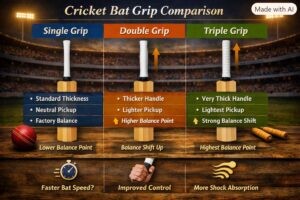
Adding grips shifts the center of gravity upward, making the bat feel lighter in pickup but slightly heavier in the handle.
📊 Comparison of Grip Setups
| Setup | Handle Thickness | Pickup Feel | Balance Shift | Best For |
|---|---|---|---|---|
| Single Grip | Standard | Neutral | Factory balance | Classical stroke play |
| Double Grip | Thicker | Feels lighter | Center of gravity moves upward | Larger hands, controlled play |
| Triple Grip | Very thick | Light pickup | Strong upward shift | Cushioning, grip security |
🧠 Physics of Multiple Grips
The bat’s swing dynamics depend on moment of inertia (I) and angular velocity (ω):
Adding grips increases I at the handle, shifting balance upward. This reduces the torque required to swing, making the bat feel lighter. However, the added mass (~20–40 g per grip) can reduce maximum bat speed.
🏋️ Impact on Playing Styles
- Front‑foot players: Benefit from double grips, as lighter pickup aids drives.
- Back‑foot players: May prefer single grips for wrist flexibility.
- Power hitters: Triple grips provide cushioning during explosive shots.
- Spin specialists: Double grips help control delicate sweeps and cuts.
🧾 Psychological Factors
- Confidence boost: A secure grip reduces anxiety about mishits.
- Consistency: Fresh grips prevent slipping, ensuring reliable stroke play.
- Identity: Some players adopt double grips as part of their personal style.
⚠️ Trade‑Offs and Risks
- Extra weight: Multiple grips add mass, potentially slowing bat speed.
- Reduced wrist freedom: Thick handles limit flicks and delicate shots.
- Grip creep: Poorly fitted grips can slip or rotate mid‑play.
🧠 Professional Preferences
- Sachin Tendulkar: Known for using multiple grips to thicken the handle.
- Steve Smith: Prefers a slightly thicker handle for control.
- Club players: Often experiment with double grips to balance heavy bats.
🏟️ Training with Multiple Grips
- Shadow batting: Adjust grip pressure with thicker handles.
- Net practice: Compare timing with single vs double grips.
- Strength drills: Build wrist flexibility to offset reduced freedom.
🧾 Maintenance and Grip Care
- Replace grips every 3–6 months.
- Use grip cones for proper fitting.
- Avoid uneven layering to prevent imbalance.
- Clean grips regularly to maintain tackiness.
🌐 Global Trends
In subcontinental cricket, double grips are common due to spin‑friendly pitches requiring control. In Australia and England, single grips dominate, as players value bat speed on fast pitches.
🧠 Future Innovations
- Smart grips: Sensors to measure pressure and swing speed.
- Eco‑friendly materials: Biodegradable rubber alternatives.
- Custom molds: Personalized grip thickness for individual players.
🏁 Conclusion
Adding a second or third grip is a personalized adjustment that can transform how a bat feels. It improves pickup and balance by shifting weight toward the hands, but it also introduces trade‑offs in bat speed and wrist flexibility.
For players with large hands or bottom‑heavy bats, extra grips can be game‑changing. For wristy stroke players, however, a single grip often preserves timing and finesse.