
Choosing a cricket bat is one of the most important decisions a batter can make. Every player wants the perfect combination of power, timing, comfort, and control, yet one factor often determines how a bat performs more than any other: weight.
Walk into any cricket store, and you will find bats ranging from lightweight models designed for fast hands and quick reactions to heavyweight giants built for maximum power. Some players swear by lighter bats, arguing that bat speed is the secret to scoring runs. Others prefer heavier bats, believing that momentum and mass create superior hitting power.
The truth is that neither lightweight nor heavyweight bats are universally better. The ideal choice depends on a player’s strength, technique, format, and personal preferences. Understanding the advantages and disadvantages of each can help cricketers select a bat that complements their game rather than working against it.
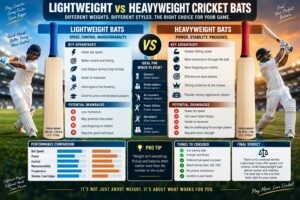
Why Bat Weight Matters
The weight of a cricket bat influences almost every aspect of batting.
It affects:
- Bat speed
- Swing mechanics
- Power generation
- Timing
- Stamina
- Shot execution
- Pickup
- Overall comfort
A difference of just a few ounces can completely change how a bat feels during play.
Many players discover that a bat which feels perfect in a shop behaves very differently during an extended innings.
That is why understanding weight is so important.
Understanding Bat Weight
Most adult cricket bats fall within the following range:
| Category | Approximate Weight |
|---|---|
| Lightweight | 2 lb 6 oz to 2 lb 8 oz |
| Medium Weight | 2 lb 8 oz to 2 lb 10 oz |
| Heavyweight | 2 lb 10 oz to 3 lb+ |
However, actual weight tells only part of the story.
Bat balance and pickup often matter even more than the number shown on a scale.
What Is Bat Pickup?
Many players confuse weight with pickup.
They are not the same thing.
Actual Weight
The measurement shown on a scale.
Pickup
How heavy or light the bat feels during a swing.
For example:
A 2 lb 10 oz bat may feel lighter than a 2 lb 8 oz bat if its balance is superior.
This explains why professional players often focus on pickup rather than weight alone.
Lightweight Cricket Bats
Lightweight cricket bats have become increasingly popular in modern cricket.
Many professional batters now prefer lighter bats that allow them to react quickly and generate high bat speeds.
Advantages of Lightweight Bats
Faster Bat Speed
This is the biggest advantage.
A lighter bat can accelerate more quickly through the ball.
Benefits include:
✅ Faster reactions
✅ Quicker stroke execution
✅ Easier improvisation
✅ Better performance against pace bowling
In modern limited-overs cricket, bat speed is a major asset.
Improved Maneuverability
Lightweight bats feel easier to control.
Players often find them more comfortable when:
- Cutting
- Pulling
- Steering the ball
- Playing late
This increased control can improve shot precision.
Less Fatigue
Batting for long periods can be physically demanding.
A lighter bat places less strain on:
- Wrists
- Forearms
- Shoulders
This becomes particularly valuable during long innings.
Better for Younger Players
Junior and developing cricketers often benefit from lighter bats because they:
- Encourage proper technique
- Improve bat control
- Reduce fatigue
- Increase confidence
Using excessively heavy bats can hinder technical development.
Disadvantages of Lightweight Bats
Despite their advantages, lightweight bats are not perfect.
Reduced Momentum
Heavier bats naturally generate more momentum.
A lighter bat relies more heavily on swing speed.
When timing is imperfect, power may be reduced.
Demanding Technique
To maximize performance, players often need:
- Good timing
- Strong hand-eye coordination
- Efficient swing mechanics
Poor technique may limit the benefits.
Less Effective on Mishits
Heavier bats often help carry slightly mistimed shots farther.
Lightweight bats may offer less forgiveness.
Heavyweight Cricket Bats
Heavy bats have always had loyal supporters.
Many legendary cricketers preferred substantial bats capable of producing immense power.
Even today, some players continue to embrace heavier profiles.
Advantages of Heavyweight Bats
Greater Hitting Power
Mass generates momentum.
A heavier bat naturally transfers more force upon impact.
Benefits include:
✅ Longer boundaries
✅ Greater punch through the field
✅ Stronger lofted shots
✅ More authority against spin
This is why many power hitters prefer heavier bats.
Better Performance on Slow Pitches
On slower surfaces, additional mass helps drive the ball with greater authority.
Players often feel they can:
- Clear the infield more easily
- Hit through sluggish outfields
- Maintain shot penetration
Forgiveness on Mishits
Heavy bats often provide greater stability.
Slightly mistimed strokes can still travel effectively due to added momentum.
This can increase confidence.
Strong Presence at the Crease
Many batters enjoy the feeling of a substantial bat.
The sense of solidity often helps players attack confidently.
Disadvantages of Heavyweight Bats
Reduced Bat Speed
The biggest drawback is slower acceleration.
Heavy bats require:
- More strength
- Better conditioning
- Greater effort
Fast bowlers may exploit reduced reaction speed.
Increased Fatigue
Long innings with a heavy bat can place significant strain on:
- Forearms
- Wrists
- Shoulders
For some players, performance decreases as fatigue develops.
Difficult for Younger Players
Junior cricketers frequently struggle with oversized bats.
Common issues include:
- Slow bat swing
- Poor technique
- Reduced confidence
- Increased fatigue
Coaches generally encourage young players to prioritize control over weight.
Bat Speed vs Bat Mass
One of cricket’s most debated topics is whether speed or mass matters more.
The answer is both.
Power depends on:
Momentum = Mass × Velocity
A heavier bat generates more momentum through mass.
A lighter bat generates more momentum through speed.
This explains why both approaches can be successful.
The Modern T20 Influence
T20 cricket has changed batting dramatically.
Modern players increasingly favor:
- Quick hands
- Rapid bat speed
- Innovative shots
- Fast reaction times
These demands often encourage lighter bat choices.
However, many professionals still use surprisingly heavy bats due to exceptional strength and technique.
Which Bat Suits Different Playing Styles?
Opening Batters
Often prefer:
✅ Lightweight to medium-weight bats
Reasons:
- Facing fast bowlers
- Needing quick reactions
- Playing late
Stroke Makers
Often choose:
✅ Lightweight bats
Reasons:
- Timing-focused approach
- Quick bat speed
- Enhanced placement
Power Hitters
Often prefer:
✅ Medium-heavy to heavyweight bats
Reasons:
- Boundary hitting
- Lofted shots
- Maximum momentum
All-Round Players
Many select:
✅ Medium-weight bats
Reasons:
- Balance between power and control
- Versatility across formats
The Pickup Myth
Perhaps the biggest mistake in bat buying is focusing only on scale weight.
A player’s hands determine what matters most.
Some bats weighing:
2 lb 11 oz
can feel:
2 lb 8 oz
because of excellent balance.
Conversely, poorly balanced bats can feel much heavier than their stated weight.
Always judge a bat by lifting and swinging it.
How Professionals Choose Bat Weight
Professional players typically evaluate:
- Pickup
- Sweet spot position
- Balance
- Profile
- Handle shape
before worrying about actual weight.
Many professionals also work with bat makers to adjust:
- Spine height
- Edge thickness
- Weight distribution
This customization creates a bat that feels perfect for their playing style.
Common Mistakes When Choosing Bat Weight
Choosing the Heaviest Bat Available
Bigger is not always better.
Many players sacrifice technique for perceived power.
Copying Professional Players
A professional’s preferred weight may not suit your strength or skill level.
Ignoring Pickup
Scale weight alone tells only part of the story.
Prioritizing Stickers Over Feel
The best bat is the one that feels comfortable and natural.
Lightweight vs Heavyweight: Side-by-Side Comparison
| Feature | Lightweight Bat | Heavyweight Bat |
|---|---|---|
| Bat Speed | ⭐⭐⭐⭐⭐ | ⭐⭐⭐ |
| Power Potential | ⭐⭐⭐⭐ | ⭐⭐⭐⭐⭐ |
| Maneuverability | ⭐⭐⭐⭐⭐ | ⭐⭐⭐ |
| Control | ⭐⭐⭐⭐⭐ | ⭐⭐⭐⭐ |
| Fatigue Resistance | ⭐⭐⭐⭐⭐ | ⭐⭐⭐ |
| Forgiveness | ⭐⭐⭐ | ⭐⭐⭐⭐⭐ |
| Junior Friendly | ⭐⭐⭐⭐⭐ | ⭐⭐ |
| Boundary Hitting | ⭐⭐⭐⭐ | ⭐⭐⭐⭐⭐ |
Final Verdict
The debate between lightweight and heavyweight cricket bats has no universal winner because the ideal choice depends entirely on the player. Lightweight bats offer faster bat speed, improved maneuverability, and reduced fatigue, making them excellent for technical players, openers, and batters who value timing. Heavyweight bats provide greater momentum, stronger hitting power, and increased stability, making them attractive to aggressive players and boundary hitters.
Ultimately, the most important factor is not the number on the scale but how the bat feels in your hands. Pickup, balance, and comfort often influence performance more than actual weight. A well-balanced heavyweight bat may feel lighter than a poorly balanced lightweight bat, and the best cricket bat is always the one that allows you to play your natural game with confidence.
When choosing between lightweight and heavyweight, remember a simple principle: don’t select the bat that looks impressive; select the bat that feels effortless to swing and inspires confidence every time you take guard. 🏏
See More: The History of Cricket Bat Making