
Cricket bat technology has evolved dramatically over the past few decades. While much of the attention focuses on willow grades, bat profiles, edge thickness, and sweet spots, one of the most important innovations has occurred in a less visible area: the handle. Traditionally made from cane and rubber inserts, the cricket bat handle has always played a critical role in determining feel, flexibility, shock absorption, and balance. Today, many manufacturers are incorporating carbon fiber reinforcement into bat handles, creating a new generation of bats that combine traditional craftsmanship with advanced materials engineering.
Carbon fiber technology has become increasingly common in professional and high-performance cricket equipment. Manufacturers use it to strengthen handles, improve durability, reduce unwanted vibrations, and help modern bats withstand the demands of faster bowling, larger profiles, and more aggressive styles of play.
Understanding how carbon fiber works and what it contributes to a cricket bat can help players decide whether this technology suits their game.
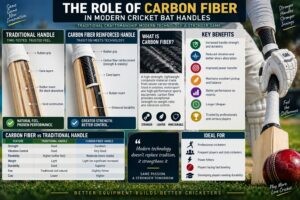
The Traditional Cricket Bat Handle
Before examining carbon fiber, it is important to understand how traditional handles are constructed.
For generations, cricket bat handles have been built from:
- Multiple layers of cane
- Rubber inserts
- Adhesives and binding materials
The cane provides:
✅ Flexibility
✅ Strength
✅ Natural feel
✅ Shock absorption
The rubber inserts help absorb impact vibrations and improve comfort.
This combination has proven remarkably effective and remains the industry standard.
However, modern cricket has created new challenges for traditional handle construction.
The Demands of Modern Cricket
Today’s cricket bats are vastly different from those used decades ago.
Modern bats often feature:
- Larger edges
- Thicker spines
- Bigger sweet spots
- More aggressive profiles
At the same time, modern players generate tremendous bat speed and frequently face bowlers delivering the ball at speeds exceeding 90 mph.
These conditions place enormous stress on the handle.
Manufacturers therefore began exploring ways to reinforce traditional designs without sacrificing performance.
What Is Carbon Fiber?
Carbon fiber is a composite material consisting of extremely thin carbon strands woven together and bonded with resin.
The material is known for:
- Exceptional strength
- Low weight
- High stiffness
- Excellent fatigue resistance
It is widely used in:
- Aerospace engineering
- Formula One racing
- Tennis rackets
- Golf clubs
- Cycling equipment
These same properties make it attractive for cricket bat manufacturing.
Why Manufacturers Use Carbon Fiber
The primary goal is not to replace the traditional handle but to improve it.
Most carbon fiber bat technologies reinforce selected sections of the handle rather than replacing the cane entirely.
This allows manufacturers to preserve the familiar feel of a cricket bat while enhancing performance characteristics.
Increased Handle Strength
One of the biggest advantages of carbon fiber is strength.
The handle is often the most vulnerable structural area of a cricket bat.
It experiences:
- Repeated impact loads
- Twisting forces
- Vibration stress
- Flexion during powerful strokes
Carbon fiber reinforcement helps strengthen the handle and reduce the likelihood of failure.
Benefits include:
✅ Increased durability
✅ Reduced risk of handle damage
✅ Better long-term structural integrity
✅ Improved performance retention
For players who train regularly or play multiple matches each week, this durability can be particularly valuable.
Improved Vibration Control
Every time a cricket ball strikes the bat, vibrations travel through the blade and into the handle.
Perfectly timed shots produce relatively little discomfort.
Mishits can generate significant vibration.
This phenomenon is often referred to as “sting.”
Carbon fiber reinforcement can help modify how vibrations move through the handle.
Benefits may include:
✅ Reduced harsh feedback
✅ Less hand discomfort
✅ Improved confidence against fast bowling
✅ Better comfort during long innings
Many players immediately notice a smoother feel when switching to reinforced handles.
Enhanced Power Transfer
Modern cricket places enormous emphasis on power.
Bat manufacturers are continually searching for ways to maximize energy transfer.
Carbon fiber contributes by helping maintain structural stability during impact.
When the handle remains stable and efficient:
- Energy loss decreases
- Shot response becomes more consistent
- Power transfer may improve
The result can be a more responsive feel throughout the sweet spot.
Better Performance on Mishits
Every batter mishits the ball occasionally.
Traditional handles absorb shock effectively, but severe impacts can still produce vibration and instability.
Carbon fiber reinforcement helps maintain handle rigidity during off-center strikes.
Benefits include:
- Greater control
- Improved stability
- Reduced twisting
- More predictable feedback
This can provide additional confidence against pace bowling.
Carbon Fiber and Bat Balance
One reason carbon fiber has become popular is its exceptional strength-to-weight ratio.
Manufacturers can strengthen handles without adding significant weight.
This offers important advantages:
✅ Preservation of pickup
✅ Improved balance control
✅ Greater customization possibilities
✅ Reduced overall mass compared with alternative reinforcements
Players receive additional strength without necessarily compromising maneuverability.
Different Types of Carbon Fiber Reinforcement
Manufacturers implement carbon fiber technology in several ways.
Carbon Fiber Strips
Some companies embed carbon strips within the handle.
Advantages:
- Lightweight
- Flexible
- Minimal impact on feel
Carbon Fiber Sleeves
Others reinforce portions of the handle using carbon fiber wraps or sleeves.
Benefits:
- Increased strength
- Improved durability
- Better vibration management
Hybrid Construction
Many modern bats use a hybrid approach.
The handle remains largely traditional while selected areas receive carbon reinforcement.
This allows manufacturers to combine:
- Cane flexibility
- Rubber cushioning
- Carbon fiber strength
Advantages of Carbon Fiber Handles
Greater Durability
The most obvious benefit is longevity.
The reinforced handle can often tolerate greater stress over time.
Reduced Vibration
Improved comfort is particularly noticeable during mishits.
Better Structural Stability
The bat remains more consistent over extended use.
Lightweight Reinforcement
Manufacturers achieve strength gains without major weight increases.
Modern Performance Characteristics
Many players appreciate the slightly firmer, more responsive feel.
Potential Drawbacks
Despite its advantages, carbon fiber is not universally preferred.
Reduced Traditional Feel
Some players prefer the softer, more flexible feedback of traditional cane handles.
Carbon reinforcement can alter the feel slightly.
Different Flex Characteristics
Traditionalists often enjoy handle flex because it contributes to shot feel.
Excessive stiffness may not suit every player.
Higher Cost
Carbon fiber increases manufacturing complexity.
As a result, bats incorporating advanced reinforcement systems often command higher prices.
Which Players Benefit Most?
Professional Cricketers
Elite players often appreciate:
- Consistency
- Durability
- Performance stability
Carbon reinforcement can help deliver these qualities.
Power Hitters
Aggressive players place significant stress on their equipment.
Additional handle strength can be particularly useful.
Frequent Players
Those who train multiple times per week may benefit from enhanced longevity.
Players Facing Fast Bowling
Reduced vibration and improved stability often improve comfort.
Carbon Fiber vs Traditional Handles
| Feature | Traditional Handle | Carbon Fiber Reinforced |
|---|---|---|
| Feel | Soft and natural | Slightly firmer |
| Flexibility | Higher | Moderate |
| Durability | Excellent | Superior |
| Vibration Control | Good | Very Good |
| Weight | Light | Light |
| Long-Term Stability | Good | Excellent |
| Cost | Lower | Higher |
The Future of Cricket Bat Handles
Carbon fiber is unlikely to replace traditional cane entirely.
Instead, the future appears to lie in hybrid designs that combine:
- Traditional craftsmanship
- Natural materials
- Advanced composites
Manufacturers continue experimenting with:
- Carbon composites
- Enhanced rubber technologies
- New reinforcement systems
- Improved vibration management
These developments aim to maximize performance while preserving the feel players expect from a cricket bat.
Common Myths About Carbon Fiber Handles
Myth 1: Carbon Fiber Makes the Bat Illegal
False.
Carbon fiber reinforcement in the handle is widely accepted, provided the blade remains compliant with cricket regulations.
Myth 2: Carbon Fiber Eliminates Feel
False.
Modern designs aim to enhance durability while retaining traditional playing characteristics.
Myth 3: Carbon Fiber Makes Every Bat Stiffer
Not necessarily.
Manufacturers can tune reinforcement levels to achieve different flex profiles.
Myth 4: Only Professionals Need Carbon Fiber
False.
Club cricketers who bat frequently may benefit just as much from improved durability and vibration control.
Final Thoughts
The introduction of carbon fiber into cricket bat handles represents one of the most significant technological developments in modern bat manufacturing. Rather than replacing traditional cane construction, carbon fiber serves as a reinforcing material that enhances durability, increases structural stability, improves vibration control, and helps modern bats withstand the growing demands of contemporary cricket. By combining the proven comfort and flexibility of cane with the exceptional strength-to-weight properties of carbon fiber, manufacturers have created handles that offer both traditional feel and modern performance.
For some players, especially traditionalists, a conventional handle may still provide the preferred sensation and feedback. For others, particularly power hitters, frequent players, and those seeking additional durability, carbon fiber reinforcement can offer meaningful advantages. As cricket bat technology continues to evolve, carbon fiber is likely to remain an important part of the ongoing effort to create stronger, more consistent, and more responsive cricket bats for players at every level of the game. 🏏