
Cricket is a game of precision, and the laws governing the dimensions of a cricket bat are among the most strictly enforced in professional sport. These regulations ensure fairness, safety, and consistency across all levels of play — from local matches to international tournaments.
This comprehensive article explores the legal specifications, historical evolution, and enforcement of cricket bat dimensions under the Marylebone Cricket Club (MCC) Laws of Cricket, which serve as the global standard.
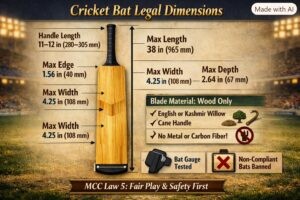
⚖️ Legal Authority: MCC Law 5
The MCC Law 5 defines the official parameters for bat size and structure. Every professional bat must comply with these limits to be eligible for sanctioned matches.
| Component | Legal Limit | Purpose |
|---|---|---|
| Length | Maximum 38 inches (965 mm) | Ensures manageable swing and safety |
| Width | Maximum 4.25 inches (108 mm) | Prevents excessive hitting area |
| Depth (thickness) | Maximum 2.64 inches (67 mm) | Controls power and rebound |
| Edge thickness | Maximum 1.56 inches (40 mm) | Limits aerodynamic advantage |
| Handle length | Typically 11–12 inches (280–305 mm) | Maintains balance and grip comfort |
These measurements are verified using Bat Gauge Tools, approved by the MCC and ICC.
🪵 Material Regulations
The bat must be made solely of wood, traditionally willow, with a cane handle.
- Blade: English or Kashmir willow.
- Handle: Cane with rubber or cork inserts.
- Covering: Protective film or tape allowed, but cannot alter rebound characteristics.
Composite materials (carbon fiber, metal, or plastic) are prohibited in the blade, though permitted in handle reinforcement.
🧠 Historical Evolution of Bat Dimensions
Cricket bats have evolved dramatically since the 18th century:
- 1700s: Curved, hockey‑stick‑like bats for underarm bowling.
- 1800s: Straight blades introduced with overarm bowling.
- 1900s: Standardized willow bats with moderate thickness.
- 2000s: Rise of power bats with thicker edges and concave profiles.
In 2017, the ICC introduced new restrictions on bat thickness to curb excessive hitting power in T20 cricket.
🧾 Enforcement and Measurement
Umpires and match officials use a bat gauge to check compliance before play.
- If a bat exceeds limits, it is immediately disqualified.
- Manufacturers must certify compliance before retail sale.
- Random checks occur during international tournaments.
The ICC also maintains a Bat Approval Registry for professional players, ensuring every bat model meets legal standards.
🧠 Impact on Performance
Legal dimensions balance power and control:
- Thicker bats generate more rebound but risk imbalance.
- Narrower bats improve maneuverability and timing.
- Regulated edges prevent unfair aerodynamic lift.
These limits preserve the skill element of batting — rewarding technique over brute force.
🧬 Modern Innovations Within Legal Limits
Manufacturers now optimize design within the legal framework:
- Concave profiles reduce weight without exceeding depth.
- Pressed willow enhances rebound while staying compliant.
- Smart sensors embedded in handles (for analytics) are permitted if they don’t affect structure.
🧠 Common Misconceptions
| Myth | Reality |
|---|---|
| “Thicker bats are illegal.” | Only if they exceed 67 mm depth or 40 mm edge. |
| “Players can modify bats mid‑match.” | Not allowed; any alteration must be approved. |
| “Junior bats follow different laws.” | Same proportions apply, scaled down for size. |
🏁 Conclusion:
The strict legal dimensions of a cricket bat ensure fair play, safety, and tradition. Every millimeter matters — from the blade’s width to the handle’s length. These laws preserve the balance between player skill and equipment technology, keeping cricket a contest of technique rather than machinery.
Whether you’re a professional or a passionate amateur, understanding these dimensions helps you choose a bat that’s not only powerful but also lawfully compliant.